
The immediate takeaway for U.S. PC builders is uncomfortably practical. The cards intended to anchor lower-cost gaming PCs may not become a safe refuge from rising prices simply because they carry less VRAM or sit near the bottom of a product stack. Current retail pricing already shows the middle of Nvidia’s GeForce RTX 50-series line moving sharply higher, and PC Partner is telling investors that its lower-end cards may be the next category where availability becomes the bigger problem.
PC Gamer highlighted the warning after The Straits Times reported on the company’s results. The underlying event is PC Partner’s half-year financial disclosure, not a new product announcement or an Nvidia roadmap. That distinction matters: this is a supplier explaining the conditions it expects to affect its own costs, allocation and sales in the months ahead.
 PC Partner is a graphics-card manufacturer, not a GPU designer
Calling PC Partner one of the world’s biggest “GPU makers” blurs an important line. Nvidia, AMD and Intel design the graphics processors; PC Partner is an add-in-board manufacturer that turns supplied processors, memory and other components into retail graphics cards. Its importance comes from the scale and reach of that assembly business, particularly through Zotac, Inno3D and Manli, rather than from control over Nvidia’s GeForce silicon allocation.
That also sets limits on what the company’s warning proves. PC Partner’s filing is a meaningful signal for the brands it owns and builds for, but it is not a universal declaration that every GeForce, Radeon or Arc model will become unavailable. The company did not identify individual models, regions, distributor allocations, or the expected scale of price rises. It did not say that a specific RTX 5050, RTX 5060, Radeon RX 9060 XT, or any other card would be discontinued or repriced by a particular date.
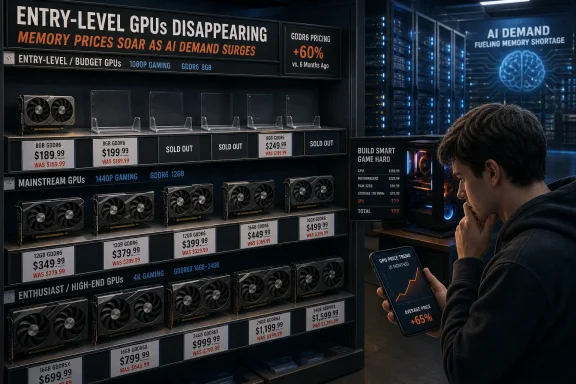
What it did say is more concrete. PC Partner expects graphics-memory costs to rise further in the second half of fiscal 2026, causing a substantial increase in graphics-card costs. It also expects graphics-card availability to decline further, with entry-level cards facing “even more severe shortages” that could raise the company’s average selling price.
For a company selling boards under several Nvidia-focused brands, that is a warning about what it sees in its own procurement pipeline. It should be read as a supply-and-cost forecast, not as proof of an imminent across-the-board consumer GPU shortage.
Its first-half results show why higher prices can coexist with fewer cards
The most revealing part of the filing is the recent financial record behind the forecast. PC Partner reported that own-brand graphics-card unit volume fell 18.4% in the first half of 2026, while the average selling price of those cards rose 10.7% year over year. Its own-brand VGA revenue declined 9.2% to HK$4.46 billion, but group revenue still edged up 1.5% to HK$6.45 billion.
Profit moved much more dramatically. Gross profit rose 58.7% and gross margin expanded to 16.5%, from 10.5% a year earlier. Net profit attributable to shareholders more than doubled to HK$545.7 million.
Those figures do not prove that PC Partner is overcharging customers; the filing also describes material cost inflation and component constraints. But they do demonstrate the market’s present incentive: fewer cards can still produce a stronger financial result when the cards that do ship command higher prices. For buyers waiting for a shortage to force manufacturers into discounting, the first-half numbers point in the opposite direction.
This is also why the entry-level warning deserves attention. Budget cards generally depend on high unit volume and tight margins. When memory, board-level components and logistics costs rise, vendors have less room to keep a low-price model at its nominal MSRP. A supplier may prefer to direct scarce components toward configurations that preserve more revenue per board, while inexpensive models become sporadic in stock.
PC Partner’s filing does not disclose how it will distribute supply among its own brands or whether it will favor specific price tiers. But its forecast and first-half results together show that the damage to consumers need not look like an empty retail shelf. It can look like a shelf full of higher-spec, higher-priced models while the low-cost configuration that made the launch price plausible is difficult to find.
U.S. GeForce prices have already moved before the predicted squeeze
Independent retail tracking from Tom’s Hardware shows that Nvidia’s GeForce pricing has already worsened in the United States, especially in the portion of the market normally described as mainstream. In its August survey of Newegg listings, the publication found a median RTX 5060 price of $469.99, up from $369.99 in June. The RTX 5060 Ti 16GB had reached $804.99, while the RTX 5070 was listed at a median of $899.99.
Those figures line up with the direction of PC Partner’s disclosure, but they also reveal a wrinkle in the most alarming interpretation of the story. The RTX 5050 was still near $315 in that survey, only modestly above its June median. The entry-level market is therefore not yet moving as one block, and a hypothetical $500 RTX 5050 remains speculation rather than evidence.
The existing price increases are concentrated more visibly in cards with larger memory configurations and in the range where gamers, creators and local-AI users compete for the same products. That does not make PC Partner’s warning harmless. It suggests that lower-cost boards could become harder to source later in 2026 even if their initial price rise is less dramatic. But readers should distinguish between the company’s forecast of tighter entry-level supply and confirmed retail prices for specific models.
AMD has not yet experienced the same broad U.S. retail price surge in the data cited by Tom’s Hardware. Its Radeon RX 9000-series cards showed smaller movements in that survey, though the availability of some models had narrowed. PC Partner’s warning cannot be limited solely to GeForce cards because a shortage of memory, printed circuit boards, power components and other shared inputs can affect any board partner. Still, the company’s owned retail brands are overwhelmingly associated with Nvidia, so extrapolating its exact forecast to every Radeon SKU would go beyond the evidence.
Memory is the stated constraint, but it is not the only one
PC Partner attributes the cost pressure principally to graphics memory. The company says demand for high-bandwidth memory used in AI data centers has exceeded supply, prompting major memory manufacturers to reduce computer-memory and graphics-memory production. Consumer graphics cards use GDDR6 or GDDR7 rather than HBM, so they are not physically the same memory products. The connection is capacity allocation and supplier priorities: memory manufacturers make choices about which product lines receive capital, wafer capacity and engineering attention.
That nuance is important. “AI demand consumed all the gaming VRAM” is too simple. GDDR and HBM have different designs, customers and manufacturing processes. Yet a supplier pivot toward higher-value AI memory can still tighten the wider memory business, increase input costs, and make a graphics-board maker less certain of what it can build at a viable price.
BenchLife, citing its own channel checks, separately reports that GeForce RTX 50-series supply in the third quarter is lower than in the second quarter and that fourth-quarter supply will fall again. BenchLife also says PCBs, passive components and power-control chips have longer lead times than in 2025. Those details have not been independently confirmed by Nvidia or PC Partner, so they should be treated as channel reporting rather than settled allocation data.
The broader point does have support in PC Partner’s filing: graphics cards are not constrained by the GPU chip alone. A finished board also needs memory packages, PCB capacity, voltage-regulation components, cooling hardware and other parts. A shortage in any one of those layers can keep a board from shipping, even where the graphics processor itself is available.
What a buyer should do before year-end
PC Partner has not announced a consumer action plan because it is not selling directly to most U.S. buyers. There is no official cutoff date, no confirmed MSRP revision schedule, and no guarantee that waiting until the holiday season will produce a better deal. The useful response is to shop the actual product rather than the chip name printed on the box.
- Compare the exact board model against its launch MSRP and against competing cards with similar VRAM and performance, because a nominally lower-tier GPU can be worse value than a better-equipped card whose price has not risen as sharply.
- Avoid paying a large premium for a future-shortage narrative alone. The RTX 5050’s comparatively stable August pricing shows that an industry warning does not automatically justify every reseller markup.
- Treat “in stock” and “low stock” labels cautiously, particularly from marketplace sellers. A genuine supply squeeze makes thin inventory easier to use as a reason for opportunistic pricing.
- If building a complete desktop, price the whole system at once. PC Partner’s filing points to pressure beyond graphics cards, and a GPU bought at an acceptable price may not offset higher memory, storage or motherboard costs later.
The significant news is not that PC hardware has suddenly become expensive on August 24, 2026. It is that a major graphics-board supplier has placed its expectation of worsening availability and higher entry-level pricing in a market filing after reporting that lower shipment volume and higher selling prices already lifted margins. For anyone planning a budget Windows gaming build this year, the cheapest sensible GPU should no longer be assumed to be the easiest part to replace later.
