
Microsoft Source detailed the deployment on August 12, describing PiAssist as the HR-facing entry point in Persistent’s broader AssIstX platform. Persistent’s own investor materials independently confirm that PiAssist and CareerAssist form part of the company’s HR agent suite, that the agents are available through Teams, and that the platform is designed to interact with systems of record including Oracle, SharePoint and Salesforce.
The more revealing part of the announcement is the measurement gap. Persistent presents PiAssist as a mature internal deployment, but the published figures use different definitions of success: Microsoft Source says about two-thirds of queries are resolved through readily available reports, while Persistent told investors in January that PiAssist autonomously resolves 83% of employee HR queries and workflow requests. Both figures may be accurate, but neither publication defines its denominator, time window, escalation rules, or whether a response counted as “resolved” resulted in a completed employee task.
For IT leaders assessing Microsoft 365 Copilot, Teams-based agents, or Azure OpenAI Service deployments, that distinction is the story. A fast answer to a policy question is useful; a correct, authorized change to an employee record is a different class of automation with different governance and audit requirements.
 PiAssist is a Teams front door, not a replacement HR system
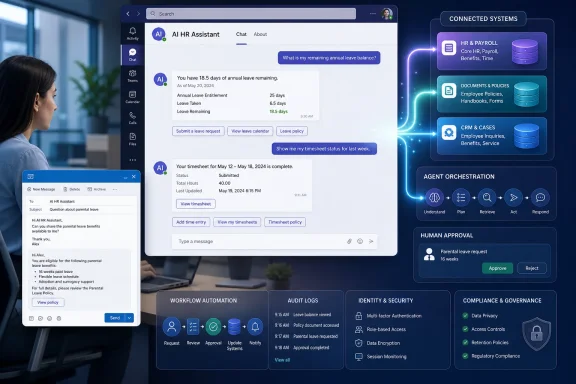
PiAssist is built around a familiar enterprise pattern: place conversational AI in the collaboration client employees already open every day, then use it to retrieve information or initiate actions in back-end business systems. Persistent says the assistant covers the employee lifecycle, including timesheets, regularization, leave, insurance benefits, recognition programs, travel approvals and policy information.
The published architecture points to three layers. Azure OpenAI Service provides the generative AI component; Semantic Kernel handles orchestration, meaning it identifies intent, chooses a source of information and can hand a request to another specialist agent; Teams and Outlook supply the user interface. Persistent’s materials also describe a system-of-record layer that includes Oracle Fusion, Microsoft SharePoint and Salesforce.
That structure is more consequential than the chat interface. A generic HR bot can summarize a handbook stored in SharePoint. PiAssist is intended to do more: recognize a question such as “Why is my leave balance lower than expected?”, draw on the right source, and potentially send the employee toward a workflow or another agent such as CareerAssist. Persistent’s January investor-call transcript says AssIstX supports “autonomous fulfillment” across business functions, although it also says the system includes human-in-the-loop oversight.
The company’s own AssIstX material describes PiAssist as covering travel, onboarding, appraisals and career development as well as timesheets and leave. This is therefore a broader internal-service platform than Microsoft Source’s HR-helpdesk framing initially suggests. It is a set of connected workflow agents, with PiAssist acting as the principal employee-facing entry point.
The reported efficiency numbers do not measure the same thing
Microsoft Source reports that PiAssist responds in under four seconds and says roughly two-thirds of its queries can be answered with available reports. It characterizes the remaining work as taking an executive about 10 minutes. In isolation, that supports a straightforward claim: automating retrieval of routine information can eliminate a meaningful share of HR’s repetitive workload.
Persistent’s January 2026 investor presentation uses a more ambitious metric, saying PiAssist “now resolves 83%” of employee HR questions and workflow requests autonomously. The company has not published the underlying query volume, how it separates a report answer from a completed workflow, whether employees rate the answers as correct, or the percentage of requests reopened after the first response.
Those omissions prevent a direct comparison between the two figures. The two-thirds number may refer only to questions answerable from reports, while the 83% number may also include actions that the system can carry out or route without an HR employee. But it is equally possible that “resolved,” “autonomous,” and “through readily available reports” are being used as overlapping marketing measures rather than consistently reported operational metrics.
The available evidence shows adoption and automation; it does not yet establish accuracy, employee satisfaction, or a verified reduction in HR staffing demand. Microsoft Source’s story gives the platform’s active-user count as around 8,000, but does not state the reporting period, the number of total queries, daily or monthly active users, or the fraction of Persistent’s workforce that uses it. Persistent’s AssIstX site refers to a workforce of more than 27,000 people, making the reported 8,000 users meaningful but not evidence that the tool has reached every employee.
A company can fairly call 8,000 recurring users a successful internal deployment. It cannot use that number alone to show universal adoption, a durable service-level improvement, or that the assistant reduces employee effort rather than merely moving it from an HR ticketing system into Teams chat.
Audit trails and approval boundaries are the deployment’s real control plane
Persistent says PiAssist operates under an ISO/IEC 42001-certified AI-management framework, maintains transaction logs across its ERP, API gateway and web server, and keeps humans in the loop for approvals, validations and sensitive decisions. Its certification is not merely a self-described badge: a certificate published by Persistent identifies DNV as the certification body and lists the company’s AI management system across a range of its locations, including U.S. offices.
ISO/IEC 42001 is an organizational management-system standard. It requires policies, processes and continual improvement to manage AI-related risks and opportunities; it is not a product-level guarantee that every PiAssist response is correct, unbiased, secure, or compliant. In other words, the certification supports Persistent’s claim that it has an AI governance structure, but it does not independently validate the assistant’s HR recommendations or transaction outcomes.
The stated approval boundary is more important. Leave approval, benefit eligibility, compensation-related matters and employee-record changes have consequences that should not be silently delegated to a language model. Persistent says sensitive decisions do not bypass governance, which indicates PiAssist is designed to assist with and route action rather than independently authorize it.
That is the right posture for a system connected to HR data. The operational risk is less likely to come from a bot incorrectly reciting a holiday policy than from a bot retrieving the wrong person’s record, inventing an exception that does not exist, or allowing an unauthorized action to cross from conversation into an ERP workflow. Logs across the ERP, gateway and web layer may help reconstruct what happened, but logs are retrospective controls; they do not substitute for identity checks, least-privilege access and enforceable approval rules at the point of action.
Microsoft’s role is substantial, but the deployment is not “Copilot” alone
The Microsoft Source account groups Azure OpenAI Service, Teams, Outlook and Copilot capabilities under the PiAssist implementation. That is accurate at a high level, but it can obscure where the enterprise work resides. The differentiating layer is Persistent’s integration and agent orchestration: grounding answers in enterprise sources, directing requests to specialized agents, and mapping an employee’s natural-language request to HR rules and transactions.
Persistent’s public AssIstX documentation describes Semantic Kernel and Azure OpenAI as orchestration and model components, while its investor presentation identifies Oracle, SharePoint and Salesforce as systems of record. The integration work between those layers determines whether an agent can do more than produce a plausible answer. It must locate authoritative data, respect the requestor’s permissions, preserve workflow ownership and make exceptions visible to a human decision-maker.
For Windows and Microsoft 365 administrators, that has a practical implication. Teams is the visible surface, but Teams governance alone is not the control set. A deployment like PiAssist requires Entra identity design, consent and access controls for the connected data sources, API gateway policy, logging and retention decisions, and a clear boundary between read-only retrieval and workflow execution. The more useful the agent becomes, the more those back-end controls become part of its user experience.
Microsoft Source’s report does not specify which model versions Persistent uses, which Azure regions process the requests, how long prompts and logs are retained, whether queries are filtered for sensitive data before model processing, or how the system handles a model-generated answer that conflicts with an ERP record. Those are the implementation details a prospective customer would need before treating the deployment as a reusable blueprint.
Persistent has built a customer-zero case study, not an independently audited benchmark
Persistent’s strategy is to test AssIstX inside its own business before offering its agent approach to clients. Its public material calls this a “customer zero” model. That gives the company a credible advantage over vendors demonstrating agents only in controlled proofs of concept: the platform has to live with real employee questions, real legacy systems and real governance obligations.
The company has also used the framework beyond HR. Its public portfolio includes ContractAssist, ITAssist, LegalAssist, ResumeAssist, InterviewAssist, SalesAssist, RenewalAssist and ObservabilityAssist. Persistent says ContractAssist reduced its internal contract cycle time by 70%, while its investor material says ITAssist reduced IT incident mean time to resolution from three hours to less than 30 minutes. Those are company-reported performance figures, not independently audited benchmarks.
PiAssist’s underlying promise is therefore believable in a narrow, concrete sense. Placing a retrieval-and-routing assistant in Teams can reduce the labor spent answering repetitive questions and help employees avoid navigating several portals. The stronger claims—high autonomous resolution, broad operational transformation and consistently reliable fulfillment across HR workflows—remain dependent on Persistent’s own reporting.
The next concrete proof point should be a fuller operational disclosure: query volume, a defined resolution metric, escalation and reopen rates, accuracy testing, and clear separation between answers retrieved from approved enterprise data and actions completed in an HR workflow. Until then, PiAssist stands as a serious internal Microsoft AI deployment with documented governance infrastructure, but its headline productivity figures should be read as vendor performance claims rather than a settled industry benchmark.