

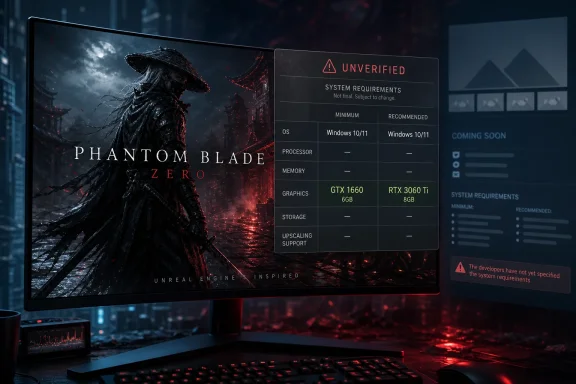
That makes a practical difference for anyone deciding whether a GTX 1660- or RTX 3060 Ti-class machine will be enough at launch. The figures attributed to S-Game — GTX 1660 or Radeon RX 5500 XT for 1080p/30 FPS with upscaling, and RTX 3060 Ti or RX 6700 XT for 1440p/60 FPS with upscaling — may eventually be added to Steam, Epic Games Store, or an official S-Game channel. As of this check, however, they should be treated as unverified specifications rather than a final purchase or upgrade guide.
The timing is also impossible to ignore. The supplied DSOGaming item is marked as published at 05:14 UTC on August 12, 2026, while this report was checked at 03:20 UTC on August 12. In other words, the reported article timestamp is still nearly two hours in the future. That does not prove the hardware figures are wrong, but it does mean there is no basis for presenting them as a confirmed official update before the underlying announcement appears on a first-party channel.
Steam Still Has Placeholder Requirements
Steam is the key primary record here because it is a confirmed launch store for the Windows edition, and S-Game has already used it to disclose meaningful PC-specific information. The page confirms that the game uses third-party Denuvo anti-tamper protection, supports Family Sharing, and offers interface and subtitle support in 15 languages, with English and Simplified Chinese full audio.
But the system-requirements block remains almost empty. It lists 64-bit Windows 10 or Windows 11 in both columns and nothing else. An official minimum specification that genuinely called for a Core i5-8700K, Ryzen 5 3600, 16GB of memory, and a GTX 1660 would normally appear in that same block, particularly with an SSD-installation requirement and explicit 1080p/30 target.
PCGamingWiki, which tracks the Steam entry, likewise does not provide the CPU, GPU, RAM, or storage figures attributed to the new DSOGaming post. Its listing identifies the game as an upcoming Unreal Engine 5 title and notes Denuvo, but its requirements table is still effectively incomplete. Independent PC-specification sites are also publishing widely divergent estimates, from GTX 1660-era hardware to RTX 3070-class minimums; those are projections, not evidence that S-Game has settled on a shipping specification.
The absence matters more than it might for a conventional game because the claimed targets are unusually forgiving for a major 2026 Unreal Engine 5 release. A GTX 1660 is a 2019 GPU without dedicated ray-tracing hardware, while the recommended RTX 3060 Ti is a 2020 card with 8GB of VRAM. If those figures prove accurate, they would suggest that the game can scale substantially below its showcase presentation — but only with upscaling enabled and, presumably, with ray tracing disabled or heavily reduced.
S-Game has not stated the upscaling technology in the submitted requirements. There is no confirmation there of DLSS, FSR, XeSS, frame generation, render-resolution presets, or the image-quality mode behind the 1080p and 1440p targets. “Upscaling enabled” is a performance condition, not a useful performance specification, until the game identifies the quality preset and internal rendering resolution used for testing.
The Ray-Tracing Claim Is Still Short on Technical Detail
DSOGaming says Phantom Blade Zero will use ray tracing for reflections and shadows but will not include ray-traced global illumination. That broadly aligns with prior discussion around the game’s graphical approach, but S-Game has not published a PC settings breakdown that lets players determine the cost of those effects, which GPUs support each option, or whether they are available on all hardware tiers.
The game is built in Unreal Engine 5, a fact S-Game and its Steam page both confirm. That alone does not establish that the final PC build uses Lumen, Nanite, hardware Lumen, software Lumen, virtual shadow maps, or any particular configuration of those tools. Unreal Engine 5 supports several rendering paths; engine branding is not a substitute for a technical feature list.
For Windows players, the missing information is substantial:
- The published material does not identify the graphical preset used for either claimed performance target.
- It does not say whether ray-traced shadows and reflections are optional, required, or supported only by RTX-class and Radeon RX 6000-series-or-newer cards.
- It does not disclose expected VRAM use, total install size, shader-compilation behavior, or whether the SSD requirement means SATA SSDs are supported or an NVMe drive is expected.
- It does not identify the upscaler or whether frame generation is available, which will determine whether the stated 60 FPS target reflects rendered frames or generated frames.
Those omissions are more important than the CPU names on a preliminary specification sheet. An RTX 3060 Ti can deliver very different results depending on whether the game is running at native 1440p, DLSS Quality, DLSS Performance, FSR, or a mode that includes frame generation. Until S-Game supplies those settings, the 1440p/60 claim cannot be meaningfully compared with other PC releases.
The “11-Minute Gameplay Video” Needs a First-Party Trail
There is a second verification gap in the report: the asserted 11-minute gameplay video. The supplied DSOGaming text refers to new gameplay, but the embedded item is labelled Phantom Blade Zero — Pre-Order Trailer, rather than an 11-minute gameplay presentation. A search of the currently available official S-Game, Steam, PlayStation, and major video records did not surface a newly published first-party 11-minute gameplay video matching that description.
That does not mean the footage does not exist. It may be scheduled, region-limited, unpublished at the time of checking, or attached to a post that has not indexed yet. But readers should not confuse older extended footage, trailers, and hands-on demonstrations with a new official gameplay upload simply because a report calls it one.
There is already independently documented gameplay context. PlayStation’s 2024 Summer Game Fest coverage said its hands-on demo looked and moved as impressively as the game’s early trailers suggested, highlighting blocking, parries, dodges, weapon variety, and a combat structure that sits somewhere between character-action games and Soulslikes. S-Game’s own 2023 PlayStation Blog introduction described the project as a fast, stylized action game inspired by titles such as Devil May Cry and Ninja Gaiden, rather than a deliberately slow, stamina-led Soulslike.
That distinction has been part of the project’s messaging from the beginning. Still, genre language is only useful if the finished game delivers controller responsiveness, encounter design, difficulty options, and PC performance that match the promise. A video can demonstrate combat animation; it cannot establish frame-time consistency, input latency, shader stutter, or how well the PC version handles traversal.
The October 29 Launch Date Has One Storefront Quirk
S-Game’s June statement, reported by Gematsu and posted to the game’s Steam community hub, moved Phantom Blade Zero from September 9 to October 29, 2026. PlayStation’s own July release roundup also lists October 29 for the PS5 release, and the announced PC launch includes Steam and the Epic Games Store.
Steam’s product page displays October 28, 2026, however. With S-Game, PlayStation, and multiple reports pointing to October 29, the most likely explanation is storefront date handling across time zones rather than a newly announced one-day change. S-Game has not publicly explained the discrepancy, so players should rely on their own Steam-region unlock time once preloads and release timing are announced.
For now, the only PC details that can be called confirmed from the official storefront are Windows 10/11 64-bit support, a single-player release, Denuvo anti-tamper DRM, and the October release window. The much more useful questions — actual hardware requirements, install size, graphics API behavior, upscaling support, ray-tracing modes, and the credibility of the claimed 11-minute gameplay upload — remain unanswered on the primary record.
Update: Steam requirements and pre-orders now appear to be live (August 13, 2026)
Prima Games reports that Phantom Blade Zero pre-orders are now live and that Steam has been updated with the previously unverified PC specification sheet. The listed targets are 1080p at 30 FPS with upscaling on a GTX 1660 or RX 5500 XT, and 1440p at 60 FPS with upscaling on an RTX 3060 Ti or RX 6700 XT. Both tiers call for 16GB of RAM, DirectX 12, and an SSD.
The report also says S-Game’s official site now lists separate hardware targets for advanced lighting modes: an RTX 5060 for ray tracing at 1080p/60 FPS with upscaling, and an RTX 5080 for path tracing. Those claims clarify that ray tracing and path tracing are distinct options rather than a single broadly supported feature.
Pre-orders are reportedly priced at $59.99 for the standard edition and $69.99 for Deluxe, with cosmetic and accessory bonuses that can also be earned in-game. The newly referenced 11-minute trailer also provides the first clear first-party trail for footage previously described only in secondary reporting.