
PTC’s Arena 2026.2 release brings its new Arena Connect workflow capability into the PLM and QMS product line, promising integrations with ERP, manufacturing-execution systems, Jira, Microsoft Teams, Slack, and other services. For manufacturers already running Arena alongside Microsoft 365 and multiple line-of-business systems, the immediate appeal is clear: change orders, quality events, and product records can trigger downstream actions without maintaining a separate point-to-point integration for every application.
But the release is less a sudden arrival of broad integration technology than a packaging and governance move inside Arena. Engineering.com first reported the 2026.2 announcement, while PTC’s own developer material shows Arena Connect documentation, its Workflow Designer, and connector references were already publicly available before the release announcement. PTC also promoted the “Arena Connect Workflow Builder” in a June 30, 2026 presentation—more than a month before the 2026.2 release date recorded in Arena’s API changelog.
The practical distinction is important for IT teams: Arena Connect is now a product capability that customers must evaluate as part of their Arena edition, workflow limits, connector permissions, audit requirements, and integration-support model—not simply as a newly exposed button in an existing PLM tenant.
Arena Connect is designed to let organizations build workflows around events in Arena, then move data or initiate actions in another system. PTC describes a visual, low-code Workflow Designer with prebuilt connectors, custom-code options, webhooks, event triggers, scheduled jobs, execution logging, alerts, and error handling.
The useful scenario is not a generic “sync everything” exercise. It is a controlled handoff at a process boundary. An engineering change order approved in Arena might create or update a Jira issue for a software team. A quality record moving to a new state could notify a Microsoft Teams channel. A released bill of materials could send an update toward an ERP or MES process, assuming the organization has built and validated the workflow and the target system exposes the necessary API operations.
Engineering.com says PTC is positioning Arena Connect with more than 200 prebuilt connectors and templates for Jira, Teams, and Slack. PTC’s public developer documentation confirms connector categories spanning ERP and finance services including SAP, NetSuite, QuickBooks, and Sage; collaboration services including Teams, Slack, Confluence, and Asana; cloud storage; databases; and generic REST, GraphQL, SOAP, and webhook options. The public documentation does not independently publish the 200-connector total, so administrators should verify the exact connector inventory, supported actions, and authentication methods during evaluation rather than treating that figure as a guarantee that a particular ERP or MES implementation is covered.
That is especially relevant in manufacturing. “ERP” and “MES” are categories, not products with interchangeable APIs. A prebuilt connector can reduce work for a common SaaS service, but it does not settle field mappings, item-number rules, revision semantics, units of measure, approval states, error recovery, or ownership of conflicting updates. Those are the reasons integrations fail after a successful proof of concept.
The Requirements API addition is more consequential than it may first appear. It exposes create, read, update, and delete operations for requirements, traceability, references, files, and parent-child structures, along with status and change-history handling. For organizations trying to connect product requirements, verification evidence, quality processes, and engineering records to outside tools, those endpoints give Arena Connect—or a custom integration—a broader set of records to work with.
There is, however, a deployment caveat in PTC’s own changelog that deserves attention. The
PTC had already described the Workflow Designer publicly in developer documentation before this week. Its June 30 presentation also said Arena users could orchestrate workflows across their application estate using no-code through full-code options. The pricing page makes the rollout boundary clearer: lower Arena PLM and QMS plans list Arena Connect with three active workflows, while the full Arena Connect Workflow Builder is listed under Enterprise and Enterprise QMS.
So 2026.2 should not be read as a blanket entitlement for every Arena customer. The builder is positioned as an Enterprise capability, and active-workflow quantities are explicitly limited by plan. PTC says additional workflow quantities can be purchased, but it does not publish prices for Arena Connect or those additions. The company requires prospective customers to request a quote.
A Teams post can be harmless status information, such as a change-order number and link. It can also become a distribution channel for supplier names, component availability, defect descriptions, regulatory documentation, or other sensitive product data. Arena’s connector documentation says connectors handle authentication and communication with external services, but public material does not spell out the exact Microsoft Entra ID permission scopes, tenant consent flow, retention behavior, or data fields used by the Teams actions.
Administrators should treat those missing details as an implementation requirement, not a minor documentation gap. Before production deployment, the Arena owner and Microsoft 365 administrator should establish which account or service principal authorizes the connector; what Teams, channels, or chats the workflow can reach; whether a post contains a direct Arena link or copies record content; how long messages remain subject to retention and eDiscovery; and how access is removed when an employee, supplier, or workflow owner changes roles.
The same problem exists with Slack, Jira, and cloud services, although the control plane differs. A workflow that creates a Jira issue is not necessarily a two-way record-management system. The authoritative system must be explicit. If an Arena change order creates a Jira issue, teams need to decide whether Jira status changes can update Arena, whether only selected fields are synchronized, and what happens if a Jira ticket is closed while the Arena process remains open.
PTC says Arena Connect includes centralized monitoring, logs, alerts, and error management. Those are necessary capabilities, but they do not replace operational ownership. Someone must receive a failed-workflow alert, determine whether the source or target record is authoritative, correct the condition, and prove the reconciliation happened. In regulated quality environments, that operating procedure matters as much as the connector.
PTC’s current plans page lists AI Item Redlines, AI File Insights, and supply-chain intelligence features across different plan tiers. That means the release’s headline feature list should not be mistaken for a single universal bundle: availability depends on the customer’s PLM or QMS plan, and higher-tier functions such as AI File Insights and Enterprise SCI sit in Enterprise offerings.
The Onshape-Arena Connection is also not a new concept introduced by this release. PTC announced the original cloud CAD-to-PLM connection in September 2022, describing product-data sharing between Onshape and Arena. The 2026.2 message is therefore about improving synchronization and transfer across engineering and downstream processes, not introducing the relationship from scratch.
This combination explains why Arena Connect is strategically important to PTC. AI-generated change summaries, BOM compliance signals, CAD changes, and requirements records are useful only if the right groups act on them. A workflow layer can route the event to quality, supply-chain, manufacturing, or software-tracking systems. It can also amplify bad data quickly if the mappings and release criteria are poorly designed.
Customers should confirm the following with PTC and their implementation team:
The practical distinction is important for IT teams: Arena Connect is now a product capability that customers must evaluate as part of their Arena edition, workflow limits, connector permissions, audit requirements, and integration-support model—not simply as a newly exposed button in an existing PLM tenant.
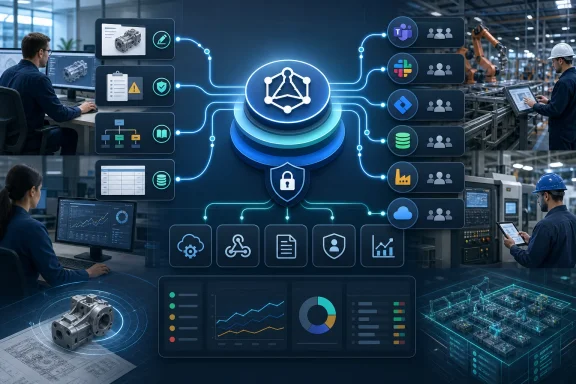 Arena Connect turns PLM events into cross-application workflows
Arena Connect is designed to let organizations build workflows around events in Arena, then move data or initiate actions in another system. PTC describes a visual, low-code Workflow Designer with prebuilt connectors, custom-code options, webhooks, event triggers, scheduled jobs, execution logging, alerts, and error handling.The useful scenario is not a generic “sync everything” exercise. It is a controlled handoff at a process boundary. An engineering change order approved in Arena might create or update a Jira issue for a software team. A quality record moving to a new state could notify a Microsoft Teams channel. A released bill of materials could send an update toward an ERP or MES process, assuming the organization has built and validated the workflow and the target system exposes the necessary API operations.
Engineering.com says PTC is positioning Arena Connect with more than 200 prebuilt connectors and templates for Jira, Teams, and Slack. PTC’s public developer documentation confirms connector categories spanning ERP and finance services including SAP, NetSuite, QuickBooks, and Sage; collaboration services including Teams, Slack, Confluence, and Asana; cloud storage; databases; and generic REST, GraphQL, SOAP, and webhook options. The public documentation does not independently publish the 200-connector total, so administrators should verify the exact connector inventory, supported actions, and authentication methods during evaluation rather than treating that figure as a guarantee that a particular ERP or MES implementation is covered.
That is especially relevant in manufacturing. “ERP” and “MES” are categories, not products with interchangeable APIs. A prebuilt connector can reduce work for a common SaaS service, but it does not settle field mappings, item-number rules, revision semantics, units of measure, approval states, error recovery, or ownership of conflicting updates. Those are the reasons integrations fail after a successful proof of concept.
The release date is August 2, while the workflow capability predates 2026.2
Arena’s official REST API changelog dates release 2026.2 to August 2, 2026, not August 5. The changelog documents several concrete 2026.2 changes: REST API access for the Requirements area, including traceability and related files; custom cost attributes; and an Item Number column in import-result CSV files for created items.The Requirements API addition is more consequential than it may first appear. It exposes create, read, update, and delete operations for requirements, traceability, references, files, and parent-child structures, along with status and change-history handling. For organizations trying to connect product requirements, verification evidence, quality processes, and engineering records to outside tools, those endpoints give Arena Connect—or a custom integration—a broader set of records to work with.
There is, however, a deployment caveat in PTC’s own changelog that deserves attention. The
GET /requirements/{requirement_guid}/trace endpoint returns all traceability data for a requirement regardless of the expand toggle state. An integration team that assumes the parameter constrains the returned trace set could retrieve more data than expected. That is an API-behavior issue worth testing before using the endpoint in a high-volume synchronization job or exposing its output in downstream reporting.PTC had already described the Workflow Designer publicly in developer documentation before this week. Its June 30 presentation also said Arena users could orchestrate workflows across their application estate using no-code through full-code options. The pricing page makes the rollout boundary clearer: lower Arena PLM and QMS plans list Arena Connect with three active workflows, while the full Arena Connect Workflow Builder is listed under Enterprise and Enterprise QMS.
So 2026.2 should not be read as a blanket entitlement for every Arena customer. The builder is positioned as an Enterprise capability, and active-workflow quantities are explicitly limited by plan. PTC says additional workflow quantities can be purchased, but it does not publish prices for Arena Connect or those additions. The company requires prospective customers to request a quote.
Microsoft Teams integration creates an IT governance task, not just a collaboration feature
For Windows-centered organizations, the Microsoft Teams connector is likely to draw the most interest because Teams is often where engineering, operations, quality, and procurement already discuss changes. Yet using Teams as the notification surface for PLM or QMS workflows creates governance questions that are easy to defer and hard to fix later.A Teams post can be harmless status information, such as a change-order number and link. It can also become a distribution channel for supplier names, component availability, defect descriptions, regulatory documentation, or other sensitive product data. Arena’s connector documentation says connectors handle authentication and communication with external services, but public material does not spell out the exact Microsoft Entra ID permission scopes, tenant consent flow, retention behavior, or data fields used by the Teams actions.
Administrators should treat those missing details as an implementation requirement, not a minor documentation gap. Before production deployment, the Arena owner and Microsoft 365 administrator should establish which account or service principal authorizes the connector; what Teams, channels, or chats the workflow can reach; whether a post contains a direct Arena link or copies record content; how long messages remain subject to retention and eDiscovery; and how access is removed when an employee, supplier, or workflow owner changes roles.
The same problem exists with Slack, Jira, and cloud services, although the control plane differs. A workflow that creates a Jira issue is not necessarily a two-way record-management system. The authoritative system must be explicit. If an Arena change order creates a Jira issue, teams need to decide whether Jira status changes can update Arena, whether only selected fields are synchronized, and what happens if a Jira ticket is closed while the Arena process remains open.
PTC says Arena Connect includes centralized monitoring, logs, alerts, and error management. Those are necessary capabilities, but they do not replace operational ownership. Someone must receive a failed-workflow alert, determine whether the source or target record is authoritative, correct the condition, and prove the reconciliation happened. In regulated quality environments, that operating procedure matters as much as the connector.
AI, supply-chain, and CAD features expand the data available to automate
The broader 2026.2 package also adds or highlights Arena AI Assistant, Arena Supply Chain Intelligence, and the Onshape-Arena Connection. Engineering.com identifies AI Item Redline and AI File Insights as features intended to summarize changes, compare revisions, and locate information in documents using natural-language requests. It also cites Automated BOM Compliance and Component Browser functions for component compliance, lifecycle, and supply-chain visibility.PTC’s current plans page lists AI Item Redlines, AI File Insights, and supply-chain intelligence features across different plan tiers. That means the release’s headline feature list should not be mistaken for a single universal bundle: availability depends on the customer’s PLM or QMS plan, and higher-tier functions such as AI File Insights and Enterprise SCI sit in Enterprise offerings.
The Onshape-Arena Connection is also not a new concept introduced by this release. PTC announced the original cloud CAD-to-PLM connection in September 2022, describing product-data sharing between Onshape and Arena. The 2026.2 message is therefore about improving synchronization and transfer across engineering and downstream processes, not introducing the relationship from scratch.
This combination explains why Arena Connect is strategically important to PTC. AI-generated change summaries, BOM compliance signals, CAD changes, and requirements records are useful only if the right groups act on them. A workflow layer can route the event to quality, supply-chain, manufacturing, or software-tracking systems. It can also amplify bad data quickly if the mappings and release criteria are poorly designed.
What Arena customers should verify before enabling workflows
The implementation priority is to select one narrow process with clear ownership—such as publishing an approved engineering change to a Teams channel or opening a Jira task from a quality event—before attempting ERP or MES synchronization. The latter can affect purchasing, production planning, inventory, and compliance records, where a failed or duplicate update becomes an operational problem.Customers should confirm the following with PTC and their implementation team:
- The Arena edition includes the required workflow capability and enough active workflows for production, testing, and contingency processes.
- The exact connector supports the needed target-system actions, authentication model, retry behavior, and field mappings.
- Arena, Jira, ERP, MES, and Teams each have a documented system of record for every synchronized field and status.
- Workflow executions, failures, manual retries, and corrections are retained long enough for audit, quality, and incident-response requirements.
- API use is tested against the 2026.2 Requirements endpoints, particularly the traceability retrieval behavior documented by PTC.
References
- Primary source: engineering.com
Published: 2026-08-05T12:10:35+00:00
PTC adds Arena Connect to PLM and QMS release - Engineering.com
The 2026.2 update links Arena with ERP, MES, Jira, Microsoft Teams and Slack using workflows and pre-built connectors.www.engineering.com - Related coverage: ptc-arena.github.io

Overview - Arena Developer & API Help Center
ptc-arena.github.io
- Related coverage: ptc.com
Arena Spring 2026 in Focus: Item Automation & Arena Connect Workflow Builder | PTC
Automate repetitive item and BOM processes while orchestrating workflows across your entire application ecosystem—no‑code to full‑code—so your business scales operations without sacrificing governance or control.www.ptc.com - Related coverage: ptc.com
PTC Introduces Onshape-Arena Connection | PTC
PTC announces the availability of the Onshape-Arena Connection, a new functionality that connects its cloud-native Onshape product development and Arena® product lifecycle management (PLM) solutions.www.ptc.com - Related coverage: arena.playplay.io
- Related coverage: arena.com.tr
- Related coverage: bigpara.hurriyet.com.tr
- Related coverage: cdn.arena.com.tr
- Related coverage: arena.com.tr
- Related coverage: ptc-arena.github.io
API Changelog - Arena Developer & API Help Center
ptc-arena.github.io
