
The important detail, which the Shane the Gamer summary compresses, is that Microsoft did not simply promise every Xbox One buyer a PC copy. The Windows 10 entitlement was a limited pre-order promotion tied to the digital Xbox One version. It excluded physical game discs, required redemption by April 4, 2016, applied only in Xbox Live markets other than China, and was described as available while supplies lasted. The code for the Windows version was to be delivered through an Xbox system message around launch week.
That distinction matters for anyone revisiting old purchases or assuming that an Xbox One disc from 2016 should unlock a Windows license today. The offer was a time-limited commercial incentive, not the modern Xbox Play Anywhere policy applied universally to a title. Microsoft was using Quantum Break to make a much larger point in early 2016: Windows 10 PCs were to be treated as a first-class Xbox destination, but the company also wanted those players inside its own store.
 A simultaneous PC launch that rewrote the original pitch
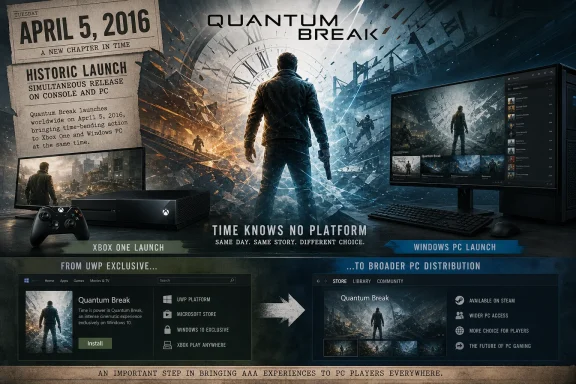
Quantum Break had been presented as a major Xbox One exclusive before Microsoft and Remedy added PC support less than two months before release. Xbox Wire framed the decision as part of Xbox’s effort to let people play across devices, while the Windows Experience Blog repeated that the game would launch April 5 on both Xbox One and Windows 10.
For the PC audience, the date mattered more than the marketing language. Remedy’s earlier Alan Wake reached PC well after its Xbox 360 debut. A same-day Windows release for Quantum Break showed Microsoft was beginning to collapse the usual console-first delay for selected first-party titles.
But the Windows edition came with a hard boundary: it was a Windows 10 and Windows Store release. Before launch, Microsoft executive Aaron Greenberg said publicly that the PC edition would be a Windows Store exclusive. Reports from PC Gamer and GameSpot at the time also noted that it would use Xbox Live integration and support shared saves and achievements between Xbox One and Windows 10.
Microsoft had effectively combined three separate propositions into one launch:
- The game would release on Xbox One and Windows 10 on April 5, 2016.
- A qualifying Xbox One digital pre-order could include a Windows 10 redemption code at no additional charge.
- The PC version would initially be available only through the Windows Store and use the Universal Windows Platform model Microsoft was then promoting.
The first two points made the announcement look consumer-friendly. The third would become the more consequential part of the story.
The fine print behind the “free” Windows copy
The supplied report correctly says that an Xbox One digital pre-order could receive the Windows 10 game free. What it leaves out is how narrow the eligibility language was in Microsoft’s own announcement.
The promotion covered Xbox Store pre-orders, digital tokens sold at participating retailers, and pre-orders of the special Xbox One console bundle. Buyers of physical Quantum Break discs were excluded from the Windows offer. Retail and bundle codes also had to be redeemed through an Xbox One console or Xbox.com by April 4, 2016. These were ordinary promotional restrictions, but they mean the offer should not be recast as a blanket cross-buy promise.
Microsoft also used the launch to attach two older Remedy games to the Xbox package. Every Xbox One copy included an Xbox 360 download of Alan Wake, plus The Signal and The Writer expansions, all playable on Xbox One through backward compatibility. A pre-order added Alan Wake’s American Nightmare as another Xbox 360 download.
Those bonuses were attached to the Xbox campaign, not a permanent feature of buying the PC version years later. The distinction is particularly relevant now, because storefront listings and libraries tend to preserve the base game while old redemption promotions and time-limited bundles do not necessarily carry forward in the same way.
Windows Store exclusivity became the PC story
At launch, Quantum Break became one of the early high-profile tests of Microsoft’s Universal Windows Platform strategy for big-budget PC games. The theory was straightforward: Windows 10 and Xbox One could share services, entitlement systems, saves, achievements, and a common Microsoft-controlled storefront.
The practical experience was much rougher. PC Gamer’s April 2016 review found the Windows Store build performed poorly even on high-end systems. PCWorld separately reported that its experience was broadly playable but criticized the surrounding Windows Store limitations, including installation management and the absence of third-party overlays. Digital Foundry’s analysis, reported by GameSpot, highlighted unstable frame pacing, crashes, image-quality concerns, and restrictions that made common PC troubleshooting and monitoring tools difficult or impossible to use.
Some of those complaints were about the game itself; others were about the platform container around it. The difference is important. A demanding new PC game can be improved through drivers, patches, settings changes, and community tools. The early Windows Store model limited several of the ordinary ways enthusiasts diagnose and work around problems, including traditional fullscreen behavior and overlay-based frame-rate monitoring.
That made Quantum Break a poor showcase for the message Microsoft was trying to sell. The game’s PC edition was technically ambitious, built around DirectX 12 and Windows 10 at a point when PC graphics drivers and UWP game delivery were still maturing. It was also tied to a store experience that many established PC players did not trust.
The launch was therefore a milestone for same-day Xbox-to-PC releases, but a warning about treating storefront exclusivity as a substitute for a mature PC release.
Microsoft reversed course within months
The “Windows Store exclusive” status did not last. In August 2016, Microsoft and Remedy announced a Steam release and physical PC edition, with PC Gamer reporting that both were scheduled for September. GameSpot later reported that the Steam launch arrived on September 29, 2016, ending the Windows Store-only period less than six months after the game’s April release.
That reversal was more significant than a routine extra storefront listing. The Steam build supported 64-bit Windows 7 or later and DirectX 11, rather than requiring Windows 10 and DirectX 12. Its current Steam requirements still identify DirectX 11, while listing Windows 10 as the recommended operating system. In practical terms, the later edition widened the game’s technical reach and avoided the original UWP-only delivery model.
Microsoft had already acknowledged the commercial and technical difficulty of the initial PC release. Ars Technica reported in June 2016 that Xbox chief Phil Spencer described Quantum Break as not being Microsoft’s best PC release. That admission came before the Steam announcement and helped explain why the exclusive-store strategy was not treated as permanent.
The episode also sits in a broader change in Microsoft’s PC approach. In 2016, the company was testing whether marquee Xbox games could help establish the Windows Store as a serious destination for traditional PC gaming. Later releases increasingly appeared on Steam alongside Microsoft’s own storefront, a strategy far closer to the buying habits of Windows players than the Quantum Break launch plan had been.
What PC players should take from the 2016 announcement
For a player looking at Quantum Break now, the relevant question is not whether it was “coming” to Windows 10. It did so on April 5, 2016. The useful question is which PC edition is being considered and what expectations come with it.
The original Windows Store release was closely connected to Microsoft’s Windows 10, UWP, and DirectX 12 push. The Steam version that followed uses a different technical baseline: 64-bit Windows support and DirectX 11. That does not erase every performance or compatibility complaint that has accumulated around an older PC game, but it explains why discussions of Quantum Break often describe two materially different PC distribution paths rather than one uniform release.
The Xbox One pre-order promotion is also historical. Anyone who qualified in 2016 should check the Microsoft account and Xbox message history associated with the original digital purchase, rather than expect a newly issued Windows entitlement. Buyers considering the game today should evaluate the storefront edition being offered, not rely on decade-old launch incentives or the original Windows 10 exclusivity claim.
Microsoft’s 2016 announcement still matters because it marked an early attempt to bring a major Xbox release to PC on day one. Its legacy is less the promotional bundle with Alan Wake than the lesson that followed: Windows players wanted simultaneous releases, but they also wanted conventional PC storefronts, transparent requirements, and the tools to manage a game when something went wrong.