
But the number should not be read as three billion people installing Qwen, or even three billion completed model installations. Alibaba’s own figure covers global distribution channels that the company did not break down. The more useful finding is the surrounding evidence: Qwen has become one of the most reused foundations in the open-model supply chain, and that creates a practical deployment question for PC and enterprise teams—how much of their local AI stack now depends on a model family they may never have selected directly?
Hugging Face’s own State of Open Source on Hugging Face: Spring 2026 report independently establishes the broader shift. It found that Chinese-developed models had reached 41% of downloads on its Hub over the preceding year, China had overtaken the United States in both monthly and overall platform downloads, and Alibaba had more derivative models than Google and Meta combined. The report counted more than 113,000 Qwen derivatives by Alibaba-family attribution, rising above 200,000 when all repositories tagged Qwen were included.
The reported 3 billion total is therefore best understood as a vendor claim about distribution scale, while Hugging Face’s data documents a related but narrower fact: Qwen has unusually deep downstream reuse.
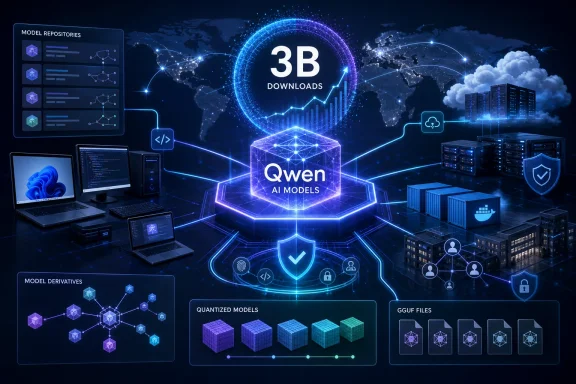 The 3 Billion Figure Is Not a User Count
The reporting combines two measurements that are easy to mistake for one another. Alibaba told Bloomberg that its Qwen models accumulated more than 3 billion downloads globally during the last six months. ForkLog also cites Hugging Face figures of 2.05 billion Qwen downloads in the first seven months of 2026, compared with 418 million for Google and 227 million for Meta, but those are Hub-specific statistics rather than a universal measure of adoption.
Hugging Face explicitly warns in its publisher-analytics documentation that download figures are not deduplicated by user. Its logs can include individual HTTP requests, and customers who need unique-download analysis must calculate it themselves from more granular records. A single person, CI pipeline, model-serving host, or container build can make repeated requests; one organization can also retrieve several precisions, architectures, adapters, and conversion formats of the same base model.
That does not render the result meaningless. It changes what the result means. Qwen’s download total is evidence of distribution and integration activity, not a census of end users or a measure of paid AI revenue. It is especially relevant where model weights are routinely fetched by automation: Docker-based inference services, developer workstations rebuilding environments, model caches, quantization workflows, and continuous integration jobs testing several variants.
For IT teams, the lesson is simple: a model registry’s download counter is a signal that a family is becoming standard infrastructure. It is not proof that each download represents a productive deployment, a distinct customer, or an independently evaluated model choice.
Derivatives Are the More Important Number
Alibaba says it has made more than 460 Qwen models available and that its ecosystem has generated more than 300,000 derivative models. The exact total is Alibaba’s claim, but Hugging Face’s independently published analysis supports the direction of travel: Qwen derivatives outnumber those associated with Google and Meta combined on the Hub.
A derivative is not necessarily a new foundational model. It may be a fine-tune aimed at a language, coding framework, vertical workflow, role-playing persona, classifier, embedding task, or document-processing job. It may be a LoRA adapter, merged model, or quantized repackaging designed to fit a specific GPU, a CPU-only Windows PC, or portable formats used by local inference runtimes.
That is why the Qwen story matters more than a league-table comparison with Meta’s Llama or Google’s Gemma. When a family becomes a default substrate for conversions and fine-tunes, downstream users can encounter it under another repository name, in a community package, or embedded in a tool that advertises only the task it performs. The original vendor’s name can disappear long before the weights reach an enterprise desktop.
Hugging Face’s Spring 2026 report identifies exactly this intermediary layer as an increasingly important part of the open-model economy. Independent developers and small collectives are quantizing, adapting, and redistributing base models at scale, shaping which models ordinary users can run and how quickly new releases spread.
For Windows administrators, this turns model governance into a software-inventory problem. Looking only for folders or repositories named “Qwen” is not enough. Teams need to record the base model, version, hash where available, license, quantization source, adapter provenance, runtime, and the business process accessing it.
Small Models Explain Much of the Adoption
The source reporting attributes Qwen’s rise to frequent releases, a broad range of model sizes, and permissive licensing across much of the family. The strongest practical explanation is the model-size range. Hugging Face found that smaller models are downloaded and deployed far more frequently than the biggest systems, reflecting limits on latency, cost, memory, and available hardware.
That pattern is directly relevant to Windows PCs. A model that can be quantized and run acceptably on a workstation GPU, or slowly but usefully on CPU and system memory, can reach developers who will never provision a multi-GPU server. It can be tested offline, integrated into a local retrieval workflow, or used for code completion without sending confidential prompts to a third-party API.
The Hugging Face report cautions that automated systems and CI pipelines inflate small-model download counts. Even so, it concludes that the broader trend toward deployable models is real. Its data shows the average downloaded model growing in size over time while the median remains much smaller, suggesting that frontier-scale use lifts the average but everyday deployments remain concentrated around models that can actually be hosted.
Alibaba’s Qwen3 technical report says its Qwen3 line spans dense and mixture-of-experts models from 0.6 billion to 235 billion parameters and makes those Qwen3 models available under Apache 2.0. That is commercially consequential: Apache 2.0 allows redistribution and modification subject to its conditions, giving enterprises more room to package a model inside an internal tool than restrictive research-only licenses do.
The family label is not a substitute for a license review, however. Earlier Qwen releases used different terms for some weights even where the repository code was Apache 2.0. A team cannot assume that every historical Qwen checkpoint, adapter, or conversion has identical commercial rights. The license attached to the specific model card and release artifact remains the record that matters.
Local Deployment Makes Provenance a Security Issue
Qwen’s popularity in GGUF and other local formats is good news for organizations seeking lower inference costs, offline operation, and control over sensitive prompts. It also creates a familiar Windows security challenge: unofficial mirrors and repackaged artifacts become attractive precisely when a model family becomes popular.
A GGUF file is not merely “an AI download” in an abstract sense. It is a large executable-adjacent dependency consumed by a runtime, frequently paired with Python packages, CUDA or ROCm components, GPU drivers, model-server binaries, web interfaces, extensions, and configuration files. The model weights may not execute like a traditional .exe, but the surrounding stack does. A developer who grabs a community bundle can inherit an unreviewed installer, an exposed local API endpoint, a permissive firewall rule, or a Python environment with unrelated dependencies.
The sensible operational response is not to ban locally hosted models. It is to treat them as software supply-chain components:
- Maintain an approved registry of base models and quantizations, including the source repository, revision, cryptographic hash where published, license, and intended runtime.
- Require teams to distinguish the base Qwen release from adapters, merged models, GGUF conversions, and “uncensored” community variants, because each can have a separate maintainer and risk profile.
- Bind local inference servers to loopback interfaces unless remote access is explicitly required, and place authenticated reverse proxies in front of any shared endpoint.
- Keep model-serving environments separate from privileged Windows administration work, domain credentials, browser sessions, and unrestricted production network access.
- Record which model version produced outputs used in customer-facing, regulated, or security-sensitive workflows so results remain reproducible after a repository is updated or removed.
These are ordinary controls for package repositories and internal tools. The difference is that model weights are large, mutable, often redistributed, and increasingly selected by developers outside central procurement.
Alibaba’s Download Lead Does Not Settle the AI Market
The reporting’s “world’s most-downloaded” framing is narrower than it sounds. Hugging Face itself says its platform statistics exclude API requests, private deployments, and other distribution channels, while its Spring report describes the Hub as a set of overlapping sub-communities rather than a single uniform market. That leaves out substantial closed-model usage and enterprise inference that never passes through public model repositories.
Qwen’s lead therefore does not establish that it has more commercial customers, generates more revenue, produces better results for every workload, or is more widely used than every proprietary service. It does establish something more concrete: Alibaba has built a release-and-reuse machine that is winning substantial attention among developers who download, modify, quantize, and redistribute model weights.
Alibaba’s fiscal 2026 annual report also shows why the company is investing so heavily in that position. It describes AI and cloud as the company’s growth engine, says AI-related products accounted for 30% of its Cloud Intelligence Group’s external revenue in the final quarter of that fiscal year, and cites three Qwen-family updates in the preceding three months. Open models can drive adoption at the developer layer while Alibaba sells cloud inference, compute, and enterprise services around them.
For Windows and enterprise IT readers, the material change is not that a download counter has crossed an eye-catching threshold. It is that Qwen is now common enough in the open-model chain that organizations should expect it to appear in local AI pilots, developer toolchains, and third-party model packages—and should govern it with the same discipline they apply to any fast-moving, externally sourced software dependency.
