
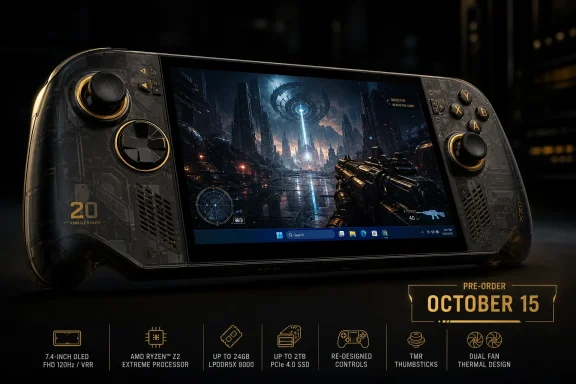
The headline upgrade is the screen. ASUS replaces the Ally X’s 7-inch 1080p IPS LCD with a 7.4-inch, 1080p, 120Hz OLED panel rated at 600 nits in SDR and 1,400 nits peak HDR brightness, with FreeSync Premium Pro variable refresh rate. It also changes the controls, cooling layout, and exterior. But this is a display-and-input revision of ASUS’s Windows 11 handheld, not a faster generation.
9to5Toys first flagged the Best Buy pre-order listing, while ASUS’s own announcement and Xbox Wire confirm the $1,299 standalone price, the $2,499 bundle, and the October 15 on-shelf date. Best Buy’s listing also identifies the X20 as a pre-order rather than an immediately shipping device. That date is worth emphasizing: placing an order on August 25 reserves a unit; it does not put a new OLED Ally in buyers’ hands this week.
There is also a cleanup needed in the original 9to5Toys report. Its update correctly states that pricing and pre-orders are live, but the body still says ASUS had not revealed pricing or availability. ASUS has now done both, and the standalone model means buyers are not required to take the $2,499 collector bundle simply to get the OLED handheld.
 The $300 premium buys the parts users touch most
ASUS still sells the 2025 ROG Xbox Ally X for $999.99. Its key specifications—Ryzen AI Z2 Extreme, 24GB of memory, 1TB of SSD storage, and an 80Wh battery—match the new X20. The prior model already has a 1080p 120Hz display and runs Windows 11 with the Xbox full-screen experience, Game Bar, Steam, Epic Games Store, PC Game Pass, and conventional Windows software.
That makes the comparison unusually clean. For $300 more, the X20 delivers:
- A 7.4-inch OLED panel rather than a 7-inch LCD, while retaining 1080p and 120Hz operation.
- A higher advertised HDR peak brightness figure, plus OLED’s per-pixel black levels and contrast.
- TMR thumbsticks and a mechanically convertible D-pad that switches between four-way and eight-way layouts.
- Revised buttons, bumpers, triggers, grips, and a reworked cooling design.
- A translucent black shell, gold internal accents, and ROG 20th-anniversary branding.
The OLED screen is the most consequential change. On a handheld PC, black-level performance is visible in dark games, letterboxed video, and UI use at low brightness; a larger 7.4-inch panel also gives Windows text and game interfaces a little more physical space without increasing resolution. ASUS has not increased the X20’s native resolution, however, so buyers should not expect the display upgrade to create a new performance burden at the usual 1080p target.
The 120Hz specification needs a little perspective. The prior ROG Xbox Ally X was already a 120Hz machine, so the X20 is not moving from 60Hz to high refresh rate. OLED should improve response behavior and HDR presentation, while FreeSync Premium Pro can smooth frame-rate fluctuations when a game runs below the panel’s maximum refresh rate. It does not make a Ryzen AI Z2 Extreme render more frames than it did in the 2025 model.
Hardware Busters, which independently reviewed the new pre-order positioning, arrived at the same central conclusion: the $300 difference is principally a screen premium rather than a silicon upgrade. That is a fair reading of ASUS’s published specification sheets.
ASUS changed the controls and airflow, but not the performance tier
The X20 has more than a cosmetic chassis. ASUS specifies full-size TMR joysticks, Hall Effect analog triggers, HD haptics, and a Transforming D-pad. TMR, or tunneling magnetoresistance, is a magnetic sensing approach meant to avoid the physical wear associated with traditional potentiometer sticks. It is an improvement buyers may value over the life of a handheld, although long-term drift resistance will need to be established through real-world use rather than product-page promises.
The convertible D-pad is a more practical differentiator than it may first appear. A four-way configuration suits menus, platformers, and many retro titles; an eight-way layout can work better for fighting games, diagonals, and some PC games. ASUS also says it has reshaped the ABXY buttons and refined the shoulder controls. Tom’s Guide, which handled the X20 ahead of its formal pre-order opening, reported that these changes were noticeable in person and identified an additional vent in the redesigned cooling arrangement.
None of those alterations change the basic buying equation for an existing Ally X owner. The same processor, memory capacity, storage capacity, battery size, Windows 11 operating system, two USB-C ports, microSD Express support, Wi-Fi 6E, and Bluetooth 5.4 mean performance comparisons should begin from parity. A game that is CPU- or GPU-limited on the 2025 ROG Xbox Ally X will remain constrained by the same Ryzen AI Z2 Extreme on the X20.
ASUS does say the new cooling system directs more airflow toward the APU and keeps the display surface cooler. That could affect sustained clocks, fan noise, or comfort in extended sessions, but the company has not published comparative benchmark data, sustained-wattage figures, or temperature measurements against the older Ally X. Until independent testing arrives, it would be premature to treat the cooling revision as proof of a performance increase.
The collector bundle is optional—and expensive
The $2,499 ROG XBOX Ally X20 Bundle combines the handheld with the ROG XREAL R1 Edition 20 gaming glasses, a dbrand Killswitch case and themed skin, joystick covers, a 68W charger, and a custom Pelican Protector Case. ASUS says the special-edition glasses will also be sold separately, which is the significant consumer-friendly part of the announcement: users can buy the X20 alone, then decide later whether the display glasses fit their use.
ASUS advertises the ROG XREAL R1 Edition 20 glasses as a 240Hz micro-OLED wearable display with a virtual 171-inch image at four meters, native three-degrees-of-freedom tracking, and an Anchor Mode intended to hold the virtual display in place. A single USB-C connection to the handheld is a simple enough proposition, especially for hotel-room or desk use. But glasses are not a substitute for the X20’s OLED panel; they are a separate, tethered display option with their own fit, prescription, comfort, and motion-sensitivity considerations.
The bundle price deserves scrutiny rather than applause for its large number of accessories. Hardware Busters reports that ASUS plans to sell the ROG XREAL R1 Edition 20 glasses separately for $799. Subtracting the $1,299 handheld and that reported glasses price from the $2,499 package leaves about $400 assigned to the Killswitch, charger, joystick caps, themed skin, and Pelican case. That is collector-edition pricing, not an obvious value bundle.
ASUS does not appear to claim a percentage discount for buying the package. Buyers who want the case and glasses should wait for individual accessory pricing and availability before assuming the bundle is the economical route.
Windows 11 remains the feature and the compromise
The X20 remains a Windows 11 Home handheld, not a console with a fixed operating environment. That gives it the same basic advantage as the current ROG Xbox Ally X: access to PC Game Pass, Steam, Battle.net, Epic Games Store, GOG, browser-based services, mods, emulators where legally used, and normal Windows applications on one device.
It also retains the familiar handheld-PC tradeoff. The Xbox full-screen experience and dedicated Xbox button may reduce the friction of launching games, but Windows still brings desktop software assumptions, launcher updates, patches, sign-ins, power settings, and games that vary widely in controller support. ASUS’s new OLED display and improved controls can make the machine more pleasant to use; they do not eliminate the software-management work inherent in a Windows gaming PC.
For first-time buyers choosing between ASUS’s two premium Xbox-branded handhelds, the X20 is easy to understand: pay $300 for the OLED panel, larger physical screen, refreshed controls, revised cooling, and anniversary finish. For current ROG Xbox Ally X owners, the lack of a processor, GPU, battery, RAM, or storage uplift makes this a luxury upgrade rather than a required replacement.
Pre-orders are open now through ASUS and Best Buy, with retail availability scheduled for October 15, 2026. The first useful test will not be a product render or a 120Hz badge—it will be independent battery, sustained-performance, heat, and OLED brightness testing against the $999.99 Ally X that ASUS is still selling beside it.