
The lower-cost system aims for practical, no-frills 1080p gaming with AMD’s Ryzen 5 5600X and an RTX 3050. The higher-tier configuration nearly doubles the budget, shifts to the Ryzen 7 7700X and AM5 platform, and makes the RTX 5060 Ti the centrepiece of a considerably more forward-looking 1440p gaming PC.
Both have credible foundations. Neither, however, should be treated as a shopping list to purchase blindly. Component variants, cooling requirements, memory capacity, and unusually high listed storage and RAM costs all deserve attention before the first order is placed.
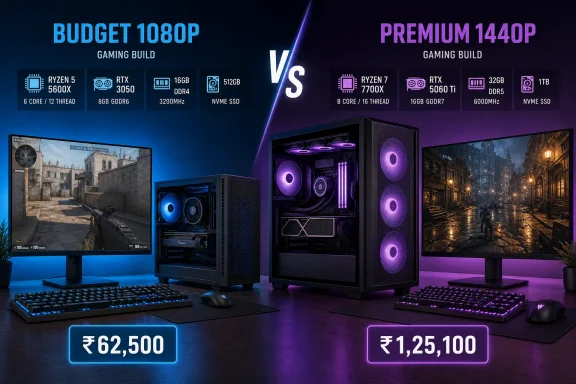 Overview: Two Budgets, Two Very Different PC Gaming Experiences
A ₹60,000-class gaming PC and a ₹1.25 lakh gaming PC no longer differ only in cosmetic extras, RGB lighting, or a few more frames per second. They target different resolutions, different longevity expectations, and different upgrade paths.
The ₹62,500 configuration is best understood as an accessible 1080p gaming PC build. It prioritises a capable six-core CPU, 16GB of memory, 1TB of NVMe storage, and an RTX card with modern Nvidia software features. It is designed to play competitive games smoothly and make demanding single-player titles workable with sensible graphics settings and DLSS enabled where available.
The ₹1,25,100 build is a move into mainstream enthusiast territory. It is intended for players using—or planning to buy—a 1440p gaming monitor, particularly one with a 144Hz or higher refresh rate. The Ryzen 7 7700X provides more CPU capacity for demanding games, background workloads, streaming, and productivity, while the RTX 5060 Ti introduces a much stronger graphics foundation for modern rendering techniques.
The central buying decision is therefore straightforward:
- Choose the ₹62,500 build when the target is affordable, dependable 1080p gaming and the buyer accepts a more limited upgrade path.
- Choose the ₹1,25,100 build when 1440p is the goal, stronger ray tracing matters, and a platform-level CPU upgrade later is part of the plan.
That distinction is more useful than simply comparing price tags.
The ₹62,500 Gaming PC Build: A Practical 1080p Entry Point
The lower-cost build is based on a combination that remains familiar for good reason: AMD’s mature Ryzen 5000 platform paired with a lower-midrange Nvidia RTX graphics card.
| Component | Proposed model | Listed price |
|---|---|---|
| CPU | AMD Ryzen 5 5600X | ₹15,000 |
| GPU | Asus Dual GeForce RTX 3050 OC Edition | ₹17,000 |
| Motherboard | Sapphire SI-E A520M-E | ₹4,800 |
| RAM | Adata Premier 16GB DDR4-3200 | ₹10,000 |
| Storage | EVM 1TB NVMe SSD | ₹11,000 |
| PSU | Cooler Master MWE 450 Bronze V2 | ₹3,000 |
| Case | Zebronics Gaming PC Cabinet | ₹1,700 |
| Total | ₹62,500 |
Ryzen 5 5600X: Still a Sensible Gaming CPU
The AMD Ryzen 5 5600X remains a sensible choice for a budget gaming PC because its six cores and 12 threads are sufficient for the majority of contemporary games. Its Zen 3 architecture may no longer be cutting-edge, but its gaming performance is still respectable when paired with a GPU in the RTX 3050 class.
For esports titles such as Valorant, Counter-Strike 2, Rocket League, and Overwatch 2, the processor should have little trouble delivering the CPU-side performance required for high frame rates. It is also capable of handling normal background applications—voice chat, browser tabs, game launchers, music streaming, and basic capture software—without turning every gaming session into a balancing act.
The limitation is platform longevity. AM4 is a mature platform, which brings lower motherboard and DDR4 memory costs, but offers a smaller future CPU upgrade runway than AM5. There are still strong AM4 processors available, but a meaningful upgrade later may be harder to justify than moving to a newer platform entirely.
Another practical issue is cooling. The Ryzen 5 5600X does not include a cooler in all retail arrangements, and the configuration does not identify one separately. A modest tower air cooler should be considered part of the actual budget, especially for buyers who want lower noise levels and more stable boost behaviour during longer gaming sessions.
RTX 3050: Modern Features, Modest Raw Performance
The Asus Dual RTX 3050 OC Edition is the defining compromise in the ₹62,500 build. It brings access to Nvidia’s RTX feature stack, including DLSS support, hardware-accelerated ray tracing, Reflex support in compatible games, and encoder capabilities useful for basic streaming or recording.
Its 8GB of GDDR6 memory is important in a 1080p-oriented configuration. While modern games are steadily increasing their VRAM requirements, 8GB remains workable at 1080p when texture settings are chosen sensibly. The card is not intended to run every new release at maximum settings, but it should provide a stable experience in a broad range of titles.
The critical point is that ray tracing should be treated as an optional enhancement, not the primary reason to buy this GPU. In lighter games or carefully tuned settings, ray-traced effects can be usable. In demanding titles, however, enabling ray tracing can impose a major performance cost. DLSS can help, but it cannot completely overcome the limitations of the GPU’s raw rendering performance.
For this build, the RTX 3050 makes the most sense when configured around these expectations:
- 1080p high settings in esports and less demanding games
- 1080p medium-to-high settings in newer AAA releases
- DLSS enabled where visual quality and performance modes look acceptable
- Ray tracing kept off, reduced, or selectively used
- 1440p avoided except in lighter games or with substantial settings reductions
That is not a criticism of the card’s role. It is simply the realistic profile of an entry-level RTX gaming experience.
A520 Motherboard: Cheap, Functional, and Limited
The Sapphire SI-E A520M-E motherboard performs a cost-control role. An A520 board can support the Ryzen 5 5600X and provides essential connectivity for a straightforward gaming PC, including M.2 NVMe storage support and standard expansion options.
However, the A520 chipset is not a full-featured enthusiast platform. Buyers should not expect the same degree of CPU tuning, PCIe flexibility, rear I/O, power delivery headroom, or BIOS refinement commonly associated with better B550 motherboards.
That does not automatically make it a poor choice. At this budget, motherboard spending should be disciplined. But it does mean buyers should check the exact retail board specification before ordering, including:
- BIOS compatibility with the Ryzen 5 5600X
- Number of M.2 slots
- Number of RAM slots
- Rear USB port selection
- Fan headers for case airflow
- Wi-Fi and Bluetooth availability
- Warranty and local service support
The absence of integrated Wi-Fi is particularly relevant for many home setups. If Ethernet is not practical, the cost of a reliable Wi-Fi adapter must be added.
16GB DDR4: Enough for Gaming, Not Unlimited Headroom
The proposed 16GB DDR4-3200 memory kit is the correct capacity target for a focused budget gaming system. It remains sufficient for gaming, especially if the PC is not being used simultaneously for intensive streaming, large creative applications, virtual machines, or extensive browser multitasking.
The more important detail is whether this is genuinely a 2x8GB dual-channel kit. Two memory sticks operating in dual-channel mode provide greater bandwidth than a single 16GB module, which can materially improve CPU-limited gaming performance on Ryzen platforms.
A single-stick configuration would be a false economy. Before buying, it is worth confirming:
- The kit contains two matched 8GB modules.
- The memory is rated for DDR4-3200.
- The motherboard BIOS can apply the advertised memory profile.
- The modules use compatible timings without manual troubleshooting.
The listed ₹10,000 memory cost is also a component buyers should scrutinise. Prices can vary sharply by seller and memory availability, but it is prudent to compare equivalent dual-channel kits rather than assuming the first listed option represents the best value.
Storage, PSU, and Case: The Quietly Important Parts
The inclusion of a 1TB NVMe SSD is welcome. Game installations continue to grow, and a 1TB drive is far more practical than the 500GB drives often used in budget builds. Windows, productivity software, several multiplayer titles, and a rotating library of large AAA games can coexist without immediate storage pressure.
Still, the exact EVM SSD model should be checked carefully. “NVMe” alone does not disclose sustained performance, controller design, NAND type, warranty length, endurance rating, or thermal behaviour. A budget NVMe drive can still be perfectly serviceable for gaming, but buyers should avoid treating all 1TB NVMe drives as technically identical.
The Cooler Master MWE 450 Bronze V2 is a strong point on paper. A reputable 450W Bronze-rated unit is appropriate for a Ryzen 5 5600X and RTX 3050 system, assuming the exact model is genuine, new, and covered by a valid warranty. This is not a high-power machine, so there is no reason to inflate the budget with an oversized PSU.
The low-cost Zebronics case is an understandable concession, although it makes airflow planning more important. At minimum, the case should have:
- A usable front intake path rather than a fully sealed front panel
- One rear exhaust fan
- Clearance for the selected CPU cooler
- Adequate GPU length support
- Reasonable cable-routing space behind the motherboard tray
A low-priced cabinet is acceptable. A poorly ventilated cabinet that causes unnecessary heat and noise is not.
Realistic Performance Expectations for the ₹62,500 Build
The Ryzen 5 5600X and RTX 3050 combination is best approached as a high-quality 1080p gaming system, not a universal gaming PC for every resolution and graphics preset.
Competitive titles should be its strongest environment. Games built around high refresh rates and scalable settings can comfortably reach frame rates suitable for 75Hz, 120Hz, or even 144Hz displays depending on graphics settings and the title itself.
More demanding games will require selectivity. Newer open-world releases, games with heavy shader compilation loads, and titles with advanced lighting may benefit from medium settings, DLSS, reduced shadow quality, or lower ray-tracing presets.
A realistic expectation is:
- Esports games: approximately 60–90fps or higher at 1080p high settings, depending on the title
- Demanding AAA games: roughly 45–60fps at 1080p with optimised medium-to-high settings
- Ray-traced games: playable only with compromises, often requiring DLSS and reduced RT settings
- 1440p gaming: possible in selected lighter games, but not the intended use case
The key strength is consistency at the target resolution. The key risk is buying the build with unrealistic expectations around 1440p, ultra settings, or ray tracing.
The ₹1,25,100 Gaming PC Build: A Genuine 1440p Platform
The higher-budget configuration targets a more complete modern gaming experience. It uses AMD’s AM5 platform, DDR5 memory, a larger PSU, a higher-airflow case, and an RTX 5060 Ti intended to carry the system into 1440p gaming.
| Component | Proposed model | Listed price |
|---|---|---|
| CPU | AMD Ryzen 7 7700X | ₹28,000 |
| GPU | Gigabyte GeForce RTX 5060 Ti Windforce | ₹39,000 |
| Motherboard | Asus B650M-AYW WiFi | ₹9,800 |
| RAM | Adata 16GB DDR5-5600 | ₹20,000 |
| Storage | Kingston NV3 1TB PCIe Gen4 x4 | ₹17,000 |
| PSU | Asus Prime 750W 80 Plus Bronze | ₹6,800 |
| Case | NZXT H3 Flow Micro-ATX Mid Tower | ₹4,500 |
| Total | ₹1,25,100 |
There is one immediate issue: the build is ₹100 above the stated ₹1,25,000 ceiling. It is a very small overrun, but it still matters when the configuration is marketed as staying under a fixed budget. More importantly, it does not account for a CPU cooler, which is essential for the Ryzen 7 7700X.
Ryzen 7 7700X: More CPU Than Most Gamers Strictly Need
The Ryzen 7 7700X delivers eight cores and 16 threads on AMD’s Zen 4 architecture, making it a powerful processor for gaming, multitasking, creator workloads, and background-heavy use. It offers substantially more CPU headroom than the Ryzen 5 5600X in the lower-priced system.
For gaming alone, the 7700X is more than adequate for an RTX 5060 Ti-class GPU. Its real value appears when the PC is doing more than one task at a time: game streaming, video editing, compiling, large file compression, recording gameplay, or running multiple applications while gaming.
The larger strategic advantage is AM5 platform access. AM5 uses DDR5 memory and is designed around a newer socket ecosystem. AMD’s long-term platform support approach makes AM5 especially attractive for buyers who want the option to upgrade the CPU later without replacing the motherboard and memory at the same time.
The trade-off is heat. The Ryzen 7 7700X is not a processor that should be installed with an afterthought cooler. It can run at high temperatures under heavy all-core loads by design, and it needs a competent thermal solution.
At minimum, the actual purchase budget should include:
- A quality dual-tower air cooler, or
- A reliable 240mm liquid cooler where case compatibility permits
- Thermal paste if not bundled
- Adequate case intake and exhaust fans
Without a dedicated cooler, the published ₹1,25,100 total is incomplete.
RTX 5060 Ti: The Build’s Most Important Component
The Gigabyte GeForce RTX 5060 Ti Windforce is the component that makes this build a real step up from an entry-level 1080p system. Nvidia’s Blackwell-based RTX 50-series family brings updated AI-assisted rendering capabilities, advanced ray-tracing hardware, and the latest DLSS feature set.
For a 1440p-focused PC, the RTX 5060 Ti is positioned where it needs to be: above entry-level cards, but below the cost of high-end enthusiast GPUs. It should be capable of delivering strong image quality and solid frame rates in modern games when settings are chosen intelligently.
The most important buying detail is the exact VRAM variant. RTX 5060 Ti cards may be sold in different memory configurations, and the supplied component name does not specify the capacity. That information is vital for a 1440p gaming purchase.
Buyers should verify:
- Whether the card is an 8GB or 16GB version
- The exact Gigabyte Windforce model number
- Card length and thickness
- Power connector requirements
- Recommended PSU specification
- Display outputs needed for the intended monitor
- Warranty terms and local support
For a PC expected to stay comfortable at 1440p for several years, the higher-memory option is likely to be more resilient in games that use high-resolution textures, ray-traced assets, and larger world-streaming workloads.
DLSS and Ray Tracing Change the 1440p Equation
The RTX 5060 Ti’s appeal is not only its conventional rasterised rendering performance. It is also the practical usefulness of Nvidia’s DLSS upscaling and frame-generation technologies in games that support them.
At 1440p, quality-focused upscaling can preserve a convincing image while reducing the GPU’s rendering workload. Frame generation can further improve perceived smoothness in supported titles, although it should not be mistaken for a replacement for strong baseline frame rates.
This matters most in demanding games with ray-traced lighting or reflections. Ray tracing remains costly, but the RTX 5060 Ti’s newer architecture and AI-assisted tools make it considerably more viable than it is on an RTX 3050-class build.
The right expectations are:
- Strong 1440p performance in competitive games
- High settings in many AAA games
- DLSS used selectively to preserve image quality and increase performance
- Ray tracing treated as a quality option that may require settings tuning
- 4K viewed as situational rather than the system’s primary purpose
The proposed 60–80fps range in demanding games at 1440p with frame generation is plausible as a broad target, but buyers should remember that game engines, patches, driver versions, VRAM capacity, and individual graphics settings can produce large differences in results.
Motherboard and Memory: A Good Platform With an Obvious Upgrade Need
The Asus B650M-AYW WiFi brings the right basic platform features for the Ryzen 7 7700X. B650 is a balanced chipset class for a gaming build: it offers AM5 compatibility, DDR5 support, NVMe connectivity, and enough expansion for mainstream users without forcing the price premium of more feature-heavy boards.
Built-in Wi-Fi is a practical inclusion. It reduces accessory spending and removes one common headache for users whose gaming setup is too far from the router for Ethernet cabling.
The board’s micro-ATX form factor also makes sense inside an airflow-oriented compact case. But buyers should still verify the number of M.2 slots, USB headers, rear ports, memory slots, and CPU power connections. A lower-cost B650 board can be excellent, but it should be matched to the actual peripherals and expansion plans.
The bigger concern is memory capacity. 16GB DDR5-5600 is functional, but it is no longer ideal for a ₹1.25 lakh gaming PC. Modern games, browsers, launchers, Discord, recording tools, and background Windows activity can increasingly push a 16GB system close to its limit.
A 32GB DDR5 kit is the more balanced choice for this class of system. It improves multitasking comfort, gives games more headroom, and makes the build feel less constrained over the next several years.
The reported ₹20,000 cost for a 16GB DDR5-5600 kit also deserves careful market comparison. If that pricing is accurate at the point of purchase, redirecting part of the budget toward a competitively priced 32GB dual-channel DDR5 kit may create a better overall machine than retaining 16GB and spending heavily on a single component category.
Kingston NV3 and 1TB Storage: Fast Enough, Capacity Still Matters
The Kingston NV3 1TB PCIe 4.0 x4 NVMe SSD is a reasonable mainstream storage selection. A PCIe 4.0 drive can provide responsive Windows performance, fast game loading, and good file-transfer speeds without requiring a premium flagship SSD.
For gaming, SSD quality is less about chasing maximum benchmark numbers and more about predictable everyday performance, adequate capacity, sound warranty coverage, and a sensible upgrade path. The NV3 belongs in that practical category.
However, 1TB fills faster than many buyers expect. A modern Windows installation, applications, media files, and several large games can consume most of the drive quickly. Games with 100GB-plus installations are no longer unusual, and some players keep a much larger active library.
The best strategy is to use the 1TB drive as the primary game and operating-system drive, then plan a future second NVMe or SATA SSD when storage pressure becomes noticeable. The B650 platform is more accommodating of that expansion than the smaller AM4 build.
Power Supply and Case: Good Headroom, Verify the Details
A 750W 80 Plus Bronze PSU is comfortably sized for a Ryzen 7 7700X and RTX 5060 Ti configuration. It provides sensible overhead without moving into wasteful territory, and it leaves room for component additions such as extra storage, fans, USB devices, and moderate future upgrades.
The use of a Bronze-rated unit is not inherently a weakness. Efficiency certification is only one part of PSU quality. Buyers should also check the exact model’s protections, warranty, connector count, cable length, and independent reliability record.
Because the listed Asus Prime unit is not necessarily modular, cable management will matter. This is where the NZXT H3 Flow earns its place. An airflow-focused chassis with a mesh-oriented design, decent routing space, and a practical internal layout makes the entire system easier to build and maintain.
The case should still be populated intelligently. Good airflow is not simply a property of the chassis name; it depends on fan configuration. A balanced setup would normally include front intake fans and at least one rear exhaust fan, creating a clean front-to-back airflow path over the GPU, CPU cooler, motherboard power stages, and storage.
Which Build Offers Better Value?
The answer depends entirely on what “value” means for the buyer.
The ₹62,500 configuration offers a reasonable way to enter PC gaming without overinvesting in components that the RTX 3050 cannot fully exploit. It has a capable CPU, enough memory, useful 1TB storage, and a power supply appropriate to the system’s needs. For 1080p players who care more about responsiveness than ultra-quality ray-traced visuals, it can be a satisfying machine.
The ₹1,25,100 build offers the more compelling long-term proposition. The AM5 platform, eight-core processor, B650 motherboard, 750W PSU, airflow-focused case, and RTX 5060 Ti provide a much better foundation for 1440p gaming, modern rendering features, and future upgrades.
Yet the premium build should be adjusted before purchase. Its two biggest weaknesses are clear:
- No CPU cooler is included, despite the Ryzen 7 7700X needing one.
- 16GB of RAM is too restrictive for a system intended to remain comfortable for several years.
If the budget must remain fixed, the case or SSD pricing should be reassessed first, while preserving the graphics card and moving to 32GB of DDR5 memory if the cost difference can be managed. If the budget can stretch modestly, adding a good air cooler and doubling memory capacity would transform the configuration from a strong component list into a much more complete gaming PC.
Final Verdict: Buy the Resolution, Not the Marketing Label
The lower-priced Ryzen 5 5600X and RTX 3050 system is a practical 1080p gaming PC for players willing to tune settings rather than chase ultra presets. It is best for esports, established multiplayer games, and AAA gaming with DLSS-assisted compromises. Its platform is mature, its case is basic, and its graphics capability is limited—but its purpose is clear.
The Ryzen 7 7700X and RTX 5060 Ti system is the more exciting build because it targets the point where PC gaming becomes meaningfully more immersive: 1440p resolution, higher refresh rates, better image quality, and more useful ray tracing. Its AM5 platform also makes it a more strategic investment for buyers who expect to upgrade over time.
The smarter final version of the ₹1.25 lakh build would include a dedicated CPU cooler, 32GB of dual-channel DDR5 memory, and an explicitly identified RTX 5060 Ti VRAM configuration. With those details resolved, it becomes a balanced and genuinely forward-looking gaming PC rather than merely an impressive-looking list of parts.
