
The important qualifier is easy to miss. Across all reported cards, the RTX 4060 Laptop GPU holds 3.64%, narrowly ahead of both the desktop RTX 4060 and RTX 5070. The RTX 5070 is therefore fourth overall, but third among desktop-specific GPU entries. Valve’s own table supports both statements, depending on whether laptop parts are included.
The result is still unusually fast adoption for a card released in March 2025. The RTX 5070 rose from 3.29% in June to 3.62% in July, a 0.33-point gain. Over the same month, the RTX 4060 slipped from 3.65% to 3.63%, while the RTX 3060 remained flat at 3.88%. If July’s movements held perfectly, the RTX 5070 would clear the RTX 4060 in August; Steam’s monthly survey has enough fluctuation that this should be treated as a plausible outcome, not a forecast.
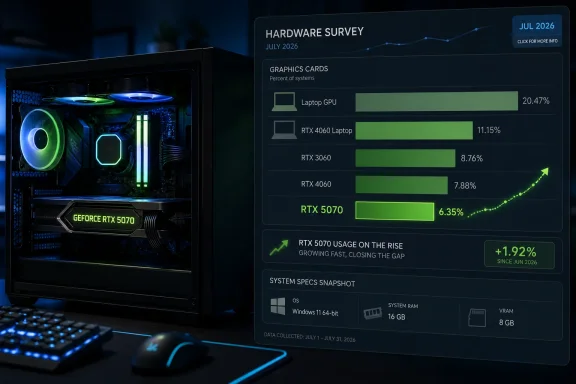 The RTX 5070 Has Reached the Top Tier Without Displacing the RTX 3060
The July ranking says more than “a new card is selling.” It shows the RTX 5070 has quickly entered the installed-base tier normally occupied by volume products that have had years to accumulate. The RTX 3060, which debuted in 2021, still leads with 3.88%, but its share has been declining for months before flattening in July. The RTX 4060, released in 2023, is effectively tied with the newer RTX 5070.
For NVIDIA, this is a stronger signal than a launch-week retail sellout. A Steam survey entry reflects systems that are installed, active, and running Steam during Valve’s collection period. It captures replacement purchases and new-PC builds that have made it into regular gaming use.
Tom’s Hardware independently highlighted the same July results, describing the RTX 3060 as Steam’s leading graphics card while noting the RTX 5070’s rapid climb. The broader survey also found that 16GB graphics configurations have, collectively, become more common than 8GB configurations among Steam users. That does not make every 8GB card unusable, but it does show where new hardware buying is moving.
The RTX 5070’s 3.62% figure is all the more notable because Valve lists a large and fragmented field of older desktop cards, laptop GPUs, integrated GPUs, and “Other” adapters in the same survey. A single discrete desktop model accounting for more than one in every 28 reported Steam systems is a substantial installed base.
The RTX 4060 Is the Immediate Target, but the Laptop Entry Changes the Headline
The ranking needs to be read carefully:
- The RTX 3060 leads all listed video cards at 3.88%.
- The RTX 4060 Laptop GPU is second overall at 3.64%.
- The desktop RTX 4060 is third overall and second among desktop cards at 3.63%.
- The desktop RTX 5070 is fourth overall and third among desktop cards at 3.62%.
That one-point gap between the RTX 4060 and RTX 5070 is statistically interesting but not a decisive changing of the guard. Valve reports rounded percentages to two decimal places. A movement of 0.01 percentage points can reverse with relatively modest changes in the surveyed mix, particularly when laptop systems, regional system counts, and opt-in sampling vary month to month.
There is a more durable takeaway in the three-month trend. The RTX 5070 recorded 3.09% in May, 3.29% in June, and 3.62% in July. The desktop RTX 4060 moved in the opposite direction over those same months, from 3.74% to 3.65% to 3.63%. Even if the rank does not flip in the August survey, the direction of travel is clear.
Valve’s survey also reports a DirectX 12-only view, where the RTX 5070 reaches 3.72%, compared with 3.76% for the RTX 4060. The ordering remains the same, but the smaller difference reinforces the practical point: these two cards are now nearly inseparable in Steam’s active DirectX 12 gaming base.
The RTX 5060 Is Growing, but It Is Not Defining This Generation
TweakTown’s larger observation is borne out by Valve’s numbers: the lower-priced RTX 5060 is gaining share, yet the RTX 5070 is gaining faster. The RTX 5060 rose from 2.81% in June to 3.03% in July, a respectable 0.22-point improvement. The RTX 5070’s 0.33-point increase was half again as large, and it now has a 0.59-point installed-base lead.
That is a break from the familiar “x60 becomes the default choice” pattern. The RTX 3060 and RTX 4060 occupy the top desktop positions precisely because NVIDIA’s mainstream tier has historically delivered the volume. This time, the x70 card is becoming the early mass-market winner.
Memory capacity is a credible part of the explanation, though it should not be presented as the only cause. NVIDIA specifies 12GB of GDDR7 memory for the RTX 5070 and 8GB of GDDR7 for the RTX 5060. That 50% capacity difference matters to buyers planning to keep a card through several major game releases, use higher-quality texture packs, play at 1440p, or enable ray tracing with upscaling.
It also creates a product-positioning problem for the RTX 5060. NVIDIA introduced the desktop card at a $299 starting price, placing it well below the RTX 5070, but buyers are not merely comparing present-day average frame rates. They are comparing how much room a card has left when a game’s texture allocation, ray-tracing data, frame-generation overhead, or background applications push toward the memory limit.
The July Steam data does not prove that 8GB is the reason the RTX 5060 trails the RTX 5070. Price, supply, prebuilt-PC configurations, retailer promotions, regional availability, and the different audiences served by each tier all affect adoption. But the numbers do show that NVIDIA’s 12GB RTX 5070 has found a much broader audience than a premium-priced x70 card normally would, while its 8GB mainstream sibling has not yet become the generation’s default desktop GPU.
AMD’s 16GB Cards Have Not Converted Steam Share Into a Challenge to NVIDIA
The same survey provides an uncomfortable scale comparison for AMD. Valve lists the Radeon RX 9070 XT at 1.40% in July, up 0.05 points from June. The Radeon RX 9060 XT stands at 0.76%, up 0.02 points. Those are real gains, and the RX 9070 XT’s lead over AMD’s lower model mirrors the preference for better-equipped cards seen in NVIDIA’s lineup.
But neither AMD entry is close to the RTX 5070’s 3.62% share. The RTX 5070 alone appears on more Steam systems than the two named RDNA 4 cards combined. That does not establish retail unit sales, because Steam is neither a shipment tracker nor a transparent, fixed sample of the whole PC market. It does establish that among active Steam systems, NVIDIA’s midrange-to-upper-midrange model has built a much faster presence.
The manufacturer percentages quoted from Steam’s overview also require restraint. NVIDIA’s 72.72% share, AMD’s 18.71%, and Intel’s 8.16% are survey shares across reported graphics adapters, including integrated graphics and laptop configurations. They are not discrete GPU market-share figures, and they should not be used to claim that NVIDIA owns 72.72% of add-in-board sales.
That distinction matters because the Steam data is strongest as a view of what active Steam players are using, not as an audit of shipments, revenue, or every PC gamer worldwide. Valve does not publish the survey’s sample size, weighting method, or a card-by-card split between retail upgrades and OEM systems. The trend is valuable; the survey cannot answer every commercial question that vendors and market-research firms answer.
What the July Survey Means for a Windows Gaming PC Purchase
For Windows gamers deciding between a 2026 midrange build and an upgrade, the RTX 5070’s rise should not be treated as a universal recommendation. Steam popularity is evidence of adoption, not proof of best value in a particular market or game library. Street prices, local availability, power supply requirements, display resolution, and whether a system already has a capable GPU still determine the sensible purchase.
It does, however, make the RTX 5070’s role in the current generation hard to dismiss. NVIDIA’s own specifications place it at 12GB of GDDR7, while the standard RTX 5060 remains an 8GB card. Steam’s latest survey shows the extra-memory, higher-tier option accumulating faster than the model that would normally carry the generation’s mainstream volume.
The next Steam survey will decide only a ranking footnote: whether the RTX 5070 overtakes the desktop RTX 4060’s 3.63% share. The larger change has already happened. In July 2026, the RTX 5070 became one of the few current-generation desktop GPUs to join Steam’s entrenched top tier less than a year and a half after launch.
