

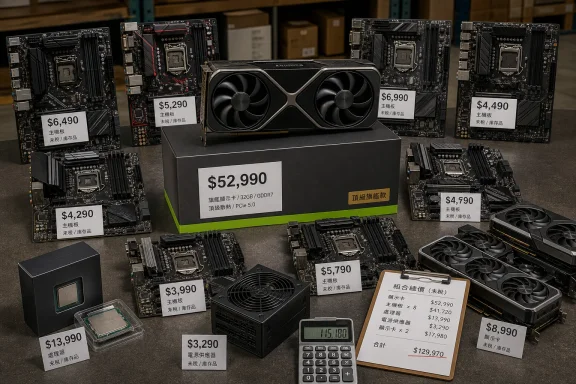
The listings were surfaced by Uniko’s Hardware on X and reported by Tom’s Hardware on August 8. They involve four very different products: an Asus ROG Astral RTX 5090, Gigabyte Aorus RTX 5090 Master, MSI RTX 5090 Gaming Trio OC, and Gigabyte Aorus RTX 5090 AI Box external GPU. That distinction is important. These are not standard RTX 5090 cards selling at a single, comparable price; they are premium board-partner cards and, in one case, a Thunderbolt-connected eGPU enclosure.
The bundles are certainly extraordinary. The Gigabyte Aorus RTX 5090 Master package carries two B860M Gaming X WiFi6E boards, one X870E Aorus Master, and five B850M Force WiFi6E boards — eight motherboards in total — plus a 1,000W power supply. The MSI package contains five motherboards and a Ryzen 9 9950X3D. Yet the evidence supports a more precise conclusion than “free parts”: these are forced bundles that shift the burden of moving unwanted or hard-to-place inventory onto the buyer.
The “free” components are financed by the bundle price
Using the NT$32.25-to-US$1 conversion in Tom’s Hardware, the Asus package is listed at roughly $7,721. Its cited U.S. comparison value is $5,145, made up of the ROG Astral RTX 5090 and four Radeon RX 9060 XT cards. The buyer therefore pays about 50% more than that comparison total.
The MSI bundle is listed at approximately $8,499, compared with Tom’s Hardware’s cited $7,003 value for the RTX 5090, three X870E Carbon WiFi boards, two B650M Gaming Plus WiFi boards, and the 9950X3D. That is a premium of about 21%. Gigabyte’s RTX 5090 AI Box package comes in about 28% higher than the report’s own $6,467 comparison total.
Only the Aorus RTX 5090 Master package comes remotely close to the cited parts total: about $7,482 against a listed comparison value of $7,220, a premium of roughly 3.6%. Even that is not evidence of a bargain, because the comparison relies on U.S. retail pricing rather than the Taiwanese prices that a PChome24h buyer would actually face. It does, however, make clear that the packages cannot honestly be described as universally free-hardware promotions.
There is a second arithmetic problem with treating the bundles as conventional deals. Uniko’s Hardware’s breakdown of the MSI offer assigns NT$42,606 to the three X870E Carbon boards, NT$8,580 to the two B650M boards, and NT$24,150 to the Ryzen 9 9950X3D. Subtracting those figures from the NT$274,090 package price leaves NT$198,754 — about $6,163 at the conversion rate used by Tom’s Hardware — assigned to the RTX 5090.
That does not establish the stand-alone Taiwanese price of the MSI Gaming Trio OC. It does establish that the bundle’s structure does not make the CPU and boards disappear from the bill. The buyer is paying thousands of dollars for a collection of components they may neither need nor be able to resell efficiently.
A crypto-era sales tactic, without proof of a GPU shortage
The comparison with the cryptocurrency-mining era has some merit. During acute GPU shortages, retailers in several markets commonly required buyers to take power supplies, motherboards, cases, or complete-system parts alongside a sought-after graphics card. The practical effect was the same: access to the high-demand item depended on buying additional merchandise.
But the available record does not prove that PChome24h or its marketplace sellers are short on RTX 5090 inventory, nor that they are using the bundles to clear a specific excess of motherboards. Tom’s Hardware interprets the packages as a way to move slow-selling inventory and free working capital. That is plausible retail logic, but neither PChome24h nor the sellers have published inventory levels, sell-through data, bundle duration, or a stated reason for the promotions.
The bundle contents do offer clues. A buyer can plausibly build around one X870E board and the 9950X3D. Five additional motherboards cannot be installed in a normal gaming PC, and eight boards in the Gigabyte deal are clearly intended to be treated as resale inventory, spares, or unwanted extras. The MSI offer also mixes premium X870E inventory with older B650M boards, while the Gigabyte sets mix Intel B860M and AMD X870E/B850M platforms. That assortment reads less like a coherent system configuration than a channel-clearance package.
It is also worth separating the RTX 5090 itself from the overall bundle. The Asus bundle adds four AMD Radeon cards; the Gigabyte AI Box bundle adds two RTX 5060 cards and three motherboards. A shopper who wants one high-end Nvidia GPU is being asked to assume the resale risk of unrelated graphics cards and platform hardware. The retailer receives one large transaction; the buyer inherits the work of becoming a small-time parts dealer.
The broader PC market gives retailers a reason to protect margins
The bundle story lands as multiple research firms describe a difficult 2026 PC market, especially at lower price points. Gartner forecast in February that global PC shipments would decline 10.4% during 2026, attributing the contraction to rising DRAM and SSD costs. Gartner also projected a 17% rise in PC prices versus 2025 and said the sub-$500 PC segment could disappear by 2028 if the cost pressure persists.
IDC’s June outlook was more severe on near-term shipment volume, forecasting an 11.3% global decline for 2026 and no meaningful relief from memory shortages before the end of 2027. IDC said manufacturers would struggle to sustain full product portfolios as component costs rise.
Omdia’s U.S. data gives the prediction a more immediate consumer-facing shape. The firm reported that U.S. PC shipments fell 7% year over year in the first quarter of 2026, while shipments of sub-$500 PCs fell 18.7%. Omdia expects U.S. PC shipments to decline 14.4% for the year, and its global forecast says systems priced below $500 will be hit hardest.
Those reports support the premise that component inflation is reshaping what retailers and PC vendors can profitably sell. They do not, on their own, prove that any one RTX 5090 package exists because motherboard demand has collapsed. What they do explain is why a retailer may prefer a high-ticket bundle over a direct price cut: a bundle can preserve the advertised price of a halo GPU while attaching inventory that would otherwise need a visible markdown.
For manufacturers, this is less damaging than lowering the sticker price of an RTX 5090-class product. For retailers, it turns a potentially weak-margin individual sale into a larger order. For buyers, it obscures the real cost of the card behind a pile of components with uncertain local resale value.
The eight-motherboard package is a warning, not a market price
Windows enthusiasts and IT buyers should not read these PChome24h listings as a new RTX 5090 price floor, a global Nvidia policy, or proof that Taiwan offers a better path to a flagship GPU. The offers are local, model-specific, and built around inventory the purchaser must absorb. Taxes, warranty coverage, import costs, and regional return policies make direct comparisons with U.S. Amazon or Newegg pricing even less useful.
The practical test is simple: price the exact GPU separately in the buyer’s own market, then assign conservative local resale values to every compulsory item — not optimistic list prices. Include platform fragmentation, selling fees, shipping costs, warranty transfer rules, and the time required to move five or eight motherboards. If the resulting effective RTX 5090 price is not compelling, the bundle is inventory financing disguised as a giveaway.
The PChome24h offers may be memorable because of the absurd hardware counts, but their real significance is more mundane. In a market where memory costs are pushing up system prices and entry-level demand is deteriorating, retailers have another way to avoid an obvious markdown: make the customer buy the stock that did not sell first.