
Samsung announced the P9 and its lower-tier P7 companion at Gamescom on August 26. Notebookcheck highlighted the P9 as the first 8 TB portable USB4 SSD rated for 4,000 MB/s, while Samsung’s U.S. Newsroom lists MSRPs reaching $2,699.99 for the 8 TB P9. DPReview and SamMobile separately reported the launch and Samsung’s August 31 availability target.
The P9 is a meaningful upgrade over Samsung’s 20 Gbps Portable SSD T9, which is rated for up to 2,000 MB/s reads and writes. But it is not a blanket “USB-C is now twice as fast” upgrade. Its value hinges on the port, cable, and workload at the other end.
 The 8 TB headline is an eventual configuration, not a launch-day guarantee
Samsung’s U.S. announcement says the P Series will begin a global rollout on August 31 in 1 TB, 2 TB, 4 TB, and 8 TB capacities, then adds a qualification: capacities can vary by market and some will arrive later. That is vague enough to leave buyers assuming every listed configuration will be on shelves next week.
A Samsung Newsroom release for Switzerland is clearer. It says the 1 TB and 2 TB P9 models begin arriving on August 31, while the 4 TB and 8 TB P9 versions will follow during the coming months of 2026. That regional difference is more than a translation wrinkle. It means the product’s defining combination — 8 TB, USB4, and a 4,000 MB/s rating — may be unavailable at the very start of the stated launch window.
Samsung has published U.S. suggested prices for all four capacities:
- The P9 is priced at $339.99 for 1 TB, $649.99 for 2 TB, $1,349.99 for 4 TB, and $2,699.99 for 8 TB.
- The P7 is priced at $289.99 for 1 TB, $549.99 for 2 TB, $1,149.99 for 4 TB, and $2,289.99 for 8 TB.
Those prices place the 8 TB P9 at roughly $337 per terabyte before tax. The P7 undercuts it by $410 at 8 TB, but Samsung’s U.S. launch material does not give the P7 an equivalent sequential-read or write specification. The P7 is being sold primarily on USB4 connectivity, broad device compatibility, and its 2-meter, or 6.6-foot, drop-resistance claim.
For buyers who need 8 TB immediately, the practical advice is to treat Samsung’s August 31 date as the beginning of a staged release, not a firm U.S. retail date for the highest capacities. Check the actual model number, capacity, and delivery estimate rather than assuming a product page carrying the full family’s MSRP means stock exists.
USB4 determines whether the P9 is a 4 GB/s drive or an expensive T9 replacement
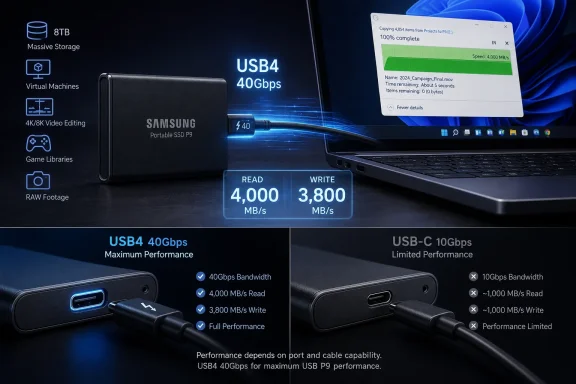
Samsung specifies USB4 Gen 3×2 at 40 Gbps for the P9. That link rate is the foundation for its claimed 4,000 MB/s reads: 4,000 MB/s is about 32 Gbps before protocol overhead, so the claim fits within a 40 Gbps USB4 connection but leaves little room for a weaker host setup.
Microsoft’s Windows USB4 documentation makes clear that a USB4 link can negotiate at 10 Gbps, 20 Gbps, or 40 Gbps and that Windows manages shared bandwidth for USB, PCIe, and DisplayPort traffic. On a 40 Gbps link, the operating system’s connection-management policy allows up to 90 percent of the link to be explicitly allocated. In other words, the connector alone is not the specification that matters; the host’s actual USB4 capability and whether the port is also feeding a display affect the usable bandwidth.
A P9 connected to a Windows laptop with a 40 Gbps USB4 port or a suitable Thunderbolt 4 implementation should have the hardware path needed to approach Samsung’s advertised ceiling. A system limited to USB 3.2 Gen 2×2 will top out around the T9’s 2,000 MB/s class. On the far more common 10 Gbps USB 3.2 Gen 2 ports, real transfers will land closer to the 1,000 MB/s class under ideal conditions.
That is the purchase test Windows users should perform before spending P9 money. Inspect the laptop or motherboard specification for “USB4 40Gbps,” not merely “USB-C,” “USB 3.2,” or a Thunderbolt-shaped port. In Windows 11, a machine with a USB4 host router will expose USB4 hardware in Device Manager under Universal Serial Bus controllers, although the PC maker’s published port specification remains the better way to establish its maximum link rate.
Cable choice also matters. The P9’s 40 Gbps mode needs a cable rated for that connection; an older passive USB-C cable may charge a laptop and connect the SSD while silently forcing a much slower data link. Samsung has yet to publish the complete retail package contents, so prospective buyers should confirm whether the included cable is specified for 40 Gbps rather than assume every USB-C cable is interchangeable.
“First” describes the 8 TB pairing, not the 4,000 MB/s speed tier
Samsung’s world’s first claim is narrow: it says the P9 is the first 8 TB USB4 portable SSD supporting speeds up to 4,000 MB/s. It is not the first portable SSD of any capacity to advertise 4,000 MB/s USB4 throughput.
Corsair’s EX400U, for example, is already sold as a USB4 portable SSD rated for up to 4,000 MB/s reads and 3,500 MB/s writes, though its retail capacities stop below 8 TB. MSI’s DATAMAG 40Gbps is also advertised at up to 4,000 MB/s through USB4. Samsung’s contribution is packing that speed rating into the uncommon 8 TB portable class, rather than inventing a new external-storage performance tier.
That capacity matters for several real Windows workflows. A single 8 TB external SSD can hold multiple local virtual-machine images, a substantial Premiere Pro or DaVinci Resolve project archive, a large Windows workstation backup set, or a portable game library without the random-access penalties of a hard drive. It also means the P9’s price is aimed at people paying for dense, fast, bus-powered storage — not at a typical PC gamer who just wants more room for installed titles.
The alternative is still worth considering. Samsung’s own 8 TB 9100 PRO internal SSD has offered far higher PCIe 5.0 performance, but installing it requires a compatible M.2 slot and is not a portable capture or transfer device. The P9’s price includes a compact enclosure, USB4 controller, portability, hardware encryption, and a five-year limited warranty. It does not change the basic tradeoff: an external drive gains flexibility while giving up much of the speed available to an internal NVMe SSD.
Samsung’s 12K recording claim needs a camera compatibility list
Samsung says the P9’s sustained write performance supports direct 12K recording, allowing creators to capture, store, and edit large RAW files and ultra-high-resolution video. The statement is plausible as a performance target, but it is not the same thing as universal camera compatibility.
Direct-to-SSD recording depends on the camera’s USB implementation, its approved media list, the codec and bitrate, the filesystem, cable stability, power behavior, and write performance after the SSD’s fast cache has been exhausted. Samsung has not yet identified a camera vendor, model, codec, bit rate, or test duration behind the P9’s 12K claim in its U.S. announcement. It also has not published a sustained-write graph, endurance rating, or thermal-throttling behavior for the drive.
Those missing details are particularly relevant for a portable SSD priced at up to $2,699.99. Sequential benchmarks normally describe a best-case, queue-friendly transfer test. A continuous camera feed in warm conditions is a different workload. Until retail drives reach reviewers, the 4,000 MB/s and 3,800 MB/s figures should be read as Samsung’s peak sequential ratings, not independently measured results.
For Windows editors, the more immediate benefit may be ingestion rather than recording. Copying a full 1 TB card dump at even 3,000 MB/s is dramatically faster than using a 10 Gbps portable SSD, provided the source reader, PC port, destination drive, and cable do not become the bottleneck. Most real production rigs include at least one of those constraints.
Samsung has created a compelling high-capacity USB4 option with the P9, but its launch message is ahead of its practical documentation. The 1 TB and 2 TB models may arrive first on August 31; the 4 TB and 8 TB models that make the P9 distinctive appear set for a later 2026 release in at least some markets. Until Samsung publishes availability by region, bundled-cable specifications, and tested camera compatibility, the sensible move is to verify the Windows PC’s port and the exact capacity’s delivery date before treating the P9 as a ready-to-buy 8 TB upgrade.
