
The immediate protest is a single-outlet report from BusinessKorea, and no other news organization had independently reported the August 20 demonstration at publication time. But the dispute it represents is neither new nor symbolic: the Yongin project is a concrete 7.77 million-square-meter national industrial complex, approved by South Korea’s land ministry in December 2024, with Samsung planning up to 360 trillion won in private investment through 2052.
For PC buyers, enterprise hardware planners and anyone watching the global chip supply chain, Yongin is more than another industrial-park fight. It is part of Samsung’s attempt to add massive domestic capacity for advanced system semiconductors, including foundry production that competes with TSMC and underpins processors, accelerators, storage controllers and other hardware used throughout the Windows PC and data-center market. The protest will not halt construction by itself, but it highlights the infrastructure constraint that can determine whether a chip-fab schedule survives contact with reality.
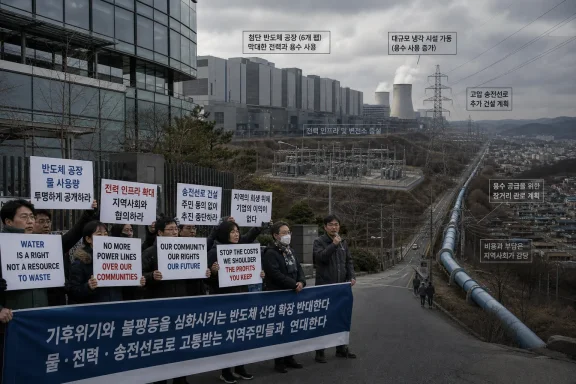 The protest targets a government-approved industrial complex
The language used at the Samsung headquarters protest can obscure who controls the central approval at issue. Samsung is the project’s anchor investor and intended fab operator, but the Yongin Advanced System Semiconductor Cluster National Industrial Complex is a government-designated national industrial project whose industrial-complex plan was approved by the Ministry of Land, Infrastructure and Transport.
That distinction has already shaped the legal challenge. Yonhap reported in January that the Seoul Administrative Court dismissed a case brought by environmental group Solutions for Our Climate, local residents and other plaintiffs seeking to invalidate or revoke the government’s project approval. The plaintiffs argued that the project’s greenhouse-gas calculations and mitigation plan were deficient under South Korea’s climate law.
The court did not find the climate review immaculate. Reporting by Yonhap, Seoul Economic Daily and ChosunBiz indicated that the court acknowledged procedural shortcomings, but concluded they were not serious enough to make the approval unlawful or justify cancellation. In plain terms, the first-instance ruling did not give the government a clean environmental bill of health; it found that the documented deficiencies did not meet the high legal threshold required to undo an approval already granted.
BusinessKorea says the plaintiffs are appealing, and that organizers delivered signatures from 10,000 opponents to the Seoul High Court before the protest. That appeal, rather than the demonstration outside Samsung’s headquarters, is the mechanism that could directly challenge the project approval. No public decision on that appeal was identified in the reporting reviewed for this article.
Six fabs bring a power-and-water problem with them
Yongin City and the South Korean government describe the project in unusually expansive terms: six large-scale semiconductor fabs, three power plants, more than 60 materials, components and equipment suppliers, and a projected 360 trillion won in private investment. Official project materials place site preparation and industrial-land construction on a 2023–2031 schedule, while Samsung’s fab investment extends well beyond that period.
Those numbers explain why critics have focused on water and electricity rather than treating the complex as a conventional factory development. Semiconductor fabrication plants require a stable supply of highly purified water, intensive electricity use and robust transmission infrastructure. The lines, substations, water facilities and related land use required to support a cluster of this scale can reach beyond the parcel where Samsung’s fabs will be built.
The activists’ central allegation is therefore broader than emissions from a single facility. According to BusinessKorea, they argue that communities may bear the burden of transmission towers, resource allocation and disrupted livelihoods while Samsung captures the commercial upside from the fabs. The report also described activists who had walked from Haenam in South Jeolla Province along transmission-line routes to bring attention to those concerns.
Government planning documents make clear that the infrastructure question is real, even if officials frame it as an implementation challenge rather than a reason to reconsider the complex. In 2024, South Korea’s industry, environment and land ministries joined Samsung, SK hynix, Korea Electric Power Corp., Korea Water Resources Corp., Korea Land and Housing Corp. and local governments in an agreement intended to accelerate the power and water infrastructure necessary for the wider semiconductor cluster strategy.
The practical conflict is over where the system-level costs land. A six-fab campus cannot operate on Samsung’s capital expenditure alone; it depends on public permitting, grid buildout, water planning, transportation links and local acceptance. A court ruling that preserves the industrial-complex approval does not resolve those implementation pressures.
Samsung’s investment case is tied to the wider chip race
The national complex is a Samsung-led project, but it sits inside a much larger South Korean semiconductor push spanning Yongin, Hwaseong, Pyeongtaek and other locations. The government’s stated objective has been to turn the region into a large-scale semiconductor manufacturing base capable of supporting domestic companies against rivals in Taiwan, the United States, China and Japan.
Samsung increased its cited Yongin investment plan from 300 trillion won to 360 trillion won when the number of planned fabs rose from five to six. Yongin City has presented the additional fab capacity as part of Samsung’s strategy to sustain competitiveness in system semiconductors, where the company has sought to grow its foundry business alongside its dominant memory operations.
For Windows users, this is several steps upstream from a laptop purchase, but the link is direct. A shortage, delay or capacity mismatch in advanced manufacturing affects the availability and pricing of components that PC makers and server vendors need: application processors, graphics and AI accelerators, solid-state-storage controllers, networking silicon and memory. Conversely, additional Samsung capacity only helps the broader market if the fabs are completed on schedule, brought up with viable process technology and filled with customers.
The protest movement does not establish that Yongin will be canceled, delayed or starved of resources. Nor has Samsung announced a change to its investment plan in response to the August 20 action. But the conflict adds another pressure point to a project already dependent on a long sequence of land preparation, infrastructure construction, environmental compliance and court outcomes.
The first court ruling narrowed — but did not end — the dispute
The most consequential fact often lost in coverage of a protest is that construction has not been paused by a judicial order. The Seoul Administrative Court’s January ruling left the state approval intact, and official project pages continue to list the complex as a live development with six fabs planned.
Environmental groups have nonetheless retained a route to challenge the approval on appeal. Their case centers on the adequacy of climate-impact review, while the protest broadens the public argument to transmission infrastructure, water use and local livelihoods. Those are related issues, but they are not interchangeable: an appellate court will assess the legality of the approval record, not decide the general political question of whether South Korea should expand domestic semiconductor manufacturing.
That makes the appeal record worth watching more closely than the protest’s headcount. If a higher court identifies a flaw requiring a new assessment, supplementary review or other corrective action, that could introduce timing risk into a project whose value depends on long-term construction sequencing. If the appeal fails, opponents will have fewer legal options to challenge the approval itself, though disputes over individual transmission, water and construction decisions could continue.
For now, Samsung’s Yongin complex remains an approved national project with a first-instance court victory behind it — and with the environmental, water and grid questions moved from the abstract into a public fight over who pays for the infrastructure that advanced chip production requires.