
Startup Fortune framed the situation as an AI-chip supply problem across Semtech’s networking portfolio. Semtech’s own first-quarter conference call gives a more precise account. CEO Hong Hou said demand for the gallium-nitride chips from the company’s recently acquired HieFo business — formerly Afore — “will probably outpace” available capacity by about three times after Semtech combined its existing customers with new inbound interest it could not previously serve.
That is still a consequential bottleneck. But it changes how IT buyers and infrastructure watchers should read the claim. Semtech is not saying that it has only one-third of the capacity required for every 800G or 1.6T product it sells into AI clusters. It is describing a supply-constrained part of its optical-components operation, one linked particularly to coherent optical networking and tunable-laser applications.
The earnings release after the U.S. market closes will show whether that constraint remains a future opportunity, or has started to impose a practical ceiling on shipments.
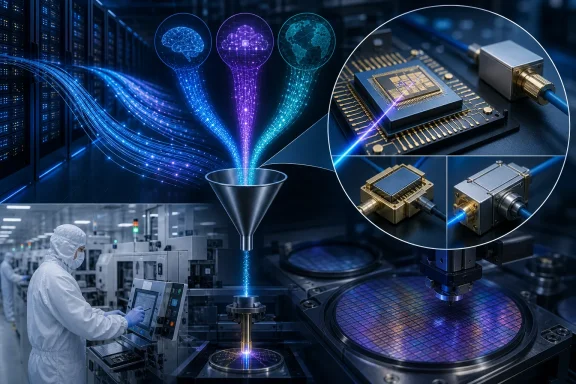 The shortage is in GaN laser components, not every Semtech chip
Semtech’s data-center portfolio is broader than the GaN chips at the center of the three-times-demand claim. It sells transimpedance amplifiers, laser drivers, linear optical components, active-copper-cable signal-conditioning ICs, and other signal integrity products used to move data between switches, optical modules, and servers.
In its first-quarter results filed with the Securities and Exchange Commission, Semtech reported record data-center sales of $71.6 million, up 14% from the previous quarter and 39% from a year earlier. Management attributed much of that result to 800G FiberEdge products and said it was seeing expanding demand for linear pluggable optics, or LPO, from hyperscale operators in the United States and China.
The GaN shortage emerged in a separate discussion of HieFo, the indium-phosphide photonics and GaN business Semtech acquired in March. Hou said Semtech’s GaN chips are used in tunable lasers for coherent modulation applications in metro networking and data-center interconnects. These are not commodity add-ons: coherent optics are used where links must carry large amounts of data over longer distances with high signal fidelity, including the connections between data-center sites.
For a Windows administrator or enterprise infrastructure team, the practical implication is indirect but real. GPU clusters do not deliver useful scale merely because servers arrive on time. They need a network fabric capable of moving training data, model parameters, and storage traffic without becoming the limiting factor. A shortage in optical components can delay the networking layer even when compute hardware and rack space are available.
Still, the company has not publicly quantified how much of its current data-center revenue comes from the constrained GaN line, nor how much of its second-quarter forecast assumes incremental output from that business. Those omissions make it impossible to turn “three times supply” into a forecast for revenue deferred or lost.
Semtech’s guidance rests on 800G today and 1.6T ramps next
What Semtech has formally forecast is a sharp near-term increase in data-center sales. The company guided fiscal second-quarter revenue to $328 million, plus or minus $5 million, representing 13% sequential growth at the midpoint. It also forecast adjusted gross margin of 54% and adjusted diluted earnings per share of $0.61, plus or minus $0.02.
More important than the companywide figure, management projected that data-center revenue would rise about 35% sequentially in the July-ended quarter, or roughly 85% from the same period a year earlier. Semtech said the growth should be supported by accelerating shipments of 800G and 1.6T components.
The sequencing matters. Semtech’s first-quarter data-center result was anchored in 800G products, which are already deployed at scale. The company said early CopperEdge 1.6T shipments had begun to cable partners for deployment at a U.S. hyperscaler, while broader FiberEdge and CopperEdge 1.6T revenue was expected to build in the second half of the fiscal year.
Those are promising milestones, but they are different from a declared, broad hyperscaler rollout. Semtech has not named the U.S. customer, disclosed its purchase commitments, or said how much 1.6T revenue entered the first quarter. The company has also not said whether the customer is buying for production deployment, qualification, or a limited initial build.
That makes tonight’s commentary on backlog, shipment volume, and customer qualification more useful than a small earnings-per-share beat or miss. The company needs to demonstrate that 1.6T is becoming a repeatable revenue stream rather than a collection of design wins that will take several quarters to become material.
Capacity expansion has to catch demand without damaging margins
Semtech’s stated remedy for the GaN shortfall is aggressive. Hou said the company is adding shifts, clean-room space, and process equipment, with a goal of increasing capacity by roughly three to four times by the end of calendar 2026 and another three to four times by the end of 2027.
That is a substantial operational undertaking for a company that relies on external foundry, outsourced semiconductor assembly and test partners, and specialized manufacturing. In the broader semiconductor operation, Hou also said Semtech was arranging more capacity with foundry, OSAT, and testing partners.
The near-term financial tension is visible in Semtech’s own guidance. Management expects total semiconductor-products gross margin to rise to 62.1% in the second quarter from 60.7% in the first. It also expects overall adjusted gross margin to increase by a full percentage point, even while it raises research-and-development spending to accelerate data-center programs.
In other words, Semtech is telling investors it can increase supply and invest in new products without diluting the profitability that has made the AI-networking story compelling. That is possible if higher-margin 800G and 1.6T content scales quickly enough. It is not guaranteed: adding capacity for specialty photonics and laser components can bring higher manufacturing costs before new output reaches efficient volume.
The company’s first-quarter results offer one reason to watch this closely. Signal Integrity gross margin fell to 62.7% from 67.4% in the prior quarter, which Semtech attributed in part to operating its newly acquired indium-phosphide facility for the first full quarter. That does not establish a broader margin problem, but it shows the acquisition and ramp are already affecting the segment’s economics.
Selling the cellular-module business narrows the company’s exposure
Semtech is also removing a sizable piece of the Sierra Wireless-era portfolio. On August 13, it announced a definitive agreement to sell its cellular-module business to Taiwan’s Compal Electronics for $62 million in cash, subject to customary adjustments and regulatory approvals.
Compal will acquire substantially all assets and operations of the unit, including intellectual property, customer relationships, and personnel. Semtech expects the deal to close during its fiscal fourth quarter of 2027.
The company says the sale will concentrate capital and management attention on data-center networking and LoRa connectivity. That is a clear strategic choice, but it also raises the consequence of an execution failure in optical interconnects. A more focused Semtech will have fewer unrelated businesses to offset a delay in 1.6T adoption, a customer qualification slip, or a shortage in the newly acquired GaN operation.
The divestiture should not be read as Semtech selling Sierra Wireless back at a fraction of its 2023 purchase price. The original Sierra Wireless acquisition covered more than the module business, including connectivity services and other IoT assets. But the sale confirms that Semtech is willing to unwind part of that earlier expansion to prioritize businesses tied to higher-bandwidth data centers and LoRa.
What to listen for after the close
The central test is straightforward: does Semtech’s reported revenue support its existing 35% sequential data-center growth forecast, and does management provide evidence that capacity is increasing in time for demand rather than merely following it?
Three details will decide whether the three-times-demand line deserves attention beyond a headline:
- Semtech should distinguish progress in the constrained GaN and coherent-optics operation from demand in its larger 800G and emerging 1.6T product families.
- Management should say whether 1.6T deployments have moved beyond early shipments and qualifications into recurring production orders from more than one customer or module maker.
- Investors should look for a capacity timeline tied to output, yields, and margin impact, rather than only a long-range promise to add clean-room space and equipment.
Semtech has already shown that data-center networking can materially move its results: $71.6 million in first-quarter data-center revenue was nearly one quarter of total company sales. Tuesday’s report must establish whether its next growth phase is constrained by an addressable market that is expanding faster than supply, or by the company’s ability to manufacture the specialized components customers are asking for.
