
Notebookcheck reported the DH810S as a new variant of Shuttle’s Arrow Lake-S mini PC, and Shuttle’s own specification sheet confirms the key change: the newer model carries HDMI 2.1 and two full-size DisplayPort 1.4a outputs, while losing the DH810’s USB4 Type-C port, 2.5GbE controller and second serial interface. It is a purposeful cut-down design, not a performance upgrade.
For Windows administrators deploying signage, point-of-sale terminals, control-room displays or compact office systems, that distinction is more important than the “desktop-class CPU” headline. The DH810S retains the processor socket, memory ceiling, storage layout and 24/7 operating rating of the more fully connected DH810, but it removes several features that make the original better suited to network-heavy and legacy-device installations.
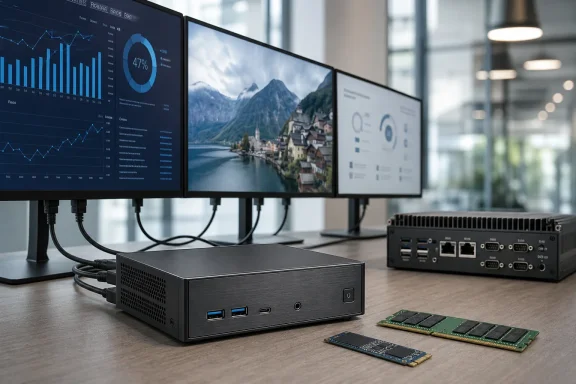 The DH810S changes ports, not compute capacity
Both Shuttle systems use Intel’s H810 chipset and an LGA1851 socket for Intel Core Ultra 5, 7 and 9 processors from the Core Ultra 200 desktop family, known as Arrow Lake-S. Shuttle specifies a maximum 65 W base TDP and support for processors with integrated graphics; Core Ultra F-series chips, which lack an iGPU, are therefore not appropriate choices for this barebone.
The processor limit deserves attention. “Supports Core Ultra 200” does not mean every desktop SKU can be installed and allowed to run without constraints. Shuttle says the DH810S does not support the unlocked K-series function, and its compact chassis uses a heatpipe cooler with two 70 mm fans. That setup may be ample for the vendor’s supported 65 W configuration, but it is not a license to treat the system as a miniature workstation motherboard for sustained high-power tuning.
Memory is also unchanged: two SO-DIMM slots accept up to 48 GB each, for a 96 GB maximum. The modules must be standard unbuffered, non-ECC DDR5-5600 SO-DIMMs. That makes the system unusually memory-capable for its volume, although it does not make it an ECC-equipped edge server. Administrators considering it for reliability-sensitive deployments should not mistake high capacity for workstation-class memory protection.
Shuttle’s documentation lists one M.2 2280 slot that supports PCIe 4.0 x4 NVMe or SATA drives, one M.2 2230 slot intended for wireless expansion, and a 2.5-inch SATA bay. The M.2 storage slot is PCIe Gen 4, not Gen 5. RAID 0 and RAID 1 are supported when the system is populated with both a 2.5-inch SATA drive and an M.2 SSD, but the hardware remains a compact barebone with limited internal expansion rather than a replacement for a multi-bay appliance.
The original DH810 remains the better industrial connectivity model
The DH810S’s connector list looks generous in isolation: two USB 3.2 Gen 2 ports, including one Type-C connection; two USB 3.2 Gen 1 Type-A ports; four USB 2.0 ports; one Gigabit Ethernet jack; and one RS-232 port. There are also separate microphone and line-out jacks, a remote-power-button connector, a VESA mount, and an “always on” jumper for unattended operation after a power interruption.
But the comparison with Shuttle’s existing DH810 changes the buying decision. The older model has dual Ethernet—one 2.5GbE and one 1GbE—two RS-232 serial ports, and USB4 Type-C with DisplayPort support. The DH810S has a single 1GbE port and one RS-232 connection, and its Type-C port is USB 3.2 Gen 2 rather than USB4.
That reduction has practical consequences:
- A DH810S cannot provide the separate operational and management networks that the dual-LAN DH810 can accommodate without an external adapter or switch arrangement.
- It gives up 2.5GbE for workloads such as moving large media assets, local backups, camera feeds or fast NAS-based deployments.
- It loses the USB4 connection that could have supported faster external storage and a more flexible dock or display path.
- It retains only one native serial port, which can be a hard limit in industrial installations built around multiple legacy peripherals.
The upside is clearer triple-display connectivity. Shuttle specifies HDMI 2.1 at up to 8K at 60 Hz plus two DisplayPort 1.4a outputs at up to 4K at 60 Hz, all driven through the selected Core Ultra processor’s integrated graphics. The original DH810 also supports three displays, but one of its display paths runs through the USB4-capable Type-C port. The DH810S replaces that more flexible connector with a second dedicated DisplayPort.
For a signage rollout where three fixed displays are the priority and high-speed I/O is not, the new layout may be easier to deploy. For a mixed-use industrial system that relies on docking, dual networks, fast external NVMe storage or several serial devices, it is a downgrade by design.
Windows 11 support is present, but the system ships empty
Shuttle lists the DH810S as compatible with 64-bit Windows 11 and Linux, but the barebone does not include an operating system, memory, storage or processor. That is normal for Shuttle’s XPC line, yet it is a material procurement issue: the published specifications are describing a platform, not a ready-to-run Windows PC.
IT buyers will need to source a compatible Intel CPU, two SO-DIMMs if dual-channel memory performance is desired, storage and—where required—an M.2 2230 Wi-Fi module. The unit includes an external 120 W power adapter and supports 12 V or 19 V DC input, which may be useful for cabinet, vehicle-adjacent or specialized power installations. It also has firmware TPM 2.0 support and UEFI boot capability, features that fit standard Windows 11 deployment requirements, although Shuttle has not presented the DH810S as a Microsoft Copilot+ PC.
The onboard NPU should also be read carefully. Shuttle’s product documentation describes an NPU delivering 13 TOPS of AI performance. That can accelerate compatible local inference workloads, but it falls well below the 40 TOPS NPU threshold Microsoft established for Copilot+ PC experiences. The DH810S is better understood as a compact PC that can run ordinary Windows 11 workloads and selected AI-enabled applications locally, rather than as a device purchased for the newest Windows AI branding.
“New” appears to mean a newly surfaced model, not a fresh platform launch
Notebookcheck’s August 15 report describes the DH810S as a newly introduced variant, but Shuttle’s own public support records show an initial DH810S BIOS release dated December 10, 2025, posted on December 19, 2025. Shuttle Europe’s current DH810S data sheet is dated June 30, 2026.
The timing does not disprove the model’s availability in a new region or channel, but it does show that the DH810S hardware was documented well before this month’s coverage. Shuttle has not published a prominent launch announcement that explains the regional rollout, a recommended price, or whether the variant is available through North American distribution. As with the earlier DH810, pricing appears likely to be handled through resellers or quotation-based commercial channels rather than a fixed consumer storefront price.
That missing information matters. A barebone aimed at professional deployments is not useful to a purchasing team merely because a specification page exists; buyers need confirmation of channel availability, warranty terms, lead times and the supported processor list in their market. Shuttle’s public materials establish the hardware configuration, but they do not yet answer those procurement questions.
A narrow fit for fixed-display deployments
The DH810S is a compact platform for organizations that need desktop Core Ultra performance, substantial memory and three directly attached displays without the physical footprint of a conventional small-form-factor PC. Its 190 × 165 × 43 mm metal chassis is rated for continuous operation at ambient temperatures up to 50°C, and Shuttle explicitly positions it for digital signage, POS and POI systems, healthcare, office and industrial uses.
The stronger conclusion is that the DH810S should be selected for its display layout and small enclosure, not because it supersedes the DH810. The original model remains the more capable choice wherever dual Ethernet, USB4, 2.5GbE or a second RS-232 port is part of the deployment requirement. The DH810S preserves the CPU and memory headroom while making those trade-offs explicit—and buyers should treat the missing I/O as a design constraint, not an incidental specification change.
