

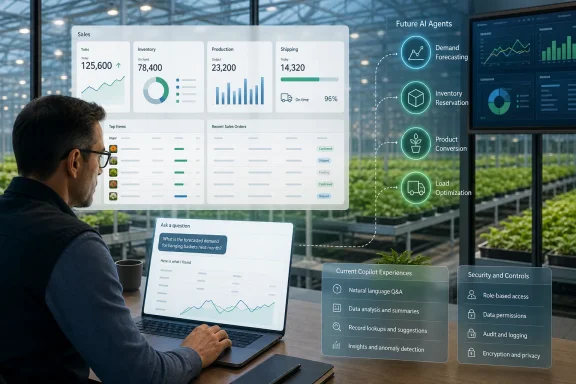
What the sponsored article does not establish is that the named SilverLeaf AI agents are products a greenhouse operator can buy or deploy today. Velosio describes its Demand Forecasting, Inventory Reservation, Product Conversion, and Load Optimization agents as “future” capabilities, without a release date, pricing, supported regions, licensing requirements, technical architecture, or customer deployment evidence. That distinction changes the story from a product launch to a roadmap pitch built around capabilities Microsoft is making available in the underlying ERP.
For Windows admins and Dynamics partners, the immediate takeaway is straightforward: Business Central Copilot can improve access to data that is already in SilverLeaf, but it does not turn a poorly governed greenhouse operation into an autonomous one. The quality of the answer still depends on the quality, freshness, and access controls of the sales, inventory, production, and fulfillment records behind it.
SilverLeaf’s Existing Foundation Is Business Central, Not a New AI System
Velosio’s own greenhouse product material identifies SilverLeaf for Horticulture as a cloud solution built on Microsoft Dynamics 365 Business Central. Its existing scope covers financials, inventory, sales, production, warehouse work, shipping, and reporting, with greenhouse-specific functions such as grow cycles, expected versus actual cost, demand planning, inventory availability based on grow time, and load management.
That is important because the questions in the Greenhouse Grower post—such as which varieties are selling best, which orders are at risk, or which products are overstocked—are not necessarily requests for a new, specialized AI model. They are largely questions that depend on whether an ERP has complete, normalized, current records and whether a user can reach them quickly.
Microsoft’s Business Central documentation says Chat with Copilot can locate records, filter them, sort them, and produce analysis tabs for grouped data and simple calculations such as totals or averages. A manager can ask for items grouped by category, locate sales orders, or find records matching business constraints without constructing the equivalent filters by hand.
That capability fits SilverLeaf’s existing data model well. If its implementation captures locations, varieties, production tasks, available inventory, customer agreements, shipping commitments, and costs consistently, a conversational interface can remove a substantial amount of report-navigation friction. A greenhouse manager should not need to remember which role center, list page, saved view, or Excel export contains the starting point for an inventory exception.
But the AI is operating on the same operational record. It does not independently verify whether a production task was completed but never posted, whether a grower’s inventory is sellable, whether substitutions respect customer requirements, or whether an optimistic ship date reflects a real truck and driver assignment.
Microsoft’s Current Copilot Can Answer and Analyze, With Limits
Microsoft has expanded Copilot inside Business Central beyond text generation. Its documented features include record summaries, analysis assistance, natural-language chat, invoice-related automation, reconciliation assistance, item substitutions, and agents for specific processes such as accounts payable. Microsoft also says Copilot is included with a Business Central license at no additional cost, though the company reserves the possibility of future quotas or pricing changes.
The most relevant feature to Velosio’s article is Chat with Copilot, which Microsoft labels a production-ready preview. It can answer questions about company data and guide users through Business Central tasks. For data requests, Microsoft says the feature turns natural-language prompts into searches, filters, sorts, and—where appropriate—analysis tabs against tables in the company database.
That is a more constrained mechanism than the sponsor post’s broad language about “instant answers” may suggest. Microsoft’s own responsible-AI documentation says the chat feature does not take action, create records, or change configuration when it is answering those questions. It retrieves and summarizes the records available through Business Central’s native search under the user’s own identity.
In practice, that means a sales manager with access to margin data may be able to ask for top customers by margin, while a production employee may not. That is the desired security model, but it creates an implementation issue that promotional material tends to glide over: “broader access” cannot mean broader access to every field, customer agreement, cost center, or employee-related record.
Microsoft also warns that AI-generated output can be incorrect. That caveat matters especially for operational prompts that compress several business rules into a short question. “What orders are at risk of shipping late?” requires more than a sales-order date: it may depend on inventory allocation, quality holds, production completion, crop timing, staging capacity, carrier schedules, and customer-specific delivery constraints. Unless those rules are encoded in the source system and the prompt is tied to reliable fields, the output may be a useful triage list rather than a decision-ready answer.
The Named SilverLeaf Agents Remain a Roadmap
Velosio’s sponsored article shifts from present-tense reporting and analysis to a prospective set of AI agents. The proposed functions are sensible for a greenhouse ERP:
- A demand-forecasting agent could surface patterns in historical orders and help planners compare expected demand with available or planned production.
- An inventory-reservation agent could assist in allocating constrained stock to priority orders.
- A product-conversion agent could recommend alternates when a requested product is unavailable.
- A load-optimization agent could help planners consolidate shipments and improve vehicle utilization.
Each one reaches further into operational decision-making than Business Central’s documented chat experience. A reporting assistant can show a user an exception. An inventory-reservation agent may change which customer receives limited inventory. A substitution agent may affect contractual terms, customer preferences, margin, plant specifications, and retail compliance. A load agent can impact delivery promises and freight cost.
Those are not simply four additional chat prompts. They require explicit business rules, confidence thresholds, human approval stages, exception handling, audit records, and a clear answer to the question of authority: can the agent recommend, reserve, release, alter, or merely draft a proposed action?
Velosio’s August 7 post does not answer those questions. It also does not say whether the proposed agents will be native Business Central extensions, Copilot Studio agents, Power Automate workflows, Azure-hosted services, or a combination of those components. That omission matters because the security, licensing, connector permissions, logging, and support model can vary materially between those choices.
Microsoft’s current Copilot Studio governance guidance makes the operational issue plain. Administrators can review an agent’s data sources, custom actions, authentication, deployment channel, and permission requirements before publishing it. Data-loss-prevention policies can block connectors, public knowledge sources, HTTP requests, skills, or publishing channels. In newer deployments, Microsoft Entra agent identities also make agent connector permissions visible for administration and Conditional Access.
The sponsor post frames this as a productivity story. For IT, it is also an identity-and-data-governance project.
Greenhouse Data Needs a Readiness Test Before an AI Test
Velosio is correct about one point that gets buried under the product language: a data foundation comes first. The practical readiness test is not whether staff can write an impressive natural-language prompt. It is whether the organization can trust the underlying operational fields to represent what is actually happening on the floor and in transit.
A grower preparing to use Business Central Copilot with SilverLeaf should first establish a narrow, verifiable use case: identify inventory that is both aging and uncommitted, identify sales orders whose committed dates exceed available supply, or compare current demand against the same selling window last season. The team should then compare Copilot’s results with an existing controlled report and document where records, filters, definitions, and permissions produce different answers.
That exercise exposes the real constraints early. “Inventory” may mean physical stock, sellable stock, stock after reservations, stock after quality holds, or stock expected to finish growing before a specified date. “Margin” may exclude or include freight, labor, discounts, shrink, and planned conversion costs. “Late” may mean a missed requested delivery date, a missed promised ship date, or a production task past a planned completion milestone.
Those definitions should be settled in Business Central and SilverLeaf before they are delegated to conversational AI. Otherwise, Copilot makes it easier to get a fast answer to an ambiguous question.
Windows and Microsoft 365 administrators should also confirm that the greenhouse operation is using Business Central online, because Microsoft says Copilot in Business Central is not available for on-premises or private-cloud deployments. They should enable and pilot features deliberately, assign the appropriate Business Central permission sets, validate role-based access to sensitive customer and financial information, and retain a human approval step for any future workflow that reserves inventory, proposes substitutions, or affects shipments.
Velosio’s post is best read as an indication of where its horticulture offering intends to go, rather than proof that autonomous greenhouse agents have arrived. Today’s concrete benefit is conversational access to Business Central data through SilverLeaf’s existing operational foundation. The consequential work—turning recommendations into safe, auditable actions—still belongs to the ERP implementation, the data owners, and the admins who control what an agent is allowed to see and do.