
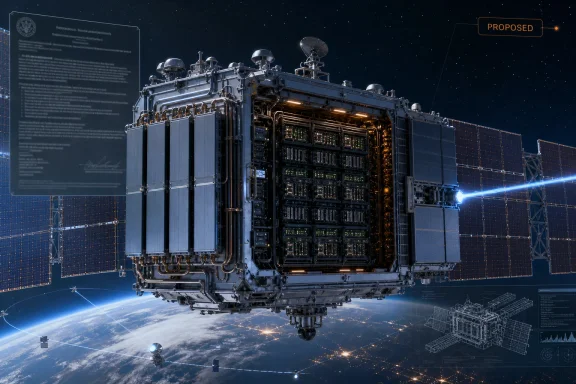
SpaceX says Nvidia will design the compute payload for its Starmind AI1 satellite, putting Nvidia Rubin GPUs and Vera CPUs at the center of a proposed orbital data-center system that remains unapproved by regulators and unlaunched. The news, reported August 4 and 5 by Interesting Engineering, Pulse 2.0, Not a Tesla App, and Teslarati, is more consequential than a symbolic “AI in space” partnership: it takes Starmind’s first hardware design from an advertised vendor-neutral platform toward Nvidia’s tightly integrated rack-scale architecture.
The immediate takeaway for enterprise AI teams is straightforward. Starmind is not a new cloud service, a Windows feature, or a deployable Nvidia product; it is a long-horizon infrastructure program whose first satellites are still proposed for 2027. But SpaceX’s selection of Nvidia establishes CUDA, Nvidia networking, and Nvidia’s Vera Rubin platform as the assumed software and hardware baseline for any workloads SpaceX eventually sells from orbit.
The reporting from Interesting Engineering and the other outlets says SpaceX is partnering with Nvidia to design the AI1 compute payload, with each Starmind satellite set to carry Nvidia Rubin GPUs and Vera CPUs. Spanish business daily Cinco Días separately reported that Elon Musk described Nvidia as SpaceX’s exclusive AI-chip supplier for its orbital data centers during the company’s second-quarter analyst call.
That claim goes beyond the language on SpaceX’s Starmind site. SpaceX describes AI1 as a modular satellite architecture that supports compute modules from any chip vendor, explicitly calling the system “AI chip vendor agnostic.” In June, when SpaceX outlined AI1’s design, the company and subsequent coverage framed that modularity as a means of preserving supplier flexibility, potentially including Nvidia, Google, Amazon, Tesla, or a future SpaceX-developed chip.
The two positions can coexist, but they are not equivalent. A payload can be mechanically modular while its initial production configuration is built around one vendor’s rack architecture, software stack, power profile, networking, and service model. In practical terms, “vendor agnostic” now appears to describe a future replacement option, while Nvidia is the named silicon partner for the satellite actually being designed.
That distinction matters for the software layer. Nvidia’s advantage is not simply access to GPUs. A Vera Rubin NVL72-class installation brings a full system design: CPUs, accelerators, high-speed interconnects, management tooling, CUDA libraries, inference frameworks, and a development environment that enterprise AI teams already use. Moving that stack into orbit does not turn it into a generic compute commodity. It makes Nvidia’s platform the reference target for Starmind workloads.
Those figures explain why Nvidia’s rack-scale design matters. Tom’s Hardware previously calculated that the original AI1 power range was in the neighborhood of a single Nvidia GB300 rack on Earth. The newer Vera Rubin configuration appears to be a bid to place a complete data-center-class AI node in orbit rather than fly a handful of radiation-hardened accelerators for a narrow space mission.
It also explains the central engineering constraint that the partnership announcement largely skips: heat. SpaceX says AI1 uses up to 110 square meters of deployable liquid radiators and promotes the vacuum of space as a cooling advantage because there is no need for chillers, cooling towers, fans, or local water systems.
Vacuum is not a source of cold air. It removes convection, leaving radiation as the way to shed the heat generated by GPUs, CPUs, memory, storage, networking, and power electronics. SpaceX must move that heat from the computing hardware into pumped fluid loops and then radiate it from large surfaces. The company’s claim is that this reduces cooling overhead; it does not eliminate the radiator mass, deployment complexity, micrometeoroid exposure, or thermal-control burden.
This is the part of the Starmind proposal that separates attractive high-level arithmetic from an operating service. Nvidia can supply a high-density AI platform, but SpaceX must prove that it can keep one working through orbital temperature cycles, radiation exposure, solar-array degradation, laser-link interruptions, and failures that cannot be repaired by swapping a server in a rack.
Acceptance for filing is the beginning of a licensing process, not approval to operate. The FCC notice also says SpaceX requested waivers from several normal requirements, including deployment milestones and surety-bond obligations. Those waivers matter because they would reduce conventional constraints intended to ensure that a license holder deploys a constellation as proposed rather than indefinitely holding spectrum and orbital rights.
The American Astronomical Society has petitioned the FCC to deny the request. Its filing argues that the projected satellites, with their large solar arrays and radiators, could be brighter and more disruptive to optical and infrared astronomy than existing broadband satellites. The group also raised radio-frequency interference, aggregate orbital-environment effects, and the lack of sufficient technical information for outside parties to assess the system’s impact.
SpaceX’s Starmind page emphasizes “space safety” and long-term orbital sustainability, but it does not publish a launch cadence, an operational lifetime for AI1, a disposal strategy, failure-rate targets, collision-avoidance details, or the number of satellites needed before the service has commercial usefulness. It also does not state whether early 2027 prototypes would contain the announced Nvidia configuration, how many satellites are planned for that phase, or whether customer workloads will be available outside SpaceX and its affiliated companies.
Those omissions are significant. A single AI1 prototype would validate pieces of the system. It would not validate an orbital data center at scale, a reliable commercial cloud offering, or the one-million-satellite filing.
A Deutsche Bank analysis reported by Investing.com in July estimated that building one gigawatt of orbital compute would currently cost roughly six times as much as a terrestrial alternative, excluding the cost of the compute hardware. The bank projected a possible path toward cost parity in the early 2030s only if SpaceX achieves much lower launch costs through reusable Starship operations and can mass-produce the satellites at scale.
That is the real bet behind the Nvidia deal. Starmind cannot win merely by operating a powerful Nvidia rack in space; ground operators already do that. It must demonstrate that SpaceX can launch, power, cool, network, and replace enough AI1 nodes cheaply enough that an orbital cluster competes with a conventional data center on delivered inference cost.
The initial AI1 design also limits what “space data center” should mean to customers. Inference workloads that can tolerate network routing through laser links and Starlink are a more credible early target than latency-sensitive interactive applications, database systems with constant data synchronization, or workloads that require frequent model and dataset transfers. Large models and training datasets still have to reach the satellite network, and results still have to come back down.
For Windows administrators and AI-platform teams, though, there is nothing to migrate, procure, or configure today. SpaceX has not announced a customer-facing Starmind service, service-level agreements, regions, pricing, identity integration, storage model, supported frameworks, data-residency terms, or a Windows-compatible control plane. Its existing description says only that localized compute results will be returned to Earth through Starlink.
The Nvidia agreement gives Starmind a named compute supplier and a clearer initial architecture. It does not solve the harder questions: whether AI1 can reject the heat of a modern rack in space, whether the FCC will authorize the requested constellation and waivers, how SpaceX will maintain an aging compute fleet in orbit, and whether launch economics can undercut a ground-based data center.
SpaceX is aiming to begin high-volume AI-satellite production from its planned Bastrop Gigasat factory as soon as late 2027. Until an AI1 prototype actually operates with the announced Nvidia payload, Starmind remains a regulated proposal and an engineering program—not the next place enterprises will run their Windows workloads.
Nvidia’s payload is the first concrete commitment
The reporting from Interesting Engineering and the other outlets says SpaceX is partnering with Nvidia to design the AI1 compute payload, with each Starmind satellite set to carry Nvidia Rubin GPUs and Vera CPUs. Spanish business daily Cinco Días separately reported that Elon Musk described Nvidia as SpaceX’s exclusive AI-chip supplier for its orbital data centers during the company’s second-quarter analyst call.That claim goes beyond the language on SpaceX’s Starmind site. SpaceX describes AI1 as a modular satellite architecture that supports compute modules from any chip vendor, explicitly calling the system “AI chip vendor agnostic.” In June, when SpaceX outlined AI1’s design, the company and subsequent coverage framed that modularity as a means of preserving supplier flexibility, potentially including Nvidia, Google, Amazon, Tesla, or a future SpaceX-developed chip.
The two positions can coexist, but they are not equivalent. A payload can be mechanically modular while its initial production configuration is built around one vendor’s rack architecture, software stack, power profile, networking, and service model. In practical terms, “vendor agnostic” now appears to describe a future replacement option, while Nvidia is the named silicon partner for the satellite actually being designed.
That distinction matters for the software layer. Nvidia’s advantage is not simply access to GPUs. A Vera Rubin NVL72-class installation brings a full system design: CPUs, accelerators, high-speed interconnects, management tooling, CUDA libraries, inference frameworks, and a development environment that enterprise AI teams already use. Moving that stack into orbit does not turn it into a generic compute commodity. It makes Nvidia’s platform the reference target for Starmind workloads.
AI1 is designed around roughly one data-center rack, not a conventional satellite
SpaceX’s public Starmind specifications put the AI1 payload at 120 kW average and 150 kW peak. The satellite is listed at 20 meters tall with a 70-meter deployed wingspan, and SpaceX says it will use high-bandwidth laser links to exchange data with other satellites and connect through the Starlink constellation.Those figures explain why Nvidia’s rack-scale design matters. Tom’s Hardware previously calculated that the original AI1 power range was in the neighborhood of a single Nvidia GB300 rack on Earth. The newer Vera Rubin configuration appears to be a bid to place a complete data-center-class AI node in orbit rather than fly a handful of radiation-hardened accelerators for a narrow space mission.
It also explains the central engineering constraint that the partnership announcement largely skips: heat. SpaceX says AI1 uses up to 110 square meters of deployable liquid radiators and promotes the vacuum of space as a cooling advantage because there is no need for chillers, cooling towers, fans, or local water systems.
Vacuum is not a source of cold air. It removes convection, leaving radiation as the way to shed the heat generated by GPUs, CPUs, memory, storage, networking, and power electronics. SpaceX must move that heat from the computing hardware into pumped fluid loops and then radiate it from large surfaces. The company’s claim is that this reduces cooling overhead; it does not eliminate the radiator mass, deployment complexity, micrometeoroid exposure, or thermal-control burden.
This is the part of the Starmind proposal that separates attractive high-level arithmetic from an operating service. Nvidia can supply a high-density AI platform, but SpaceX must prove that it can keep one working through orbital temperature cycles, radiation exposure, solar-array degradation, laser-link interruptions, and failures that cannot be repaired by swapping a server in a rack.
The FCC has accepted an application, not granted SpaceX permission to build the constellation
The regulatory record is considerably less advanced than the Nvidia announcement may imply. On February 4, the Federal Communications Commission’s Space Bureau said it had accepted SpaceX’s application for filing and was seeking public comment on a non-geostationary system of up to one million satellites, operating from 500 km to 2,000 km in multiple orbital shells.Acceptance for filing is the beginning of a licensing process, not approval to operate. The FCC notice also says SpaceX requested waivers from several normal requirements, including deployment milestones and surety-bond obligations. Those waivers matter because they would reduce conventional constraints intended to ensure that a license holder deploys a constellation as proposed rather than indefinitely holding spectrum and orbital rights.
The American Astronomical Society has petitioned the FCC to deny the request. Its filing argues that the projected satellites, with their large solar arrays and radiators, could be brighter and more disruptive to optical and infrared astronomy than existing broadband satellites. The group also raised radio-frequency interference, aggregate orbital-environment effects, and the lack of sufficient technical information for outside parties to assess the system’s impact.
SpaceX’s Starmind page emphasizes “space safety” and long-term orbital sustainability, but it does not publish a launch cadence, an operational lifetime for AI1, a disposal strategy, failure-rate targets, collision-avoidance details, or the number of satellites needed before the service has commercial usefulness. It also does not state whether early 2027 prototypes would contain the announced Nvidia configuration, how many satellites are planned for that phase, or whether customer workloads will be available outside SpaceX and its affiliated companies.
Those omissions are significant. A single AI1 prototype would validate pieces of the system. It would not validate an orbital data center at scale, a reliable commercial cloud offering, or the one-million-satellite filing.
The economics still favor ground data centers by a wide margin
SpaceX pitches orbit as a solution to terrestrial data-center constraints: grid interconnection delays, land, water, cooling, permitting, and local opposition. Those pressures are real, and they are why the company’s argument has attracted attention from AI infrastructure investors. But moving a rack into orbit replaces local power and cooling constraints with launch mass, spacecraft manufacturing, thermal hardware, communications capacity, orbital operations, and a no-touch maintenance model.A Deutsche Bank analysis reported by Investing.com in July estimated that building one gigawatt of orbital compute would currently cost roughly six times as much as a terrestrial alternative, excluding the cost of the compute hardware. The bank projected a possible path toward cost parity in the early 2030s only if SpaceX achieves much lower launch costs through reusable Starship operations and can mass-produce the satellites at scale.
That is the real bet behind the Nvidia deal. Starmind cannot win merely by operating a powerful Nvidia rack in space; ground operators already do that. It must demonstrate that SpaceX can launch, power, cool, network, and replace enough AI1 nodes cheaply enough that an orbital cluster competes with a conventional data center on delivered inference cost.
The initial AI1 design also limits what “space data center” should mean to customers. Inference workloads that can tolerate network routing through laser links and Starlink are a more credible early target than latency-sensitive interactive applications, database systems with constant data synchronization, or workloads that require frequent model and dataset transfers. Large models and training datasets still have to reach the satellite network, and results still have to come back down.
What Nvidia gains, and what IT buyers should not assume
For Nvidia, the Starmind arrangement supplies a high-profile validation of its strategy to sell full AI factories rather than discrete GPUs. If SpaceX standardizes on Vera Rubin systems, every AI1 satellite becomes a self-contained Nvidia platform whose software compatibility starts with CUDA and Nvidia’s supported inference stack.For Windows administrators and AI-platform teams, though, there is nothing to migrate, procure, or configure today. SpaceX has not announced a customer-facing Starmind service, service-level agreements, regions, pricing, identity integration, storage model, supported frameworks, data-residency terms, or a Windows-compatible control plane. Its existing description says only that localized compute results will be returned to Earth through Starlink.
The Nvidia agreement gives Starmind a named compute supplier and a clearer initial architecture. It does not solve the harder questions: whether AI1 can reject the heat of a modern rack in space, whether the FCC will authorize the requested constellation and waivers, how SpaceX will maintain an aging compute fleet in orbit, and whether launch economics can undercut a ground-based data center.
SpaceX is aiming to begin high-volume AI-satellite production from its planned Bastrop Gigasat factory as soon as late 2027. Until an AI1 prototype actually operates with the announced Nvidia payload, Starmind remains a regulated proposal and an engineering program—not the next place enterprises will run their Windows workloads.
References
- Primary source: Not a Tesla App
Published: 2026-08-05T14:40:00+00:00
Loading…
www.notateslaapp.com - Independent coverage: Teslarati
Published: 2026-08-05T06:17:00+00:00
Loading…
www.teslarati.com - Independent coverage: Interesting Engineering
Published: 2026-08-04T21:39:29+00:00
Loading…
interestingengineering.com - Independent coverage: Pulse 2.0
Published: 2026-08-04T19:55:22+00:00
Loading…
pulse2.com - Related coverage: spacex.com
Loading…
www.spacex.com - Related coverage: notebookcheck.net
Loading…
www.notebookcheck.net - Related coverage: starship-spacex.fandom.com
Loading…
starship-spacex.fandom.com - Related coverage: notebookcheck.net
Loading…
www.notebookcheck.net - Related coverage: tuttotech.net
Loading…
www.tuttotech.net - Related coverage: linkedin.com
Loading…
www.linkedin.com - Related coverage: notebookcheck.pl
Loading…
www.notebookcheck.pl - Related coverage: optimusk.blog
Loading…
optimusk.blog - Related coverage: ixbt.com
Loading…
www.ixbt.com - Related coverage: danielmarin.naukas.com
Loading…
danielmarin.naukas.com - Related coverage: content.spacex.com
- Related coverage: content.spacex.com
Loading…
content.spacex.com - Related coverage: cincodias.elpais.com
Loading…
cincodias.elpais.com - Related coverage: starmind-technology.netlify.app
Loading…
starmind-technology.netlify.app - Related coverage: datacenterdynamics.com
Loading…
www.datacenterdynamics.com - Related coverage: investing.com
Loading…
www.investing.com - Related coverage: techcrunch.com
Loading…
techcrunch.com - Related coverage: timesofai.com
Loading…
www.timesofai.com - Related coverage: tomshardware.com
Loading…
www.tomshardware.com - Related coverage: datacenterdynamics.com
Loading…
www.datacenterdynamics.com - Related coverage: peer.org
Loading…
peer.org - Related coverage: space.com
Loading…
www.space.com - Related coverage: tomshardware.com
Elon Musk's first-gen orbital data center craft spans wider than a Boeing 747 and runs an interchangeable chip payload — AI1 satellite compute payload is 120 kW, peaks at 150 kW | Tom's Hardware
The first-gen orbital data center craft spans wider than a Boeing 747 and runs an interchangeable chip payload.www.tomshardware.com - Related coverage: space.com
Loading…
www.space.com - Related coverage: spaceedu.org
Loading…
spaceedu.org - Related coverage: nextbigfuture.com
Loading…
www.nextbigfuture.com - Related coverage: chipbriefing.substack.com
Loading…
chipbriefing.substack.com - Related coverage: aol.com
Loading…
www.aol.com - Related coverage: wetalktesla.com
Loading…
wetalktesla.com