
For Windows and PC hardware readers, the important qualification is equally concrete. Terafab is not a new source of PC CPUs, graphics cards, or retail memory. SpaceX and Tesla describe it as a captive manufacturing project intended to feed Tesla vehicles and Optimus robots, along with SpaceX systems and planned orbital data centers. Its relevance to the broader semiconductor market is indirect: if the project becomes operational at scale, it could turn Musk’s companies into a far larger buyer—and eventually maker—of advanced logic, memory, packaging, and AI-compute hardware.
The Global Sources report frames Terafab as an effort to “revolutionize” manufacturing at scale. The public record supports the scale of the ambition. It does not yet support the claim that the factory has solved the engineering, supplier, staffing, power, water, or process-technology problems that determine whether a semiconductor fab can actually ship competitive chips.
 The Texas location is now more specific than the original announcement
Musk announced Terafab on March 21 in Austin as a joint effort involving Tesla, SpaceX, and xAI. At the time, the public plan centered on a smaller “Advanced Technology Fab” at Tesla’s Giga Texas campus, intended as a rapid-iteration research facility where teams could design, fabricate, test, revise, and repeat without sending wafers through a conventional chain of specialized suppliers.
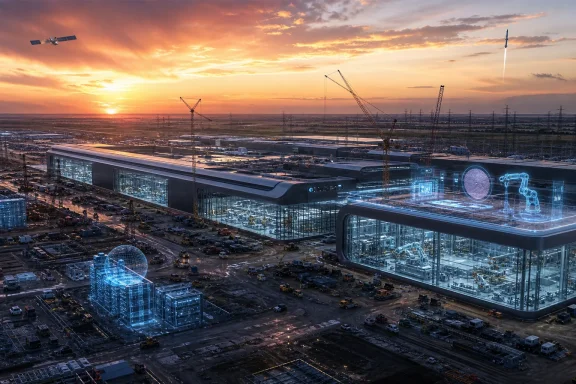
Bloomberg and other outlets reported then that the Austin operation was meant to be a starting point rather than the final industrial campus. SpaceX’s August announcement resolves the location of the full-scale project: Grimes County, northeast of Houston and near College Station. Tesla says it broke ground on the Austin research fab in April, while the larger Terafab site is now being positioned as the production-scale follow-on.
That split matters. A research line and a high-volume leading-edge fab are different businesses with different failure points. A pilot facility can be useful for chip design validation, packaging experiments, process learning, and faster hardware iteration. It does not automatically establish the yield, contamination control, tool availability, supplier qualification, and operational discipline needed to manufacture advanced chips in volume.
Semiconductor plants also do not become globally significant simply because they are physically large. The productive unit is clean-room capacity equipped with qualified tools and supplied with dependable materials, rather than total floor area. SpaceX has disclosed an eventual manufacturing footprint above 100 million square feet, but has not publicly detailed how much of that space will be clean room, when specific production lines will be installed, or what annual wafer capacity the first phase will deliver.
The $16.8 billion figure does not describe the whole project
The most useful context missing from most accounts of the new announcement is that the $16.8 billion number is neither Terafab’s original estimate nor a final buildout cost. It is described as the initial capital investment from SpaceX and Tesla. Earlier project documents filed with the Texas Comptroller’s office presented a much larger multi-phase range: $55 billion to $119 billion for initial phases, with the possibility of further expansion.
Those documents describe four independently capable phases, each potentially containing a similar set of semiconductor improvements. One application tied to the Iola Independent School District estimated roughly $6.4 billion in capital expenditure for a single phase. The filings also show that the project is seeking benefits under Texas’s Jobs, Energy, Technology, and Innovation program, or JETI, and characterize the Grimes County area as the primary full-scale deployment site.
This is less a contradiction than an indication of the project’s unusually fluid public accounting. The initial $16.8 billion figure may describe near-term spending, while the $55 billion and $119 billion figures describe a larger series of possible phases. But prospective readers should resist treating any of those figures as the all-in price of an operating advanced fab.
The distinction is material because the hardest and most expensive elements arrive after a site has been secured and shell construction begins. Lithography systems, deposition tools, etchers, metrology equipment, clean-room systems, ultrapure-water treatment, specialty gases, chemicals, advanced packaging equipment, power infrastructure, and workforce development can push fab budgets into the tens of billions of dollars before a new process achieves commercially acceptable yields.
SpaceX’s public messaging has focused on capital commitment and footprint, not on the staged technical milestones that would make the investment legible to chip-industry customers: tool orders, process qualifications, target wafer starts, product tape-outs, yield targets, or volume-production dates.
Vertical integration is Terafab’s central wager
Terafab’s stated manufacturing model is unusually broad. Texas filings describe a single co-located campus intended to combine integrated-circuit design, photomask generation, wafer fabrication, memory production, advanced packaging, system-level integration, power generation, and a space-compute test facility.
That approach has a practical appeal for Musk’s companies. Tesla, SpaceX, and xAI have hardware roadmaps that depend on custom silicon and have repeatedly been constrained by outside manufacturing capacity. Combining design feedback, wafer manufacturing, packaging, validation, and deployment under one organizational roof could shorten the time between a design revision and an installed product—particularly for Tesla’s AI hardware, robotics systems, and SpaceX’s satellites.
The problem is that Terafab is attempting to consolidate specialties that the modern chip industry usually separates for good reason. Leading-edge logic fabrication, DRAM or other memory manufacturing, advanced packaging, masks, substrate supply, and automated testing all operate with distinct technical supply chains and expertise. Even established semiconductor companies tend to partner extensively rather than own every stage at leading edge.
Intel joined the Terafab effort in April and said its ability to design, fabricate, and package high-performance chips would help the project. Yet Intel has not publicly specified its equity stake, its operating role, the technology it will license or supply, whether it will run production tools, or how the resulting capacity will be divided. Reuters previously reported that Musk said Terafab would use Intel’s 14A process, but the companies have not published a detailed process roadmap for the Grimes County site.
That leaves a major gap between the project’s commercial description and its technical disclosure. No public equipment plan or manufacturing schedule has established that Terafab will produce leading-edge chips on the timetable implied by its rhetoric. The absence does not mean those plans do not exist; supplier and process agreements are often confidential. It means they cannot yet be treated as confirmed.
Texas incentives move risk beyond the companies
Grimes County had already helped set the project in motion before the August site announcement. County records show fully executed agreements with SpaceX under Texas’s reinvestment-zone and economic-development mechanisms. Reuters reported in June that SpaceX secured local tax incentives despite substantial opposition from residents concerned about the effect on a rural county’s resources and character.
The county agreement is central to how Terafab should be read. This is not simply two private companies deciding to spend their own money on a factory. It is a public-private industrial development arrangement, with local governments accepting lower or altered property-tax collections in exchange for investment, jobs, and associated economic activity.
SpaceX and Texas officials have promoted the project’s employment potential, with the first phase expected to create more than 3,000 jobs. Those jobs would be significant in a county with a relatively small population, but job counts alone do not answer the harder questions: how many roles will be permanent fab positions, how many will be temporary construction jobs, where the specialized workforce will come from, and what infrastructure upgrades will be needed to support a facility of this size.
Chip fabrication is intensely dependent on electricity and water. The JETI material says Terafab may include supporting power generation, an acknowledgement that conventional grid service may not be sufficient for the planned scale. SpaceX has not released a detailed energy plan, water-demand forecast, wastewater strategy, or environmental permitting timetable for the final buildout. Those omissions are more consequential than comparisons to the Pentagon or Giga Texas.
What Terafab changes—and what it does not
Terafab gives Musk’s companies a credible industrial direction: build an internal supply chain for the processors and packaged systems they expect to consume in enormous volumes. It also gives Texas another major semiconductor bet alongside existing operations from companies such as Samsung, Texas Instruments, NXP, and others.
For the PC market, however, Terafab currently offers no reason to expect cheaper GPUs, a new consumer CPU rival, or a source of off-the-shelf hardware. The announced demand is internally focused, and the companies have not described a foundry service, retail chip line, or merchant semiconductor business.
The next meaningful evidence will be technical rather than architectural: disclosed tool suppliers, confirmed process technology, completed clean-room capacity, a functioning Austin pilot line, and evidence that the first Grimes County phase can make chips with viable yields. Until then, Terafab is a real Texas construction and incentive project attached to an exceptionally ambitious manufacturing thesis—not yet a demonstrated semiconductor revolution.

