
Tesla reported $28.2 billion in second-quarter revenue, up 26% year over year, but net income fell 5% to $1.1 billion. Operating income dropped 57%, free cash flow swung to a $1 billion loss, and spending climbed sharply as the company funds Cybercab, Optimus, battery production and its expanding robotaxi effort. TechCrunch reported that Tesla also pushed expected volume production of Cybercab, Semi and Megapack 3 beyond 2026.
For Windows users and enterprise IT teams, the headline is less about vehicle deliveries than the financial reality behind Tesla’s transition into an AI company. Musk is asking investors to finance a large, capital-intensive mix of robotics, autonomy, semiconductor manufacturing and data infrastructure before its commercial products have reached broad scale.
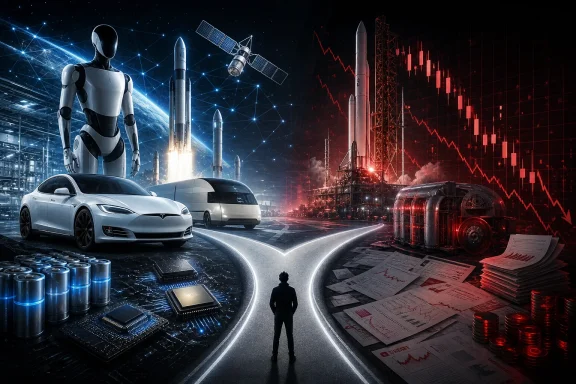 A Merger Is No Longer a Side Conversation
On Tesla’s July 22 earnings call, Musk declined to rule out a combination with SpaceX, saying the companies have increasing overlap and that such a move would need the “appropriate process.” Reuters reported that Tesla and SpaceX already collaborate on batteries, manufacturing technologies and the Terafab semiconductor project, while Starlink connectivity is being integrated into Tesla vehicles.
That overlap makes technical sense on paper: shared AI infrastructure, edge connectivity, custom silicon, robotics and energy systems. It also introduces governance risk. Tesla shareholders own a public EV and energy company; SpaceX investors now have exposure to launch systems, Starlink, xAI and X. Folding the businesses together could consolidate engineering assets, but it would also concentrate execution risk in one Musk-led platform.
SpaceX’s Post-IPO Reality Check
The pressure on SpaceX is especially acute after its June IPO. The Washington Post reported that SpaceX shares had nearly halved from their post-listing high by July 27, while Tesla had lost more than 18% over the preceding week.
SpaceX’s IPO filings had already shown the challenge beneath the growth narrative. The Associated Press reported that SpaceX lost $2.6 billion from operations in 2025 on $18.7 billion in revenue, though Starlink generated $4.4 billion in operating income. The filing also disclosed operating losses at xAI, now part of the SpaceX structure.
Fortune’s analysis of the proposed Tesla-SpaceX logic points to the central problem: a stock-for-stock acquisition becomes much more dilutive when SpaceX shares fall faster than Tesla’s. That does not rule out a deal, but it makes Musk’s corporate integration strategy harder to sell to investors who expected a cleaner exposure to either space infrastructure or electric vehicles.
The Next Test Is Execution, Not Vision
Tesla still has meaningful growth in EV deliveries, energy storage and Full Self-Driving subscriptions. SpaceX still has Starlink’s cash generation and a dominant launch business. But investors are now demanding evidence that the spending cycle can produce durable products, margins and cash flow—not simply a larger constellation of connected Musk companies.
The next milestones are Tesla’s delayed production ramps and SpaceX’s ability to stabilize after its public-market debut. Until then, the most consequential question is whether deeper integration creates operational leverage—or merely moves the same risks under one roof.
