

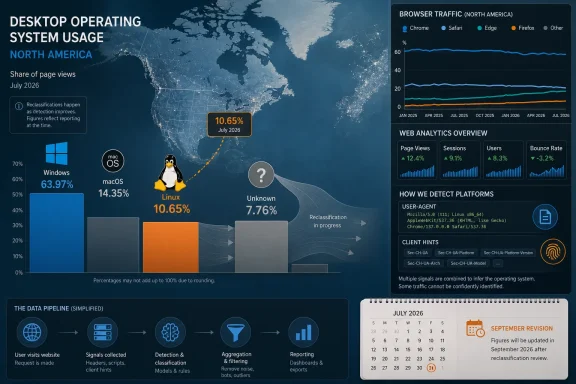
Tech Times reported the milestone as confirmed by both StatCounter and Cloudflare Radar. The first part is straightforward: StatCounter’s monthly desktop operating-system chart did move Linux from 5.52% in June to 10.65% in July. The second part is less settled. Cloudflare publicly documents that Radar can identify desktop operating systems from User-Agent and Client Hints data, but the article does not provide a Cloudflare percentage, a reproducible Explorer query, or an export that would let readers test the claimed North American Linux result against StatCounter’s 10.65%.
The important news, then, is narrower and more defensible: Linux has registered an unusually large North American desktop-web signal in StatCounter’s July data. The claimed one-month doubling is not yet a reliable adoption rate.
The Unknown Category Is the Story Behind the Spike
StatCounter’s June North America desktop table showed Windows at 53.84%, OS X at 21.62%, Unknown at 9.24%, macOS at 7.77%, Linux at 5.52%, and Chrome OS at 2.01%. Linux’s July increase therefore arrived immediately after an unusually large block of desktop traffic had been assigned no operating system at all.
That does not prove that all—or even most—of the Unknown traffic became Linux in July. It does establish why a 5.13-percentage-point Linux gain cannot be treated like a normal monthly shift in installed PCs. The total pool is fixed at 100%; when a large unclassified category changes, the visible operating-system shares can move sharply without a corresponding wave of device migrations.
StatCounter says it derives Global Stats from more than 3 billion monthly page views across more than 1 million sites that run its analytics code. It classifies the browser, operating system, and platform attached to each page view, filters bots, and publishes the recorded data without artificial weighting. That methodology makes the service useful for spotting web-usage patterns, but it also means the result depends on what browser identification reaches its tracking network and how that identification is parsed.
A Linux machine using a conventional Chromium or Firefox configuration normally announces enough information to be classified. Privacy-oriented browsers, altered User-Agent strings, proxy arrangements, embedded browsers, automation, and changes in detection logic complicate that picture. A movement from Unknown to Linux can therefore describe better identification of existing traffic rather than a new Linux installation.
The July figure may contain both effects: a real rise in Linux activity and a reallocation of traffic that StatCounter previously could not label. The available public data does not separate them.
StatCounter’s Own Revision Policy Makes July Preliminary
This is not a theoretical concern. In June, StatCounter’s worldwide desktop chart briefly showed Windows falling to roughly 56.55%, down from about 79% in April. Windows Latest documented the abrupt result and the parallel rise in Unknown traffic; StatCounter later corrected the data, returning Windows to roughly 72%.
That episode is relevant because it shows how quickly an operating-system chart can be distorted when traffic classification changes. It does not mean the July Linux reading is wrong. It means the burden is on anyone claiming a sudden, near-doubling of Linux desktop use to show that the shift survives the same quality controls.
StatCounter explicitly says its figures are subject to quality-assurance testing and revision for 45 days from first publication. Its FAQ also says monthly data becomes available on the second day of the following month. Since July’s monthly result appeared on August 2, 2026, it should not be treated as closed until roughly September 16, 2026.
That date matters for IT departments, hardware vendors, and software developers tempted to build a narrative around the July chart. The right operational conclusion today is that Linux traffic deserves attention; the wrong conclusion is that North America added millions of Linux desktops in a month.
The same caution applies to Windows’ July position. If Linux’s gain partly reflects reclassification, then the apparent movement in the Windows, OS X, macOS, and Unknown columns may also be a statistical consequence rather than a change in machine ownership or corporate standardization.
Cloudflare Is Useful Evidence, but It Does Not Supply a Headcount
Cloudflare Radar is a genuinely different measurement system from StatCounter. Cloudflare says Radar draws on traffic across its Web and DNS services, and its browser and operating-system detection uses User-Agent and Client Hints HTTP headers. Its network scope is far broader in some respects than a panel of sites running a specific analytics tag.
That independence can help validate direction. If both systems show elevated Linux-associated desktop requests in North America during the same period, it becomes harder to dismiss every movement as a problem unique to StatCounter’s panel.
It still does not convert either source into a census. Both observe HTTP requests, not individual owners, installed machines, or corporate endpoints. A software developer building packages, a workstation making repeated requests to technical sites, a home PC browsing the web, and a Linux-based device exposing a desktop-like user agent are all traffic sources rather than counted people.
Cloudflare also has its own classification constraints. User-Agent strings are increasingly reduced, modified, or augmented by Client Hints. Browsers can suppress identifying information, and traffic that does not pass through Cloudflare’s network is naturally outside Radar’s view. These are not defects unique to Cloudflare; they are the unavoidable limits of trying to infer an operating-system population from web requests.
The missing piece in the Tech Times report is reproducibility. An independent measurement claim needs the time range, regional filter, device filter, OS categories, and observed percentage. Without them, Cloudflare can be described as contextual support for elevated Linux traffic, but not as a published numerical confirmation of a 10.65% North American share.
Why the Linux Signal Still Deserves Attention
The qualification should not obscure the underlying trend. Linux is far more practical on desktop hardware in 2026 than it was when the “Year of the Linux Desktop” joke took hold. Modern distributions have easier installers, broad driver support, mainstream browsers and productivity applications, and increasingly mature gaming support through Valve’s SteamOS work and Proton.
Windows 10’s end of free support on October 14, 2025 has also created a durable decision point for older PCs. Microsoft’s Extended Security Updates program gives eligible users more time, but it does not remove the eventual choice between a new Windows 11-capable machine, a paid support path, unsupported Windows, or another operating system. For hardware excluded by Windows 11’s TPM 2.0 and supported-processor rules, Linux remains a realistic way to keep receiving current OS security updates without replacing a working PC.
Those factors make a larger Linux web-traffic footprint plausible. They do not establish the magnitude of any particular month’s migration. The distinction is especially important for Windows software vendors: a growing Linux traffic share is a reason to test web applications, Electron packages, browser compatibility, and perhaps Steam Deck or Proton behavior. It is not, by itself, evidence that a tenth of North American business desktops need native Linux client support.
What to Watch When the July Data Settles
The next StatCounter revisions will be more informative than the headline published on August 2. If Linux remains near double digits after the 45-day revision window and Unknown stays low, July will look like a meaningful step-change in observed North American desktop traffic. If Linux retreats as Unknown returns or other categories are revised, the headline will have captured a classification event more than an adoption event.
Readers should also compare several months rather than treating July in isolation. A sustained Linux range above the prior 5%–6% level would tell a much stronger story than a single 10.65% print. Country-level data for the United States and Canada would add useful context as well, because “North America” combines markets with different device mixes and web-usage patterns.
For now, StatCounter has recorded a notable threshold, and it is worth watching. What it has not shown is that Linux suddenly doubled its installed desktop base across North America—and Cloudflare, as presented in the Tech Times report, does not yet close that evidentiary gap.
Update: Report attributes spike to automated traffic, not desktop migrations (August 6, 2026)
Gizchina now reports that Cloudflare Radar’s “Likely Human” traffic filter reduces Linux’s North American desktop share to 4.7%, arguing that automated AI crawlers and scrapers using Linux server environments inflated the broader traffic signal.
If accurate, that is more specific evidence for the classification-and-traffic explanation raised above: the July StatCounter result may have measured a surge in Linux-identified requests rather than a comparable increase in human-operated Linux PCs.
However, Gizchina does not publish the underlying Cloudflare Radar query, date range, regional and device settings, or export needed to independently reproduce the reported 4.7% figure. Its account should therefore be treated as a reported explanation rather than a settled cross-platform measurement.
For developers and IT decision-makers, the practical takeaway is unchanged but sharper: separate bot-filtered, likely-human web traffic from total request volume before using operating-system analytics to guide desktop-support or deployment decisions.