

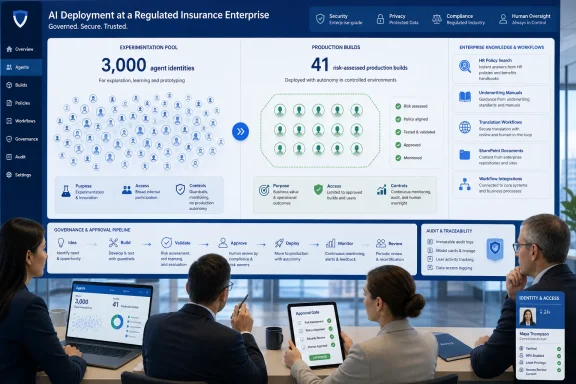
Microsoft’s customer story, dated August 11, 2026, describes State Farm’s effort to turn employee experimentation with Copilot Studio into governed internal services for HR, underwriting, onboarding, translation, content review, and information security. State Farm’s own 2024 Impact Report separately says its AI use is subject to governance, risk management, accountability, and human engagement through the lifecycle. That corroborates the company’s stated direction, though it does not independently verify Microsoft’s deployment counts or claimed time savings.
The practical takeaway for IT teams is straightforward: State Farm is showing a credible pattern for scaling low-code AI in a regulated enterprise, but the story leaves out the operating measures that would prove the rollout has delivered broad business value. It provides no adoption totals, no accuracy or escalation rates, no cost data, no details on the risk-assessment criteria, and no description of which systems the next generation of action-taking agents will be allowed to touch.
The 3,000-agent figure is not a production count
Microsoft’s executive summary uses careful language: State Farm has “more than 3,000 agent identities” and 41 production builds. Further into the story, however, the wording shifts to “more than 3,000 agents,” a looser claim that makes the program sound far more operationally mature than the production figure establishes.
Those are not interchangeable metrics. Microsoft Entra documentation explains that an agent identity is a managed identity construct associated with AI agents, while older Copilot Studio implementations can also appear as traditional applications or service principals. In a governed tenant, identities are part of the control plane: they make it possible to assign ownership, authenticate, audit activity, enforce access policy, and disable a specific agent when an incident or compliance review demands it.
A count of 3,000 identities can therefore represent an extensive maker community, experiments, prototypes, personal productivity tools, shared internal agents, agents awaiting review, or multiple identity objects associated with distinct agent configurations. It does not demonstrate that 3,000 production workloads have cleared enterprise controls. State Farm’s 41 risk-assessed production builds are the more meaningful operational number, and even that is not broken down by department, user population, or business criticality.
This is not a flaw in State Farm’s strategy. It is a reporting problem in the Microsoft case study. Organizations evaluating Copilot Studio should resist treating identity inventory as a deployment KPI. A useful dashboard separates at least four categories: draft agents, shared pilots, approved production agents, and high-risk agents with permissions to invoke actions outside the Microsoft 365 content boundary.
State Farm’s strongest evidence is still retrieval, not autonomy
The current deployments described by Microsoft are mostly knowledge-retrieval use cases: put governed documents in accessible repositories, give employees a conversational interface, and reduce the time spent searching manuals or sending routine questions to a support team.
The Ask HR policy agent is the clearest example. State Farm says employees can ask about benefits and HR policies rather than contact an HR representative, and that the HR organization has mapped out 12 more agents after the initial rollout. That is a sensible first workload for Copilot Studio because it can be bounded around policy content and monitored for gaps in source material.
Underwriting is the other substantive use case. State Farm moved large underwriting manuals into SharePoint Online and built an agent for life underwriters and trainees. Microsoft says the tool became the second most-used agent within 30 days. The claim is promising, but the story does not provide the number of users, query volume, answer-quality score, reduction in average handling time, or evidence that underwriting decisions became more consistent.
That missing evidence matters more in insurance than it would in a general employee-help bot. A retrieval assistant that helps a trainee find a paragraph in an approved manual is one thing; an agent that can interpret criteria, recommend an underwriting outcome, or update a policy is another. The first can support a human’s review. The second begins to influence regulated business decisions and needs a much more explicit governance, testing, audit, and exception-handling model.
Microsoft’s story says State Farm is now exploring orchestration across systems, approvals, and more action-oriented or autonomous workflows. Those plans are the point at which the hard questions arrive: which connectors are permitted, which data sources are approved, whether an agent acts with delegated user permissions or its own identity, how actions are logged, and where a human must approve the result.
Microsoft’s current Copilot Studio governance documentation makes clear that administrators can restrict agent authentication choices, block knowledge-source types, prohibit specific Power Platform connectors, limit publishing channels, and block HTTP requests or event triggers. Those controls are essential once an agent can do more than search SharePoint. The State Farm story says it has approval paths and close alignment with risk and compliance teams, but it does not identify which of those enforcement controls it actually uses.
The translation result needs more context than Microsoft provides
Microsoft’s headline efficiency claim is an email-based translation workflow that allegedly reduced turnaround time for English-Spanish marketing materials and claims letters from 12 months to 24 hours. If measured on a comparable end-to-end workload, that would be a substantial operational change.
But the case study does not say what the 12-month baseline represents. It does not state whether the earlier process involved backlogged batches, external translation procurement, legal and brand review, multiple markets, template redesign, or publication scheduling. Nor does it say whether the new 24-hour process includes human linguistic review, compliance approval, claims-specific terminology validation, or only the machine-translation step.
The comparison may be completely valid, but the published record does not allow readers to judge it. “Translation turnaround” is particularly vulnerable to measurement ambiguity because a workflow can be fast at generating a draft while remaining slow at approval, localization, accessibility review, and final release.
The same issue appears in a smaller claim: Microsoft says a content agent checks writing against internal standards and eliminates the need for a separate license. The story never identifies the displaced product, license tier, annual spend, number of affected users, or whether the Copilot Studio capacity and premium licensing costs were included in that calculation.
These omissions do not erase the value of the projects. They do mean the story should be read as a vendor-published deployment narrative, not an independently audited ROI report.
The governance model is the actual product lesson
State Farm’s most transferable lesson is not that it built an HR bot or moved manuals into SharePoint. Many organizations can do that. Its more disciplined move was to make risk review, responsible-AI training, workshops, office hours, reusable templates, and a path from individual experimentation to department-level deployment part of the program.
Microsoft says workshops can host up to 150 people and that every employee receives a premium license. Broad access can increase the number of useful ideas reaching the platform team, but it also increases the number of potential data paths, connectors, abandoned prototypes, and requests for exceptions. The control model has to scale at the same pace as the maker population.
For Windows and Microsoft 365 administrators, the State Farm example reinforces several practical priorities:
- Inventory agent identities and shared agents separately from production services, and assign a responsible owner to every one.
- Require authentication and use least-privileged access for agents that retrieve internal data or act across systems.
- Treat SharePoint content quality as part of the AI project, because a conversational layer cannot fix outdated, duplicated, or poorly permissioned source documents.
- Define production exit criteria before a build-a-thon begins, including testing, data classification, approval requirements, monitoring, rollback, and an escalation path for inaccurate answers.
- Keep action-oriented agents behind explicit approvals until the organization can demonstrate reliable audit trails and predictable failure handling.
State Farm has not announced customer-facing autonomous insurance decisions. Its first external-facing Copilot Studio agent is being prepared by HR to help prospective employees explore benefits and support recruiting. That narrower scope is significant: the company is starting customer-adjacent deployment with information delivery, rather than allowing an agent to change a claim, quote a policy, or make an eligibility determination.
The 41 production builds show that State Farm has progressed beyond a demo-stage Copilot program. The 3,000-identity figure shows it has created a sizable internal pipeline. What remains unproven is whether the company can maintain the same controls as those experiments become agents that invoke systems, request approvals, and take actions on behalf of employees.