
Superleap says it has raised ₹36 crore, about $3.7 million, in a pre-Series A round led by Peak XV’s Surge program, money the Bengaluru AI-CRM vendor plans to spend on enterprise sales, product development and AI capabilities. For Microsoft-centric organizations, the relevant product claim is not the funding headline: Superleap is positioning Microsoft Teams as a working surface for its CRM, with meeting transcripts, recordings, notes and deal updates tied back to customer records.
The problem is that the financing itself has only been reported by Ascendants so far. Neither Peak XV nor Superleap had published an announcement confirming the ₹36 crore figure, valuation, ownership sold, close date, or the rest of the round’s participants when this report was prepared. That does not disprove the investment, but it means the deal terms should be treated as reported rather than independently confirmed.
There is also a more consequential record mismatch in the company’s history. Ascendants describes Superleap as founded in 2024 and portrays this as a pre-Series A led by Surge. Peak XV’s own portfolio page, however, lists Superleap as founded in 2021, says Peak XV partnered with it in 2022, and labels its current stage as Seed. The founders listed by both records are the same: Subham Kumar Boundia, Saurabh Maheshwari and Alok Maurya.
That discrepancy makes the new round look less like Peak XV’s first encounter with a newly founded AI startup and more like additional capital for a company with an existing Peak XV relationship. The most likely explanation is stale portfolio metadata or a change in the company’s operating identity before Boundia began listing his Superleap role in 2024. But neither party has clarified that history, and customers evaluating Superleap as a newer enterprise vendor should not mistake the date conflict for a settled company timeline.
Superleap’s pitch is an AI-native CRM for sales, marketing and revenue teams. The company divides that offer into SuperOS for data management, SuperSense for customer intelligence and AI agents intended to handle repetitive revenue work. It also markets voice bots and integrations with business software including WhatsApp, Slack, Microsoft Teams, Anthropic’s Claude and OpenAI’s ChatGPT.
The practical distinction in Superleap’s strategy is implementation. Its “Superleap Deploy” offering says the company’s own team builds, deploys, runs and expands the platform rather than passing a customer to a systems integrator after the license sale. That model is aimed squarely at the difficult part of replacing an established CRM: extracting old data, reconnecting telephony and internal systems, retraining a distributed sales force, and keeping daily sales activity running during cutover.
Superleap claims that it migrated more than 10 million records in 45 days in one customer engagement. Boundia separately wrote on LinkedIn that a major education-company deployment involved more than 4,000 users, more than 20 API integrations, bidirectional data synchronization with a data lake and a 1,500-person call-center operation. Ascendants describes a related Aakash Education rollout as moving 5,000 counselors across 400 locations in under 60 days.
Those are company claims, not independently audited implementation results. The difference matters because CRM migrations routinely fail on data quality, permissions, workflow exceptions and user adoption long after an announced go-live. Still, Superleap’s own product materials and customer-logo pages do show Razorpay, Cars24, Aakash Education and other organizations as users or deployment customers. That supports the narrower conclusion that the company has landed enterprise-style accounts; it does not verify the claimed data volumes, timelines or business outcomes.
For sales teams living in Teams, that is a sensible automation target. A common weakness in CRM data is that the customer conversation stays in a meeting recording or an employee’s notes while the account record receives only a vague, delayed update. Automatically connecting a transcript to a customer, contact or opportunity can make pipeline reporting more useful — provided identity matching, access controls and retention policies are correct.
It also creates a larger governance burden than Superleap’s funding announcement acknowledges. Meeting recordings and transcripts can include commercial terms, financial information, support escalations, personal data and internal discussion. An organization considering the integration needs to establish where Teams artifacts are processed and stored, whether Superleap receives raw recording or transcript content, how long it retains that data, what models or third parties process it, and whether existing Microsoft Purview retention labels and eDiscovery procedures continue to work as intended.
Superleap’s public Teams page speaks broadly of an enterprise-grade and secure AI CRM but does not specify the Microsoft 365 permissions required, its data residency options, retention controls, audit-log coverage, tenant isolation, model-training policy, or compliance certifications. Those omissions are normal for marketing pages, but they are not minor configuration details for regulated banks, healthcare providers or education organizations — the very verticals Superleap says it is targeting.
A Teams administrator should therefore treat Superleap as a CRM integration that can ingest meeting intelligence, not as a lightweight notification bot. Pilot it with representative meetings, data-classification rules and a small group of account teams before allowing automatic synchronization across a broad sales organization.
Superleap’s own website says it has more than 100 customers and more than 100 integrations. Those claims indicate a company moving beyond an early prototype, but the available public material does not disclose annual recurring revenue, net revenue retention, number of paying enterprise accounts, contract values, churn, or the portion of revenue coming from implementation versus recurring software subscriptions. A tenfold-growth claim without a starting revenue base is directionally interesting but cannot show the scale or durability of the business.
The use-of-proceeds is more revealing. Enterprise go-to-market spending means more sales capacity, implementation staff and customer success effort, alongside work on AI features. That is consistent with Superleap’s decision to sell deployment ownership as part of the product. The company is not simply asking buyers to replace Salesforce, HubSpot or a homegrown CRM with another database; it is selling a managed migration and operating model around the replacement.
That can be attractive for businesses that have been stranded by an old CRM rollout. It can also deepen customer dependence on the vendor. When the same company owns the application, deployment process, custom workflows, data mappings and AI agents, a future migration away from the platform becomes harder unless the customer contracts for usable exports, documented integrations, clear data ownership and support during exit.
A ₹36 crore, or roughly $3.7 million, round fits inside that stated range. It is therefore plausible as a Surge-led financing, even though the exact deal has not yet been publicly confirmed by the investor. More importantly, the ticket is big enough to fund a period of enterprise expansion but small enough that Superleap will need to turn its migration-heavy services model into repeatable delivery rather than relying on bespoke rescue projects.
The announced investor list also includes Gruhas and Supermorpheus Group, with angels including Unacademy co-founder Gaurav Munjal, Shaadi.com founder Anupam Mittal, Mukesh Bansal and Zerodha co-founder Nikhil Kamath. Ascendants named those supporters, but it did not say whether they invested in this round, were prior investors, or how much capital each committed. The distinction is material: a historic cap-table list is not the same thing as a new financing syndicate.
The outlet also attributes Superleap’s claimed migration of more than 10 million records in 45 days specifically to Razorpay. These remain company-reported deployment figures rather than independently audited results.
There is also a more consequential record mismatch in the company’s history. Ascendants describes Superleap as founded in 2024 and portrays this as a pre-Series A led by Surge. Peak XV’s own portfolio page, however, lists Superleap as founded in 2021, says Peak XV partnered with it in 2022, and labels its current stage as Seed. The founders listed by both records are the same: Subham Kumar Boundia, Saurabh Maheshwari and Alok Maurya.
That discrepancy makes the new round look less like Peak XV’s first encounter with a newly founded AI startup and more like additional capital for a company with an existing Peak XV relationship. The most likely explanation is stale portfolio metadata or a change in the company’s operating identity before Boundia began listing his Superleap role in 2024. But neither party has clarified that history, and customers evaluating Superleap as a newer enterprise vendor should not mistake the date conflict for a settled company timeline.
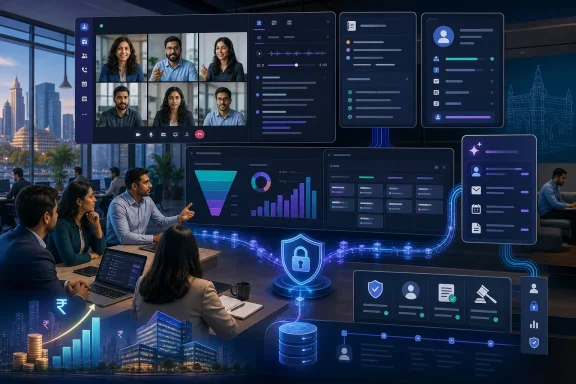 A CRM vendor trying to own the deployment, not just the subscription
Superleap’s pitch is an AI-native CRM for sales, marketing and revenue teams. The company divides that offer into SuperOS for data management, SuperSense for customer intelligence and AI agents intended to handle repetitive revenue work. It also markets voice bots and integrations with business software including WhatsApp, Slack, Microsoft Teams, Anthropic’s Claude and OpenAI’s ChatGPT.The practical distinction in Superleap’s strategy is implementation. Its “Superleap Deploy” offering says the company’s own team builds, deploys, runs and expands the platform rather than passing a customer to a systems integrator after the license sale. That model is aimed squarely at the difficult part of replacing an established CRM: extracting old data, reconnecting telephony and internal systems, retraining a distributed sales force, and keeping daily sales activity running during cutover.
Superleap claims that it migrated more than 10 million records in 45 days in one customer engagement. Boundia separately wrote on LinkedIn that a major education-company deployment involved more than 4,000 users, more than 20 API integrations, bidirectional data synchronization with a data lake and a 1,500-person call-center operation. Ascendants describes a related Aakash Education rollout as moving 5,000 counselors across 400 locations in under 60 days.
Those are company claims, not independently audited implementation results. The difference matters because CRM migrations routinely fail on data quality, permissions, workflow exceptions and user adoption long after an announced go-live. Still, Superleap’s own product materials and customer-logo pages do show Razorpay, Cars24, Aakash Education and other organizations as users or deployment customers. That supports the narrower conclusion that the company has landed enterprise-style accounts; it does not verify the claimed data volumes, timelines or business outcomes.
Microsoft Teams is the clearest Windows-side integration
Superleap’s Microsoft Teams integration page describes a workflow that lets users create Teams meetings from CRM records, automatically synchronize recordings, transcripts and notes to the relevant record, share deal context inside Teams chats, and deliver lead or pipeline updates to Teams channels. It also says its AI can use meeting transcripts to prepare follow-up emails with action items and deal context.For sales teams living in Teams, that is a sensible automation target. A common weakness in CRM data is that the customer conversation stays in a meeting recording or an employee’s notes while the account record receives only a vague, delayed update. Automatically connecting a transcript to a customer, contact or opportunity can make pipeline reporting more useful — provided identity matching, access controls and retention policies are correct.
It also creates a larger governance burden than Superleap’s funding announcement acknowledges. Meeting recordings and transcripts can include commercial terms, financial information, support escalations, personal data and internal discussion. An organization considering the integration needs to establish where Teams artifacts are processed and stored, whether Superleap receives raw recording or transcript content, how long it retains that data, what models or third parties process it, and whether existing Microsoft Purview retention labels and eDiscovery procedures continue to work as intended.
Superleap’s public Teams page speaks broadly of an enterprise-grade and secure AI CRM but does not specify the Microsoft 365 permissions required, its data residency options, retention controls, audit-log coverage, tenant isolation, model-training policy, or compliance certifications. Those omissions are normal for marketing pages, but they are not minor configuration details for regulated banks, healthcare providers or education organizations — the very verticals Superleap says it is targeting.
A Teams administrator should therefore treat Superleap as a CRM integration that can ingest meeting intelligence, not as a lightweight notification bot. Pilot it with representative meetings, data-classification rules and a small group of account teams before allowing automatic synchronization across a broad sales organization.
The funding is being aimed at enterprise distribution
According to Ascendants, Superleap says it grew tenfold over the past year and now serves customers in banking, financial services and insurance, SaaS, healthcare, travel, hospitality and media. The company has named Razorpay, Aakash Education, MediBuddy, HCL GUVI, Cars24, PagarBook, Plum and Superhealth among its customers.Superleap’s own website says it has more than 100 customers and more than 100 integrations. Those claims indicate a company moving beyond an early prototype, but the available public material does not disclose annual recurring revenue, net revenue retention, number of paying enterprise accounts, contract values, churn, or the portion of revenue coming from implementation versus recurring software subscriptions. A tenfold-growth claim without a starting revenue base is directionally interesting but cannot show the scale or durability of the business.
The use-of-proceeds is more revealing. Enterprise go-to-market spending means more sales capacity, implementation staff and customer success effort, alongside work on AI features. That is consistent with Superleap’s decision to sell deployment ownership as part of the product. The company is not simply asking buyers to replace Salesforce, HubSpot or a homegrown CRM with another database; it is selling a managed migration and operating model around the replacement.
That can be attractive for businesses that have been stranded by an old CRM rollout. It can also deepen customer dependence on the vendor. When the same company owns the application, deployment process, custom workflows, data mappings and AI agents, a future migration away from the platform becomes harder unless the customer contracts for usable exports, documented integrations, clear data ownership and support during exit.
Peak XV’s existing relationship changes the reading of the round
Peak XV’s Surge program has changed substantially from its original cohort-centered form. The Economic Times reported in June that Peak XV had folded Surge more closely into broader early-stage investing after partner departures and fewer cohorts. Peak XV’s current Surge materials say it can invest from $500,000 to $5 million at seed stage, co-invest with other backers and provide hands-on support in hiring, product, go-to-market, communications and expansion.A ₹36 crore, or roughly $3.7 million, round fits inside that stated range. It is therefore plausible as a Surge-led financing, even though the exact deal has not yet been publicly confirmed by the investor. More importantly, the ticket is big enough to fund a period of enterprise expansion but small enough that Superleap will need to turn its migration-heavy services model into repeatable delivery rather than relying on bespoke rescue projects.
The announced investor list also includes Gruhas and Supermorpheus Group, with angels including Unacademy co-founder Gaurav Munjal, Shaadi.com founder Anupam Mittal, Mukesh Bansal and Zerodha co-founder Nikhil Kamath. Ascendants named those supporters, but it did not say whether they invested in this round, were prior investors, or how much capital each committed. The distinction is material: a historic cap-table list is not the same thing as a new financing syndicate.
What IT buyers should ask before treating AI CRM as a Teams extension
The central appeal of Superleap’s product is clear: reduce the manual work between a sales conversation in Teams and an updated customer record. The critical due diligence is less glamorous. IT and security teams should request answers that connect the CRM’s AI features to their existing Microsoft 365 controls.- The organization should determine exactly which Microsoft Graph and Teams permissions Superleap requires, including whether it receives access to recordings, transcripts, chat messages, calendars or user profiles.
- The organization should verify the data path for recorded meetings and AI-generated summaries, including storage regions, subprocessors, encryption, retention periods and deletion behavior after a Teams meeting or CRM record is removed.
- The organization should test how Superleap handles Microsoft Purview labels, sensitivity markings, legal holds and eDiscovery obligations before enabling automatic transcript synchronization.
- The organization should require a documented export plan for contacts, activities, meeting metadata, transcripts, workflow configuration and AI-agent histories before committing deeply to vendor-managed deployment.
Update: Additional details (August 4, 2026)
Indian Startup Times additionally names Deepinder Goyal and Kunal Shah among Superleap’s backers, alongside the previously reported investors, and adds Qube Cinema to its customer list.The outlet also attributes Superleap’s claimed migration of more than 10 million records in 45 days specifically to Razorpay. These remain company-reported deployment figures rather than independently audited results.
References
- Primary source: ascendants.in
Published: 2026-08-04T07:07:30+00:00
Superleap Raises Rs 36 Crore In Pre-Series A Funding
AI-native CRM startup Superleap has raised Rs 36 crore in a pre-Series A round led by Peak XV’s Surge to expand its enterprise and AI capabilities.ascendants.in - Related coverage: surge.peakxv.com
How We Partner | Surge by Peak XV
Capital, dedicated partners, and full-stack support from day zero. Up to $5M seed investment with always-on platform access and Peak XV network.surge.peakxv.com - Related coverage: peakxv.com
Superleap | Peak XV Partners Portfolio Company
 www.peakxv.com
- Related coverage: surge.peakxv.com
FAQ | Surge by Peak XV
Frequently asked questions about the application, eligibility, and evaluation.surge.peakxv.com - Related coverage: techcrunch.com
Peak XV raises $1.3B, doubles down on AI as global VC rivalry in India heats up | TechCrunch
Peak XV says most of its new capital will target India as the firm prioritizes AI, fintech and cross-border bets while navigating recent partner departures.techcrunch.com - Related coverage: economictimes.indiatimes.com
Peak XV folds Surge into broader early-stage investing amid executive exits, fewer cohorts - The Economic Times
Peak XV Partners is reshaping its Surge seed-investing platform. The venture capital firm is integrating Surge more closely with its overall early-stage investment operations. This move follows team exits and a slower cohort intake. Surge will now offer up to $5 million per company. This...economictimes.indiatimes.com - Related coverage: peakxv.com
Peak XV
www.peakxv.com
- Related coverage: techcrunch.com
Learn what it takes to raise a Series A in 2027 at Disrupt 2026 | TechCrunch
Learn what it takes to build a Series A in 2027 from top VCs at TechCrunch Disrupt 2026, taking place at San Francisco’s Moscone West on October 13-15.techcrunch.com - Related coverage: superleap.com
Careers at Superleap — Build the future of #1 AI CRM for enterprises
Join Superleap's team building next-gen AI CRM. Peak XV-backed, 100+ enterprise customers. Own your work, ship fast, skip corporate theatre. www.superleap.com
- Related coverage: superleap.com
Superleap Blog Author – Subham Kumar Boundia
Subham is the Co-Founder and CEO at Superleap. He is an experienced founder with over 8 years of experience in hyper-growth roles at Unacademy and Ola. His vision is to help fast-moving sales teams with a new-age CRM they love.
www.superleap.com
- Related coverage: nexus.opensphere.ai
Subham Kumar Boundia - Superleap | OpenSphere Nexus
Subham Kumar Boundia is a Co-Founder of Superleap, focused on product innovation in the CRM space. nexus.opensphere.ai
- Related coverage: linkedin.com
Superleap CRM went live with 4000+ users at one of India's biggest education companies! 10+ years of legacy CRM buildup. Cleaned up and migrated in 45 days. A Big Four firm had consulted them… | Subham Kumar Boundia
Superleap CRM went live with 4000+ users at one of India's biggest education companies! 10+ years of legacy CRM buildup. Cleaned up and migrated in 45 days. A Big Four firm had consulted them earlier and quoted a 9-month timeline. We did it in 1.5 months at half the cost. What did the...www.linkedin.com
- Related coverage: linkedin.com
#superleap #crm #ai #hiring | Subham Kumar Boundia
Superleap has grown a solid 400% over the past 6 months (AMJ & JAS) on the back of our reimagined AI CRM. We are on a mission to liberate long-stuck Enterprise and Mid-Market customers from painful legacy sales CRM experience across industries in Education, BFSI, Healthcare, B2B, Tech... - Related coverage: glassdoor.co.in
Superleap Reviews | Glassdoor
11 Superleap reviews. A free inside look at company reviews and salaries posted anonymously by employees.www.glassdoor.co.in
- Primary source: Indian Startup Times
Published: 2026-08-04T13:51:23+00:00
