

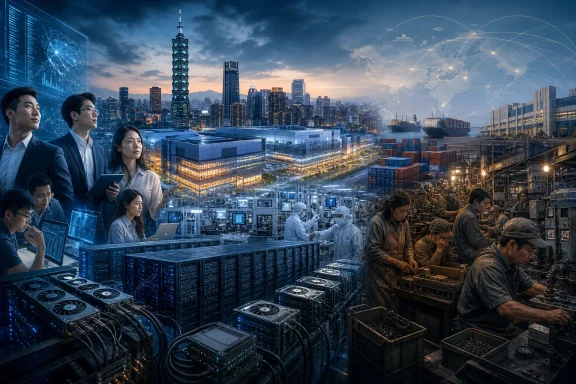
The original Lianhe Zaobao reporting, republished by ThinkChina, captures the lived contradiction well. Semiconductor engineers, server makers and investors are participating in a market boom tied to Nvidia systems, TSMC manufacturing and a dense network of Taiwanese power, cooling, board and assembly suppliers. Workers in lower-paid domestic services and traditional industries see the headline numbers but have far less reason to believe the surge will materially change their pay or career prospects.
For Windows users and IT buyers, Taiwan’s position matters far beyond chips alone. The island’s companies supply the contract-built AI servers, motherboards, power systems, networking equipment and thermal hardware behind the data-center buildout that is making Copilot-era infrastructure, AI PCs and enterprise GPU capacity possible. The boom is generating real supply-chain strength—but it is also moving some of that physical production outside Taiwan.
Taiwan’s GDP surge is an AI infrastructure story
Taiwan’s latest growth forecast is not a broad consumer-led boom. The DGBAS said first-quarter real exports of goods and services rose 35.76% year over year, driven by demand for AI and associated infrastructure. Its 9.64% full-year projection was the product of that export acceleration, along with investment spending by companies expanding capacity.
The Central Bank of the Republic of China separately raised its own 2026 growth forecast to 9.45% in June, citing AI-related exports and private investment. Taiwan’s Ministry of Finance reported that June exports rose 40.3% from a year earlier to US$74.83 billion, the third-highest monthly total on record. Information and communications technology products plus electronic components rose 52.9%, while traditional industries collectively rose 6.9%.
That last figure complicates the starkest reading of a two-speed economy. Traditional manufacturing is still growing much more slowly than the AI-linked export engine, but it is not uniformly collapsing. The central bank explicitly pushed back on claims of an economy split into winners and losers, arguing that traditional manufacturers have been improving their value-added output and joining AI supply chains.
Both descriptions can be true. A 6.9% increase is a recovery, especially after a long period of weak demand in sectors such as metals, petrochemicals and machinery. It is also nowhere close to the expansion available to firms shipping high-end components, servers and related electronics into the global data-center spending cycle.
The meaningful comparison is therefore not whether traditional exports are positive or negative in a single month. It is who can command investment, scarce engineering staff, stock-market capital and pricing power when AI demand is accelerating. On that measure, the distance between the two sides remains large.
The concentration problem is visible in wages and capital
ThinkChina describes a market in which retail investors are increasingly worried about leverage and valuations. That concern is not theoretical: Taiwan’s stocks have become a concentrated way to express confidence in AI infrastructure, and TSMC occupies an outsized place in the local market as well as global semiconductor supply.
The economic risk is not that TSMC or Nvidia demand is imaginary. TSMC’s financial results and Taiwan’s export data show that AI hardware orders are translating into shipments, revenue and capital expenditure. The problem is that national statistics can make a concentrated gain look widely distributed.
DGBAS wage data released in July showed the share of employees earning below the average monthly wage had reached 69.95% in the first quarter, a record. This is a familiar consequence of averages being pulled upward by bonuses, overtime and high compensation in a relatively narrow set of industries. Electronics workers are not the only people benefiting, but their income gains are sufficiently large to distort the picture for everyone else.
The distinction matters for policymakers and employers. AI manufacturing is capital-intensive and does not create jobs at the same rate as a construction, hospitality or services boom. Taiwan can post a near-double-digit GDP growth forecast while a kindergarten teacher, retail employee or worker in a domestically focused factory experiences little more than higher living costs and more visible wealth in the stock market.
The government cannot solve that gap with a single interest-rate decision. The central bank itself has recently discussed the K-shaped economy as a structural problem in which averages conceal diverging outcomes. Broader diffusion of AI tools may eventually raise productivity outside electronics, but that is an expectation, not something Taiwan’s 2026 data have demonstrated.
Taiwan’s manufacturing advantage is being exported with its companies
The strongest part of ThinkChina’s account is its explanation of why Taiwan is hard to replace. A leading AI system is not merely a GPU. It requires advanced chip fabrication, packaging, substrate and board design, networking, mechanical components, redundant power, liquid or air cooling, server assembly, validation and logistics. Taiwan’s advantage is the coordination among firms across those layers, often within short distances and with long operating relationships.
That makes the popular shorthand—Taiwan makes the world’s AI chips and servers—directionally useful but incomplete. The semiconductor lead is real: Taiwan remains the central location for leading-edge manufacturing and advanced packaging. But “Taiwanese server production” does not always mean servers built in Taiwan.
The Market Intelligence & Consulting Institute, or MIC, forecast in April that US AI-server production capacity would rise from 23% to 40%, while Taiwan and Mexico’s shares decline and capacity emerges in Southeast Asia and Europe. That is a critical qualification to the claim that Taiwanese companies produce about 90% of AI servers. Taiwanese original design manufacturers and contract manufacturers may retain the customer relationship, engineering role and a large share of the value. The rack-level systems, however, are increasingly assembled closer to US cloud customers.
This is not a sign that Taiwan is losing the AI race. It is the practical effect of tariffs, customer risk management and pressure for geographically diversified supply chains. For a hyperscaler buying tens of thousands of GPU servers, US assembly can reduce freight, shorten deployment timelines and limit exposure to a single production location.
But it changes what “AI island” means. Taiwan’s companies can remain global leaders while more of the physical manufacturing footprint and some associated jobs are relocated. That makes headline export and corporate-profit data a less reliable proxy for where the next wave of value creation will occur.
China competition is strongest below the cutting edge
The report correctly identifies mainland China as a competitive threat, but the immediate pressure is more nuanced than a direct challenge to TSMC’s leading-edge production. US export restrictions still constrain access to the most advanced tools and accelerators. Taiwan retains a formidable edge in advanced foundry work, packaging and the supply chains serving top-tier AI training systems.
The more immediate challenge sits in mature-node semiconductors, general-purpose hardware and the emerging market for physical AI: robots, vehicles, industrial systems and devices collecting real-world operational data. China has scale in domestic deployment, a large manufacturing base and fast-moving model developers including DeepSeek and Alibaba’s Qwen.
Taiwan’s hardware firms are well placed to supply those markets, but success will require more than assembling systems designed elsewhere. The next phase of AI shifts value toward software integration, data, deployment tools and industry-specific applications. A company that builds an AI server captures a different—and potentially more replaceable—piece of the stack than a company controlling the platform, model, customer data or recurring software contract.
For the Windows market, this is where the story reaches beyond fabs and GPU clusters. AI PCs, industrial Windows deployments, local inference workstations and edge devices will depend on the same Taiwanese manufacturing depth. Yet the larger margins may accrue to the companies that own operating systems, cloud platforms, enterprise applications and AI services rather than the firms that assemble the equipment.
The boom’s test is whether gains spread before production moves
Taiwan has not merely caught a speculative wave. It has built a globally important manufacturing position over decades, and the current AI spending cycle is producing observable output, exports and investment. Claims that the entire advance is a bubble go further than the evidence supports.
The more defensible warning is that Taiwan has become unusually dependent on a single, capital-heavy growth engine at the same moment its most important manufacturers are being asked to duplicate capacity overseas. If AI infrastructure spending slows, Taiwan’s economy has less room than diversified peers to absorb the shock. If it continues, the country still must decide how much of the resulting income, skills development and production remains at home.
June’s improvement in traditional-industry exports offers a small but important counterpoint to the bleakest version of the two-speed narrative. It does not erase the wage divide, the capital-market concentration or the offshoring pressure. It does show that the lower branch of the K can rise.
The practical measure of Taiwan’s AI success over the next several quarters will not be another record TSMC valuation or a larger GDP forecast. It will be whether the country can turn its unmatched hardware cluster into broader productivity gains—and retain enough of the server and advanced-manufacturing work now being redistributed to the United States and elsewhere.