

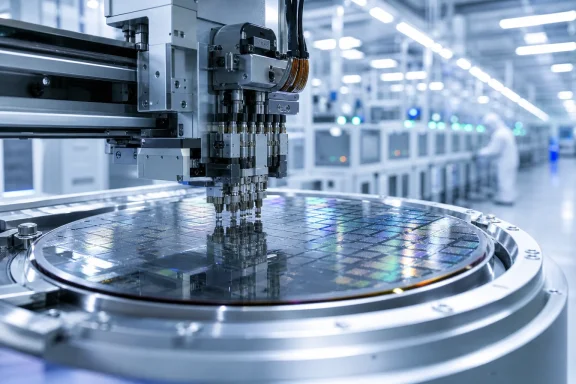
The central technology in this discussion is TSMC’s CoWoS service, but the most defensible conclusion is not that one company’s position is about to disappear. It is that AI demand is encouraging a broader Taiwanese build-out involving foundry packaging, outsourced semiconductor assembly and test providers, new facilities, and alternative panel-level approaches. The outcome will matter to Windows users indirectly: availability and cost of the GPUs and AI accelerators used in cloud services, workstations, and eventually AI-capable PCs depend on the entire supply chain, not solely on chip design.
Why CoWoS has become so important
CoWoS is an advanced-packaging service designed to integrate multiple system-on-chip dies with high-bandwidth-memory stacks for high-performance-computing products. This matters because modern AI workloads move vast quantities of data between compute silicon and memory. Packing these elements together in a capable, high-bandwidth assembly is fundamental to the performance of many AI accelerators.
TSMC says demand for CoWoS has grown strongly with AI since 2023. That timeline should not be confused with the release of ChatGPT itself: ChatGPT was publicly introduced as a research preview on November 30, 2022. The distinction is more than a date correction. A consumer-facing AI launch and a sustained industrial ramp in servers, accelerators, memory, substrates, test, and packaging are separate events. The latter can accelerate after the former as cloud providers and hardware vendors turn interest in AI into procurement plans.
This is why packaging shortages can constrain AI systems even when there is adequate demand for chips. A sophisticated accelerator is not a finished product when its logic die leaves a wafer fab. It must be connected to memory and other silicon, then tested and integrated into systems. Bottlenecks at any of those stages can limit delivered hardware.
An investor estimate reported in June 2026 placed the then-current CoWoS supply-demand gap at about 20%, with a projection that it could narrow to around 10% by year-end as TSMC and its partners expand. That is useful as an indication of how market participants viewed tightness, but it is not a TSMC capacity disclosure. It should not be read as a precise measure of output, utilization, or the timing at which shortages will end.
The spending numbers need careful handling
The largest error in many discussions of the packaging race is treating broad capital-expenditure totals as if they were directly comparable, packaging-only investments. They are not.
TSMC’s reported 2026 capital-expenditure outlook of US$60 billion to US$64 billion included an allocation of 10% to 20% for a combined category that covers advanced packaging, testing, mask-making, and related capacity. Simple arithmetic produces a US$6 billion to US$12.8 billion range, but that is a category-wide implication. It does not reveal how much TSMC is spending on advanced packaging alone.
That limitation also prevents a clean comparison with claims that five Taiwanese back-end firms—ASE, Powertech Technology, King Yuan Electronics, Sigurd and ChipMOS—have combined 2026 expansion plans above NT$460 billion. The reported aggregate has not been independently established here, and even if it were, a combined total across several companies would not automatically match TSMC’s broader spending bucket. Investment totals can cover land, buildings, conventional assembly, testing, tools, capacity maintenance, and other activities with very different relevance to advanced AI packages.
ASE’s own announced program provides a more concrete example. The company raised its 2026 capital-expenditure guidance by US$2 billion to approximately US$10.5 billion in response to demand. Reporting described 13 greenfield projects and eight brownfield projects, an indication of expansion through both entirely new sites and upgrades or additions to existing operations.
But this too should not be labeled as US$10.5 billion of advanced-packaging spending. The program covers facilities and equipment: about US$4 billion was described for new factory buildings and facilities, with US$6.5 billion for equipment. That is a major commitment to manufacturing expansion, yet it does not by itself reveal the share dedicated to a specific packaging technology, customer, or product category.
For investors, policymakers, and technology buyers, that accounting discipline matters. Large numbers can signal confidence and an intention to add capacity. They cannot, on their own, establish who has the most usable AI-packaging output, who has the best yields, or who will meet a particular accelerator vendor’s requirements first.
OSATs are gaining options, not automatically replacing foundry packaging
Outsourced semiconductor assembly and test companies, commonly called OSATs, are the natural firms to watch as packaging becomes more valuable. Their historical role gives them manufacturing experience in assembly and test, while AI creates demand for more complex integrations and potentially more diversified supply.
ASE’s announced automated 310 mm by 310 mm panel-level packaging line is a specific sign of this effort. The company expects the new line to enter production in the first half of 2027. Panel-level packaging is notable because it takes a panel-based route rather than relying exclusively on wafer-format processing, potentially opening a different path for scaling advanced-package manufacturing.
The announcement demonstrates that a major non-TSMC supplier is investing in a tangible new technology and capacity initiative. It does not establish that panel-level packaging will displace CoWoS, match it in every application, or change the market leader by 2027. Manufacturing transitions are difficult: qualification, reliability, customer design choices, equipment availability, and yield all determine whether a promising line becomes commercially significant.
This is the key counterweight to narratives of inevitable disruption. Expanding capacity at OSATs can reduce supply-chain concentration and offer customers additional routes to package some chips. Yet advanced packaging is not a commodity defined only by square millimeters of factory floor. The technology must work with a customer’s chip architecture, memory configuration, thermal requirements, interconnect needs, and production schedule. A new line is valuable only after it produces qualified packages consistently and economically.
What cannot yet be concluded about TSMC’s position
Several strong claims circulating around the AI packaging boom need to be treated as unverified rather than repeated as fact.
One assertion puts TSMC at roughly 90% of advanced packaging for AI chips. That figure was attributed to an executive at C Sun, but there is no independently published market definition or methodology establishing TSMC’s share of the whole advanced-packaging market. “Advanced packaging” can cover a wide range of technologies and end markets. A share in a narrow AI-accelerator segment cannot be expanded into a share of the entire industry without a defined denominator.
Similarly, a claim that Nvidia has secured more than half of TSMC’s CoWoS capacity—and that this directly pushed Broadcom and AMD toward OSAT suppliers—lacks primary allocation data or independent confirmation. Capacity reservations are commercially sensitive, and public discussion can easily blur the difference between a customer’s large demand, a negotiated allocation, and a confirmed volume of production.
These gaps matter because they shape a popular forecast: that OSAT expansion will end TSMC’s unrivaled position in advanced packaging. The evidence supports a more restrained view. TSMC has reported AI-driven CoWoS growth; ASE has expanded its 2026 capital plan and announced a panel-level line scheduled for 2027; and tight supply has created clear incentives for more suppliers to participate. Those facts point to an ecosystem seeking more capacity and technical alternatives. They do not prove a coming reversal in market leadership.
Nor is there verified support for claims that TSMC deliberately withholds process knowledge from OSATs, that certain suppliers will complete particular Taiwan and Arizona facilities in 2028 before requiring another year to achieve good yields, or that a defined number of dollars is lost for every failed advanced package. Each might sound plausible in an industry where yields and know-how are consequential, but plausibility is not evidence.
Practical consequences for Windows and AI buyers
For a person buying a Windows laptop today, the link between a Taiwanese package line and the price of a PC is indirect. Most consumer systems do not use the same high-end multi-die AI packages found in leading data-center accelerators. Still, the AI infrastructure market affects the broader technology economy in several ways.
First, cloud AI features depend on data-center hardware. If packaging remains a bottleneck, providers may have fewer accelerators to deploy, slower expansion of AI capacity, or higher costs to absorb. That does not guarantee higher prices for Windows software or cloud subscriptions, but it can influence how rapidly AI services scale and where providers impose usage limits.
Second, scarcity of advanced packaging can influence which products reach market first. A chip designer with enough packaging access may be able to ship accelerators earlier than a competitor with comparable silicon but less assembly capacity. For enterprise Windows environments, that can affect the selection and availability of GPU-equipped workstations, virtual desktop infrastructure, and on-premises AI servers.
Third, diversification has resilience value. A larger Taiwanese base of packaging suppliers and technologies could give chip designers more manufacturing options over time. It would not eliminate concentration risks—advanced semiconductor supply chains remain specialized—but it could make one constrained production path less singularly important.
For IT decision-makers, the sensible response is not to make procurement decisions based on unverified allocation stories. Instead, treat accelerator lead times, qualified system availability, memory configuration, power and cooling requirements, and vendor support as operational variables. A Windows workstation fleet intended for local AI work should be evaluated on delivered systems and supported software stacks, not on broad claims about packaging market share.
The real story is capacity, qualification, and proof
Taiwan’s packaging ecosystem is reacting to an AI boom that has elevated the value of interconnecting logic and high-bandwidth memory. CoWoS remains a prominent technology because it serves exactly that requirement for high-performance computing, while ASE’s larger capital program and planned panel-level production line show that other manufacturers are pursuing expansion and new approaches.
The direction is clear: more investment and more competition for advanced-packaging capability. The scale and consequences are less certain. Broad capex figures are not packaging-only measures, investor shortage estimates are not company capacity disclosures, and bold market-share or customer-allocation claims remain unproven without transparent definitions and independent evidence.
The milestone worth watching is therefore not an oversized headline number. It is whether new lines enter production on schedule, achieve reliable yields, win customer qualifications, and deliver meaningful volumes of the packages needed for AI systems. That is the point at which expansion becomes real supply—and at which the effects can begin to reach the servers, services, and Windows devices that depend on the AI hardware pipeline.