
For organizations that run recurring project, operations, and department meetings from a Team channel, the practical benefit is straightforward: Facilitator’s notes, agenda tracking, questions, and captured actions should no longer require creating a separate calendar-only meeting. Channel meetings place their chat as a thread in the channel’s Posts or Conversations feed, where channel members can find and continue the discussion afterward. Today, that very meeting type is excluded from Facilitator.
Microsoft’s current Facilitator support documentation still states, without qualification, that the agent can be added only to scheduled meetings and cannot be added to channel meetings, instant meetings, or Teams calls. That confirms the feature is not live as of August 7, 2026; admins and users who do not see the Facilitator control in a channel meeting are encountering the documented current behavior, not a licensing or client-side fault.
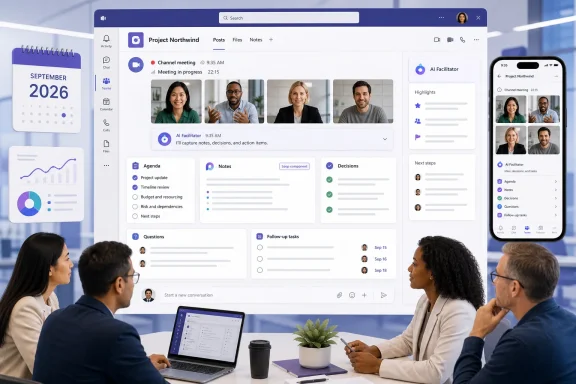 Channel Meetings Have Been the Awkward Exception
A channel meeting is not simply a normal Teams meeting with a channel name attached. Teams treats its discussion as a persistent channel post, visible in the channel and organized as a thread. Microsoft’s own support guidance says members can join from that channel feed, and that conversation remains attached to the channel after the call.
That arrangement makes channel meetings especially common for work where the history belongs to a group rather than a set of invitees: sprint reviews, editorial planning, service-desk handoffs, change advisory discussions, and recurring department meetings. It also made Facilitator’s absence conspicuous. A team could use AI notes in a scheduled meeting created from the calendar, or retain the discussion in the channel, but could not have both through Microsoft’s native workflow.
Facilitator currently creates live collaborative notes, identifies decisions and open questions, tracks agenda timing, responds when mentioned in the meeting chat, and captures follow-up tasks. The notes are stored on a Microsoft Loop page and can be edited by meeting participants. It can also produce a post-meeting transcript summary through Teams Recap, assuming transcription is available.
The channel-meeting addition should bring that work into the place where a project’s meeting conversations already live. But it does not turn every Teams conversation into an AI-notetaking session. The roadmap item, as reported by Windows Report, concerns channel meetings specifically. Microsoft’s current documentation still separates those from Meet now sessions, one-to-one calls, group calls, and external meetings.
The Public Roadmap Record Is Hard to Verify
There is an important reporting wrinkle in this announcement. Windows Report says Roadmap ID 568936 identifies the feature, its worldwide scope, the supported clients, and September 2026 as the rollout period. But Microsoft’s public roadmap page for that exact feature ID did not expose a feature card when checked on August 7; it returned “0 Updates found” rather than the claimed entry.
That does not disprove Windows Report’s reporting. Microsoft 365 roadmap records can be changed, regionally filtered, delayed in the public interface, or made visible through the Microsoft 365 admin center before the consumer-facing roadmap page reflects them. Still, it means the detailed platform and date claims presently rest on Windows Report’s reading of the record rather than on a publicly inspectable Microsoft entry.
It also means readers should treat September 2026 as a rollout target, not a ship date. “In Development” is Microsoft’s status for work being built and tested; it is not the same as “Rolling out,” much less “Launched.” A worldwide general-availability target does not establish that every tenant, Teams update ring, sovereign cloud, or managed device will receive it on September 1, 2026.
Microsoft has not publicly explained whether the capability will initially support every form of channel meeting, whether it will be available in shared channels, or whether it will work with channel meetings created through Teams’ newer calendar experience. Private channels deserve particular attention: Teams does not support scheduling channel meetings in private channels today, so the new Facilitator support cannot remove a restriction that exists one layer below the AI feature.
Licensing and Governance Do Not Change With the Meeting Type
The coming support expansion does not make Facilitator a free Teams feature. Microsoft’s support documentation says a Microsoft 365 Copilot license is required for a user to add Facilitator or turn it on during a meeting. Other internal meeting participants can see the real-time notes and chat updates, but the license requirement remains with the person initiating the agent.
For IT administrators, that means channel meeting support will likely broaden usage more than it changes entitlement. A licensed project lead may start Facilitator for a meeting attended by colleagues without licenses, subject to existing policy and tenant configuration. It does not mean every channel member receives a Copilot license, nor does it automatically authorize every channel owner to enable the feature.
There are also dependencies that teams often miss during a pilot:
- Facilitator relies on Loop experiences in Teams for collaborative AI-generated notes. Microsoft says admins can disable those notes tenant-wide through the
IsCollabMeetingNotesFluidEnabledsetting. - Transcription is central to the after-meeting experience. Microsoft says that if users want to ask Facilitator about the meeting after it ends, transcription must be on before or during the meeting.
- A meeting’s Copilot settings must allow Copilot and Facilitator during the meeting, or during and after it, before the Facilitator toggle can be used.
- Only organizers or presenters using Teams desktop or web can currently turn Facilitator on or off during a meeting. Mobile participants can see notes, but Microsoft has not said the channel-meeting rollout will change who can initiate the agent.
- Microsoft currently lists external chats and meetings among Facilitator’s limitations. The roadmap description reported by Windows Report does not state that channel-meeting support changes the handling of guests, anonymous attendees, or cross-tenant participants.
That last point is operationally significant because channels frequently include guest users. Teams supports guest membership in a Team, while Facilitator’s current limitations distinguish internal meeting participants from external ones. Before using channel-meeting Facilitator for customer, supplier, or partner-facing work, administrators should wait for Microsoft to publish the updated limitations rather than assume that a channel’s guest settings and Facilitator’s note-access rules will align cleanly.
AI Notes Can Bypass Some Familiar Meeting Controls
Moving Facilitator into channel meetings also makes an existing compliance issue more visible. Microsoft’s current admin documentation warns that meeting controls such as Prevent copy and paste and Watermarks do not apply to Facilitator’s responses or AI-generated notes. It additionally says AI-generated notes are not automatically collected as cloud attachments in Microsoft Purview eDiscovery.
Those limitations do not make Facilitator unusable, but they do require a different review from the one an organization uses for recordings and transcripts. A channel meeting often serves as an informal project record. Once AI-generated notes, decisions, and task summaries are available in that same context, teams should decide whether those notes are business records, where they are retained, and how users should correct or remove an inaccurate AI-generated action item.
Microsoft also notes that Facilitator currently supports a single spoken language per meeting. Users select the meeting language when enabling it, and notes may not be generated correctly if that selection does not match the language spoken. Teams with multilingual meetings should not expect the channel-meeting expansion alone to solve that limitation.
The near-term action is modest: do not redesign meeting practices yet, but identify the channel-based recurring meetings that currently use manual notes or workarounds. When Microsoft moves Roadmap ID 568936 from development into rollout and updates its Facilitator documentation, admins will need to test the feature against their Copilot licensing, Loop policy, transcription settings, guest access, retention requirements, and desktop-versus-mobile initiation rules.
Until then, Microsoft’s own published support page remains the controlling record: Facilitator is unavailable in Teams channel meetings today.
