

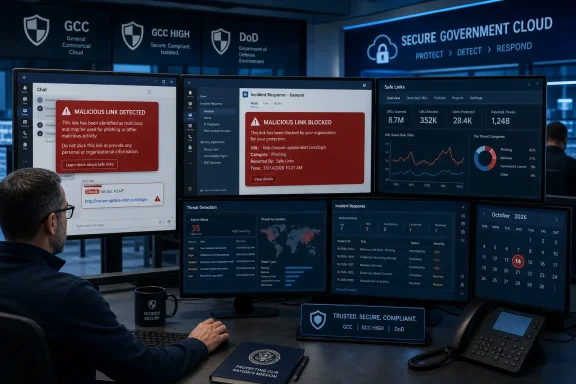
The practical takeaway for government IT teams is narrower than the roadmap wording may suggest: this is a message-warning feature, not a universal click-blocking control. Microsoft’s existing Teams documentation distinguishes its built-in Malicious URL Protection from Defender for Office 365 Safe Links, which can block a URL at the time of click, and from zero-hour auto purge, which can remove malicious content after it was delivered.
For GCC, GCC High, and DoD tenants, that distinction should shape October rollout planning. A warning banner can interrupt a casual click, but it does not replace Defender licensing, external-access restrictions, user reporting, or incident-response procedures.
Roadmap ID 569421 targets GCC, GCC High, and DoD
The Microsoft 365 Roadmap describes the feature as protection for malicious URLs sent in Teams chat and channels. It lists general availability as October 2026, with support across Teams desktop, Android, and iOS clients. The entry is still marked In development as of August 14, meaning administrators should treat October as Microsoft’s published target rather than a completed deployment date.
Microsoft also lists Worldwide standard multi-tenant, GCC, GCC High, and DoD under the item’s cloud instances. That broad cloud list is notable because Teams has already offered malicious-link warnings outside the government clouds. Microsoft’s Defender for Office 365 change log says known malicious URLs in Teams messages began receiving warnings in internal and external chats and channels in September 2025; links found malicious up to 48 hours after delivery could receive warnings as well.
The new roadmap item therefore reads as a sovereign-cloud availability expansion, rather than a new detection engine or a wholesale redesign of Teams link handling. Microsoft has not published an accompanying technical announcement detailing the rollout sequence between GCC, GCC High, and DoD, whether all three will receive it simultaneously, or whether users must be on a minimum Teams client build.
Those omissions matter in federal environments, where feature parity often arrives on a different schedule and under different service constraints than commercial Microsoft 365. An October target is useful for planning, but it is not yet a deployment notice that an agency can use to close a compliance finding or retire a compensating control.
A warning is not Safe Links blocking
Microsoft’s Teams documentation is unusually direct about the limits of Malicious URL Protection. The base protection checks links shared in chats, channels, and meeting messages and displays a warning to both the sender and the recipient when a link is suspicious or unsafe. The documentation says the feature does not block a link when the recipient clicks it.
That is materially different from Safe Links for Teams in Microsoft Defender for Office 365. Safe Links applies policy-based time-of-click protection: Microsoft reevaluates the destination when a user attempts to open it and can block access according to Defender portal settings. It is a licensed Defender capability, not the baseline Teams warning feature described in Roadmap 569421.
Zero-hour auto purge, or ZAP, is a third and more forceful layer. Microsoft says ZAP for Teams can remove malicious URL and content from internal messages after delivery, with actions governed through Microsoft Defender settings. The company identifies Defender for Office 365 Plan 2 as the required licensing tier for ZAP in its feature comparison.
For administrators, the result is a simple but important hierarchy:
- Malicious URL Protection adds an in-message reputation warning and is intended as a baseline layer.
- Safe Links can intervene when a recipient clicks the URL, provided the tenant has the necessary Defender licensing and policies.
- ZAP can remediate content after delivery, but it is not a substitute for stopping a user from acting on a link before Microsoft’s verdict changes.
A Teams tenant that receives Roadmap 569421 should gain a useful user-facing signal, but it should not assume that every dangerous destination will be blocked or that every harmful message will disappear automatically. Teams remains a collaboration surface where the speed of a social-engineering campaign can outpace both end-user judgment and post-delivery remediation.
Teams messages have become a security operations workload
Microsoft has steadily built out Teams-specific response and reporting controls since its initial collaboration-security work. Its Defender for Office 365 change log documents user reporting for malicious Teams messages across chats, standard channels, shared channels, private channels, and meeting conversations. In 2026, Microsoft also added the ability for security operations teams to block malicious domains and sender email addresses connected to Teams external communication from the Defender portal.
Those controls are relevant to the government-cloud rollout because link warnings only help if employees recognize them and security teams can act on the report. A warning shown to an end user does not itself identify whether the message came from a compromised internal account, a guest, an external tenant, or an attacker using a newly created external identity. Nor does Microsoft’s roadmap item say that the new warnings will create a new alert type, incident queue, audit event, or reporting surface for GCC, GCC High, or DoD administrators.
Microsoft’s documentation also says malicious-URL warnings in external conversations apply to all participants if any participating organization has URL protection enabled. That creates a useful protection effect in cross-organization collaboration, but it also means agencies should test the experience with trusted partner tenants before relying on it in operational workflows. A warning visible to a partner is not the same as centrally enforceable containment inside an agency’s own tenant.
The clearest operational value is in reducing the chance that an ordinary Teams message gets treated as inherently trustworthy. Teams chats are often short, immediate, and tied to active work: a shared document, a procurement request, an emergency change, or a request from someone presented as a colleague. A conspicuous warning gives users a reason to stop and report. It does not establish that the destination is safe when no warning appears.
What government tenant admins should do before October
There is no indication in the roadmap that administrators will need to turn on a new tenant-wide switch for the government rollout. Microsoft’s current Teams guidance says the protection is included in Teams’ baseline security posture for new tenants. For existing tenants where the setting remains visible, it can be reviewed under Teams admin center Messaging settings and Messaging safety settings, using the option to scan messages for unsafe URLs.
That guidance is useful, but it is not yet government-cloud-specific rollout documentation. GCC, GCC High, and DoD administrators should confirm the feature’s status in their own tenant when Microsoft posts the final availability notice rather than assuming that commercial-tenant configuration behavior maps perfectly to sovereign clouds.
Before the scheduled release window, security and Teams administrators should review four areas:
- Confirm whether the Teams admin center exposes the unsafe-URL scanning setting in the tenant, and record its current state before the rollout changes anything.
- Verify that users know how to report suspicious Teams messages and that reports reach Microsoft, the organization’s reporting mailbox, or both, according to the tenant’s user-reporting configuration.
- Review whether Microsoft Defender for Office 365 licensing and Safe Links policies already provide time-of-click protection for Teams, particularly for high-risk users and externally facing groups.
- Test external chat, guest access, shared channels, and cross-tenant collaboration policies, because warnings do not remove the need to limit who can initiate or participate in conversations.
Agencies should also make sure their help desk and security operations center can distinguish a link-warning report from a confirmed compromise. A user who clicked a warned-about URL may require endpoint investigation, credential-risk assessment, browser telemetry review, and potentially account containment. The Teams warning is evidence that the user encountered a known-bad or suspicious destination; it is not by itself proof of execution, credential theft, or data loss.
Microsoft has not yet described the government-cloud control plane
The roadmap entry gives a target month and cloud coverage, but leaves several deployment questions unanswered. Microsoft has not stated whether protection will be enabled automatically for every existing government tenant, whether administrators can disable it, how quickly reputation verdicts will synchronize in each sovereign cloud, or whether the warning experience will differ across desktop and mobile clients.
It also does not say whether the feature will initially cover meeting conversations, which Microsoft’s general Teams support page includes alongside chats and channels. The submitted roadmap language specifically names chats and channels, so administrators should not extend the October commitment to meetings until Microsoft publishes a government-cloud-specific confirmation.
The same restraint applies to licensing. Microsoft’s general documentation calls Malicious URL Protection base protection that does not require extra licenses, but Roadmap 569421 does not explicitly restate licensing terms for GCC, GCC High, or DoD. Agencies should not change Defender licensing assumptions solely on the basis of the roadmap entry. They should wait for final documentation or verify entitlement in the relevant government service description.
Microsoft has set October 2026 as the milestone for Teams malicious-URL warnings in its government clouds. When that rollout lands, it will close a visible parity gap for users in GCC, GCC High, and DoD—but it will add a warning layer, not a complete Teams anti-phishing program.