
The promised release is marked In development for general availability in Microsoft’s worldwide standard multi-tenant cloud. That means it is a rollout target, not a feature administrators can enable today, and Microsoft has not yet published an app version, device-firmware requirement, licensing requirement, Message Center notice, or a more exact October deployment date.
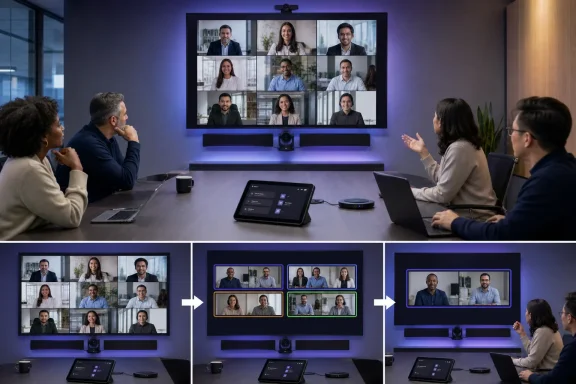
For organizations that use conference rooms as actual meeting participants rather than merely shared displays, the distinction is important. A physical room with several in-person attendees can presently become stranded in the main session while remote colleagues split into working groups. The October change should allow the room system to travel with its assigned group, keeping its front-of-room camera, speakers, microphones, and content display connected to that conversation.
 Android rooms are catching up to a Windows capability
Microsoft’s own Teams Rooms feature-comparison documentation currently lists “Participate in breakout rooms” as available on Teams Rooms on Windows and unavailable on Teams Rooms on Android in the commercial cloud. The roadmap entry is therefore a direct correction to a documented Windows-versus-Android difference, rather than a new breakout-room model for Teams meetings.
Teams Rooms on Windows received comparable breakout-room support in 2023. Microsoft’s public-sector roadmap newsletter at the time said Windows rooms could participate in a breakout room and be moved in and out of the main meeting under an organizer’s control. The Android rollout, if it reaches general availability on the stated schedule, arrives roughly three years later.
That delay matters most for organizations that selected Android room hardware because it is simpler to deploy or less expensive than a Windows-based room PC. Basic meeting join, content sharing, gallery layouts, captions, chat, and PowerPoint Live already exist across both room platforms, but a small number of missing collaboration controls can determine whether a device is suitable for training, workshops, classrooms, board meetings, and hybrid planning sessions.
The roadmap language also sets the scope correctly: the feature is about participation and organizer-directed movement, not breakout-room administration from the room console. Microsoft’s broader Teams support guidance says Android clients can be moved into breakout rooms but cannot manage them. Nothing in Roadmap 569447 says a Teams Rooms on Android console will gain the ability to create rooms, allocate attendees, open or close sessions, or act as a breakout-room manager.
That leaves organizers and designated managers on supported desktop clients responsible for operating the session. The conference room becomes a more capable participant, rather than a control station.
What changes for meetings held in physical rooms
Breakout rooms are often treated as an individual-attendee feature, but conference-room support changes the design of a hybrid meeting. A room resource is a single Teams participant representing everyone seated in that space. When the organizer assigns it to a breakout room, the entire physical group moves together.
This is useful when a team wants an office-based group to deliberate with remote colleagues, or when multiple meeting rooms are used as separate workshop tables. It also avoids the awkward workaround of asking people in the physical room to leave the room system connected to the main meeting and join a separate breakout session from individual laptops. That workaround can create echo, duplicate video tiles, competing audio paths, and a fragmented record of who was present where.
The planned behavior should also improve coordination when the organizer recalls participants to the main meeting. Rather than relying on the people in the room to notice a chat instruction or manually rejoin, the organizer can move the room endpoint back through Teams’ breakout-room controls.
There are still operational limits inherent to breakout rooms. Microsoft’s support documentation says breakout rooms are for meetings of up to 300 participants, and the organizer or an authorized breakout-room manager controls assignment and transitions. If an organization has meeting templates, policies, or meeting types that disable breakout rooms, Android room support will not override those controls.
Administrators should also distinguish this feature from webinar and town hall support. Teams Rooms on Android has been adding attendee and presenter experiences for larger structured events, but breakout rooms are a Teams meeting feature with their own organizer controls and meeting-size limits. The new roadmap item does not announce breakout sessions for webinars or town halls.
The rollout is commercial-only for now
Roadmap 569447 lists only Worldwide (Standard Multi-Tenant) under cloud instances. Microsoft has not listed GCC, GCC High, or Department of Defense availability for this feature. Government tenants should not infer parity from the commercial October target.
Microsoft’s feature-comparison page separately presents commercial, GCC, and GCC High matrices, reflecting the fact that Teams Rooms capabilities do not necessarily arrive in every cloud at the same time. A commercial deployment reaching general availability in October therefore will not answer the question for regulated or sovereign environments.
The omission of a licensing detail is also meaningful. Microsoft has tied several recent Teams Rooms on Android additions to Teams Rooms Pro, including webinar and structured-meeting attendance and the Interpreter agent. Roadmap 569447 does not say whether breakout-room participation will require Teams Rooms Pro, will work with Teams Rooms Basic, or will have another entitlement condition.
Until Microsoft publishes an accompanying Message Center post or product documentation, IT teams should avoid using the roadmap item as grounds to change licenses or replace room hardware. The relevant fact today is that breakout-room participation is planned for Android rooms; the commercial terms and technical prerequisites remain undisclosed.
Admins should prepare the management path now
The timing overlaps with a larger administrative change for Android Teams devices. Microsoft has been moving management of Teams Rooms on Android, Teams phones, Teams panels, and SIP devices from the Teams admin center to the Teams Rooms Pro Management Portal. Microsoft’s migration guidance identifies September 2026 as the period when remaining overlapping Android device-management functions in the Teams admin center are retired.
That creates a practical dependency even though Microsoft has not formally linked the two changes. The breakout-room feature will almost certainly arrive through an application update, and Android room update visibility, maintenance timing, and device health checks are increasingly handled in the Pro Management Portal rather than the Teams admin center.
Microsoft says enrolled Android devices should appear automatically in the newer portal, but older or long-offline devices may need manual attention. Its guidance specifies a minimum Admin Agent version of AA 830 for portal management, while devices on older agent builds can require an OEM firmware update before they can receive the newer management components. Administrators who have permanently disabled automatic updates should pay special attention: Microsoft says it may force a required Admin Agent update ahead of the admin-center retirement to prevent management disruption.
Before October, organizations that depend on breakout sessions should do four things:
- Confirm every supported Teams Rooms on Android device is visible and manageable in the Teams Rooms Pro Management Portal, including rooms that normally remain powered down between events.
- Check each room’s update posture and OEM support status, because a device that cannot receive the required Teams application update will not benefit from the feature merely because the tenant has reached general availability.
- Test an existing breakout-room meeting with a representative room after rollout, including assignment into a room, organizer-directed recall to the main session, audio reconnection, front-of-room video, and any paired touch-console behavior.
- Keep meeting organizers on a supported Windows or macOS Teams client for creating and managing breakout rooms, since the roadmap does not promise management controls on the Android room device.
Microsoft’s roadmap carries its standard warning that schedules and descriptions can change, and the October 2026 target should be read accordingly. But the practical outcome is clear: organizations that chose Android Teams Rooms will soon have a path to use their physical meeting spaces in breakout workflows that Windows Teams Rooms have supported since 2023.