
That does not undercut the certification itself. Microsoft Learn lists Tendfor as certified under both its Unify and Extend models, and its contact-center certification program is intended to validate participating products for quality, compatibility, and reliability. But it does mean this is best read as a public milestone announcement or a renewed market push, not necessarily a certification awarded this week. Neither AnywhereNow nor ChannelLife UK supplied the certification-completion date, the specific Tendfor version assessed, or whether existing deployments must upgrade or alter their tenant configuration.
For Teams administrators, the practical value is less about a new badge and more about what Unify changes in the contact-center architecture: it connects an Azure Communication Services-based customer-engagement application to Teams calling infrastructure. That places Tendfor among a relatively small group of Microsoft-listed providers pursuing the newer model, while retaining its existing Extend certification.
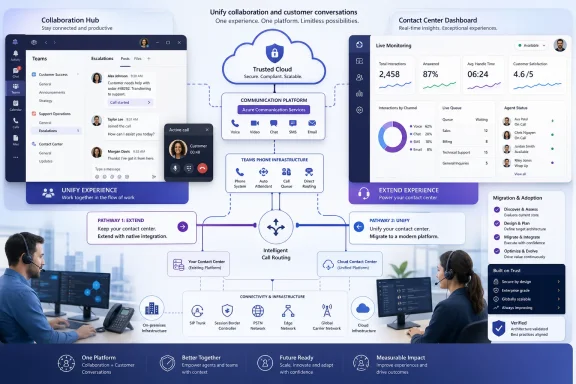 Tendfor Appears in Microsoft’s Unify and Extend Columns
Microsoft’s Teams Contact Center documentation currently lists Tendfor with certifications in two columns: Unify and Extend. Those are distinct integration approaches, not different marketing labels for the same Teams app.
The Extend model builds Teams-facing apps with the Teams client platform, Microsoft Graph, and Cloud Communications APIs. In Microsoft’s description, Teams Phone remains the system used for calls and call-control experiences, while the contact-center provider operates alongside Microsoft 365. This is the model many Teams-integrated contact-center products have used to place agents in familiar Teams workflows while preserving a vendor-run routing and management layer.
Unify is newer and more tightly tied to Azure Communication Services. Microsoft describes it as an approach for native CCaaS applications that use Teams calling infrastructure, extending Teams Phone functions through Azure Communication Services call automation and calling SDKs. In plain administrative terms, the contact-center client can use Teams Phone capabilities without relying on the same SBC-centered architecture associated with older Direct Routing integrations.
ChannelLife UK says Tendfor combines contact-center and attendant-console functions in the Teams workspace, aimed at organizations managing customer calls, internal communications, reception work, and operational call handling. Microsoft’s public certification table, however, certifies contact-center solutions and their integration models. It does not separately describe an attendant-console certification, enumerate Tendfor’s supported receptionist features, or certify every individual workflow that AnywhereNow sells alongside the product.
That distinction matters during procurement. Certification supports the underlying Teams integration, but it is not evidence that a particular operator-console function, CRM connector, wallboard, compliance workflow, or AI feature has been tested by Microsoft.
The Announcement Leaves the Upgrade Question Unanswered
The most consequential omission for existing Tendfor customers is deployment detail. AnywhereNow says the certification gives customers confidence in Tendfor’s alignment with Microsoft’s direction, but the announcement does not state whether a tenant already running Tendfor through the Extend model can move to Unify in place, needs a new Tendfor release, requires a separate Azure Communication Services configuration, or faces changes to call routing and recording.
Those are not minor implementation details. A contact center can include queue logic, resource accounts, telephone-number assignments, carrier connectivity, recording controls, retention policies, supervisor tools, CRM screen pops, emergency-routing decisions, and service-level reporting. Replacing or reworking the integration underneath those pieces is a migration project unless the vendor documents clear compatibility and rollback paths.
Microsoft’s documentation also makes clear that certification is a support boundary. For a certified contact-center solution, the customer contacts the partner first; the partner escalates into Microsoft through its support channels if required. Microsoft may reject a case involving an uncertified solution or an issue the partner can resolve. Tendfor’s certification therefore improves the escalation position for customers, but it does not turn Microsoft into the first-line support desk for Tendfor faults.
Administrators should ask AnywhereNow for the exact build and deployment architecture covered by its Unify listing before treating the announcement as an upgrade directive. The immediate checks should include:
- Confirm whether the tenant is using Tendfor’s Extend integration today and whether Unify requires a parallel deployment, data migration, or new agent sign-in model.
- Obtain a written matrix for Teams Phone, Azure Communication Services, Operator Connect, Direct Routing, Calling Plans, resource accounts, and licensing prerequisites.
- Test inbound routing, transfers, consultative transfers, failover behavior, agent presence, recordings, reporting, and emergency-call handling in a pilot before moving production queues.
- Establish which party owns incidents involving Teams Phone, Azure Communication Services consumption, Tendfor workflow logic, PSTN connectivity, and any connected CRM or identity service.
Microsoft’s Teams Phone extensibility guidance says agents using an Azure Communication Services Calling SDK-based CCaaS client need Teams Phone licensing, and Teams users must be Enterprise Voice enabled to make and receive calls through Teams Phone. It also notes that customers need a connectivity option—Calling Plans, Operator Connect, or Direct Routing—for PSTN calling. Those requirements make it especially important not to interpret “Teams-native” as “license-free” or “carrier-free.”
Certification Is Meaningful, but It Is Not Exclusivity
AnywhereNow describes Tendfor on its product site as the world’s first fully certified contact center and attendant console for Microsoft Teams. The public record supports the narrower claim that Tendfor is a certified Teams contact-center solution on Unify and Extend. It does not establish that Tendfor was the first Unify-certified contact center overall.
CX Foundation, an industry publication covering contact-center vendors, reported that CentrePal became the first provider certified on Microsoft Teams Unify for contact centers in August 2025. Microsoft’s own certified-provider table also shows other products with Unify certification, including AudioCodes, CentrePal, ComputerTalk, ContactCenter4All, Heedify, Landis Technologies, ROGER365.io, and Sensiple. The differentiator AnywhereNow may be asserting is the combination of contact-center and attendant-console functions in one product, but that broader “world’s first” formulation is not independently substantiated by Microsoft’s certification material.
The more defensible conclusion is that Tendfor is now one of the certified Unify options in a maturing Teams contact-center market. That status helps customers distinguish it from integrations still in certification or products built around a different architecture. It does not settle feature depth, pricing, regional telephony availability, migration effort, or suitability for a particular service desk.
Microsoft’s current list shows three providers—Mitel, Purple, and Unexus—still in the certification process. The field is therefore still moving, and Unify certification should be considered a shortlist criterion rather than a complete selection decision.
What Unify Changes for Teams Contact Centers
The Unify model is relevant because Microsoft is putting more of its customer-engagement development around Teams Phone extensibility and Azure Communication Services. For a vendor, that creates opportunities for richer call automation, direct use of media and calling capabilities, and more integrated AI features. For an organization, it can reduce the architectural distance between Teams calling and the contact-center workspace—but the operational model remains shared among Microsoft, the vendor, the carrier, and the customer’s IT team.
A third-party contact-center client can also introduce a dual-persona arrangement, where an employee uses one experience for ordinary internal Teams collaboration and another for customer-care calls. Microsoft says this can allow Teams administrators and ISVs to control which endpoints originate or answer each class of call. That may be useful for separating personal Teams calls from queue-based contact-center work, but it should be designed deliberately to avoid confused presence states, missed transfers, or inconsistent recording behavior.
There is also a governance consideration that should not be buried in a certification announcement. Microsoft’s Teams Phone extensibility FAQ states that calls handled by a server-side CCaaS application acting through a Teams resource account fall outside Microsoft Purview Information Barrier policy enforcement by design, because those policies do not evaluate communications started by bots, Entra applications, or APIs. Organizations subject to internal separation rules should validate the precise behavior of their Tendfor design with their compliance and legal teams rather than assume normal Teams policy coverage applies unchanged.
A Useful Shortlist Signal, Not a Deployment Plan
Tendfor’s appearance in Microsoft’s Unify-certified list is a concrete positive for organizations standardizing contact-center work on Teams Phone. It provides Microsoft-recognized assurance for the integration and a defined support path through AnywhereNow, while the product’s simultaneous Extend certification gives the vendor more than one integration route.
The announcement’s weak point is specificity. It does not say when the certification was completed, which Tendfor release it covers, how an existing customer reaches the Unify architecture, what it costs in Azure Communication Services consumption, or whether customer deployments need a change in licensing or PSTN design. With Microsoft’s documentation already listing Tendfor in April, customers should ask for those implementation facts—not assume that an August certification announcement automatically changes what is running in their tenant today.
