
The catch is that buyers are purchasing a direct-die cooling project, not a conventional drop-in AM5 CPU. Thermal Grizzly’s own documentation says AMD’s original processor warranty is void once the company removes the heat spreader, and the replacement coverage has firm exclusions for physical damage, liquid-metal spills on package components, PCB damage, and overclocking beyond AMD’s specified clock and memory limits.
That distinction makes the new Ryzen 9 9950X3D2 option more useful than a casual reading of “delidded with warranty” suggests. Thermal Grizzly is taking responsibility for its machining and for qualifying CPU faults, but it is not insuring every mistake that can happen after a user exposes the chiplets and installs a cooler.
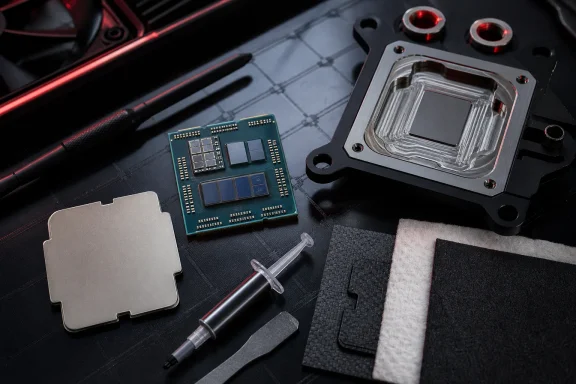 A flagship AM5 chip with the lid already removed
AMD released the Ryzen 9 9950X3D2 on April 22, 2026, as its 16-core, 32-thread Zen 5 flagship with second-generation 3D V-Cache on both compute chiplets. AMD rates it at up to 5.6GHz boost, 200W TDP, 192MB of L3 cache, and 208MB of total cache once its L2 cache is included. It remains a standard Socket AM5 processor, with support for Windows 11 and Windows 10, DDR5, PCIe 5.0, EXPO, Precision Boost Overdrive, and Ryzen Master.
The reason to delid such a chip is straightforward: remove the integrated heat spreader, or IHS, and the cooling assembly can transfer heat from the silicon through fewer material layers. The 9950X3D2 is also AMD’s highest-TDP mainstream desktop processor to date, with a 200W default rating and a recommended liquid cooler. That makes thermal headroom especially attractive for buyers trying to sustain high all-core work such as compilation, rendering, simulation, or long gaming sessions alongside background workloads.
Thermal Grizzly says each processor is cleaned and function-tested after delidding. It ships a USB stick containing a temperature-test screenshot and microscope image of the individual processor, plus the removed AMD heat spreader. The company warns, however, that the included heat spreader must never be refitted: its materials cannot reliably bridge the height difference to the exposed chiplets after delidding, and reinstalling it voids Thermal Grizzly’s warranty.
That leaves the customer with a CPU that cannot safely return to an ordinary air cooler or an all-in-one liquid cooler designed around an intact AM5 package. The modification only makes sense when the rest of the cooling build has been planned around it.
The reported price is high, but the comparison needs care
Club386 and KitGuru reported a €1,199 price for the delidded Ryzen 9 9950X3D2, while TweakTown listed the store price as $1,402.83 including VAT. AMD’s official suggested price for the unmodified processor is $899 in the United States.
The frequently repeated “more than $500 extra” framing is directionally fair as a description of the premium service, but it is not a clean retail-price comparison. Thermal Grizzly’s European store displays pricing with VAT included, while AMD’s $899 SEP is a U.S. suggested price that excludes sales tax. At Germany’s 19% VAT rate, €1,199 represents roughly €1,008 before VAT, before shipping and before any currency conversion. Thermal Grizzly has not published a comparable U.S. storefront price or a separate line-item charge for delidding the 9950X3D2.
The practical conclusion remains the same: the buyer is paying substantially more than for AMD’s boxed chip. But that difference covers the processor itself, the manual delidding work, validation, documentation, a replacement guarantee, and the cost Thermal Grizzly assumes when a modified CPU needs an RMA. It also does not include the specialised cooling hardware and insulation materials the company recommends.
For someone who already owns a 9950X3D2, this is not a service that converts an existing CPU into a warrantied delidded model. Thermal Grizzly is selling its own pre-modified inventory. Owners who delid their own AMD CPU would still void AMD’s warranty and would not gain Thermal Grizzly’s coverage.
Thermal Grizzly’s warranty is meaningful, but limited
Thermal Grizzly’s warranty document provides a 24-month voluntary guarantee from the invoice date and says it applies worldwide. Approved claims may result in replacement, substitution with an equivalent model if the original is unavailable, or a full refund. In Germany, the company also distinguishes the voluntary guarantee from statutory retailer obligations for defects present at delivery.
That is materially better than a self-delidded CPU, where the customer takes both the mechanical risk and the loss of AMD manufacturer support. Still, the warranty terms put responsibility for the most delicate part of a direct-die system on the purchaser.
Thermal Grizzly specifically excludes mechanical damage to the CPU, damage to the exposed silicon, damage caused by liquid metal reaching SMD components, and PCB damage. It also excludes overclocking outside AMD or Intel specifications, including CPU and memory clock settings. The terms say normal use and overclocking within the manufacturer’s specifications are covered, but do not spell out how every Precision Boost Overdrive, Curve Optimizer, or EXPO configuration would be evaluated in an RMA case.
That ambiguity matters for the audience most likely to consider a delidded X3D flagship. AMD supports PBO and Curve Optimizer on the 9950X3D2, but a direct-die build combined with aggressively tuned power, voltage, and memory settings can cross from manufacturer-supported features into settings that are difficult to classify after a failure. Buyers who want the warranty to remain meaningful should retain screenshots of BIOS settings, use conservative profiles, and confirm any unusual configuration with Thermal Grizzly before assuming it is covered.
The cooling hardware is part of the purchase decision
Thermal Grizzly recommends its Mycro Direct-Die, Mycro Direct-Die Pro, or High Performance Heatspreader products, along with Conductonaut Extreme liquid metal on the CPU die or chiplets. It also recommends insulating the nearby surface-mounted components with TG Kapton Insulation Sheet or TG Shield before liquid metal is applied.
Those recommendations are sensible for direct-die work, but they illustrate why the €1,199 processor price is only the opening cost. A buyer needs a compatible mounting arrangement, a cooler designed for direct contact or an appropriate replacement heat spreader, electrical protection around the package, and the confidence to work around liquid metal. A coolant leak or mounting-pressure error can turn a covered CPU into a denied claim if it physically damages the silicon or PCB.
TweakTown’s report describes the product as incompatible with AMD Direct Die Frames, but the underlying Thermal Grizzly product page is less clear: it names the older Ryzen 9 9950X3D in its compatibility warning while presenting the 9950X3D2 as a selectable CPU variant. Thermal Grizzly has not, on the public page reviewed for this article, published a model-specific compatibility matrix for every AM5 direct-die frame and cooler combination. Buyers should therefore treat the company’s recommended Mycro cooler and heat-spreader options as the validated path rather than assume a third-party AM5 frame will fit.
There is still no 9950X3D2 temperature result to buy on
Club386 cited a der8auer demonstration of the earlier Ryzen 9 9950X3D showing a roughly 20°C reduction and about 20W less power consumption after delidding. That result is useful evidence that direct-die cooling can change thermals on AMD’s 16-core X3D design, but it is not a benchmark of this product.
The Ryzen 9 9950X3D2 differs from its predecessor in a consequential way: it carries 3D V-Cache on both CCDs and has a 200W TDP, versus 170W for the Ryzen 9 9950X3D. Its cooling behavior, clock response, leakage characteristics, and direct-die gains need independent testing on the actual dual-cache chip. Neither Thermal Grizzly nor the reports from Club386, KitGuru, and TweakTown identify a validated temperature reduction, sustained-clock improvement, power saving, or performance gain for the delidded 9950X3D2 specifically.
For Windows workstation builders, the processor remains an expensive specialty option rather than a general recommendation. AMD’s boxed Ryzen 9 9950X3D2 already operates within its specified 95°C maximum and works with normal AM5 cooling hardware. Thermal Grizzly’s version is for users who have deliberately chosen direct-die cooling and accept that the warranty protects the modified CPU only until installation, liquid-metal handling, and tuning practices create the kind of physical or out-of-spec damage the policy excludes.
