
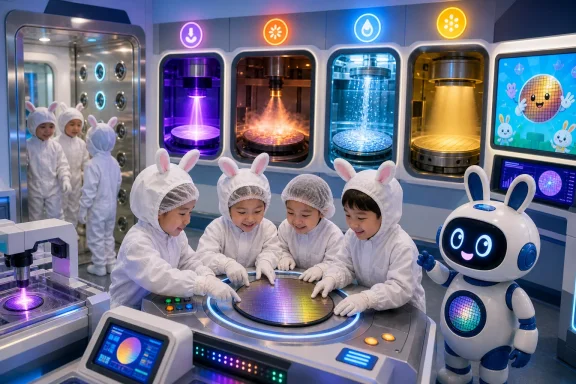
The lab opened July 28 in Seoul’s Jamsil district, according to Maeil Business Newspaper and corroborating reports from Yonhap News Agency and ChosunBiz. Rather than presenting semiconductor manufacturing as a distant industrial process, the installation puts visitors in child-sized cleanroom suits, sends them through an air shower, and asks teams of six to complete a virtual wafer-production mission.
 A cleanroom experience scaled for young engineers
Children take the role of “Dream Engineers” charged with producing a chip for Chips, a service robot that wants to become a dancer. The activity uses simplified physical controls and on-screen simulations: participants brush on photoresist, expose patterns, use a joystick-driven plasma etching game, clean contamination with water guns, and arrange falling blocks to represent thin-film deposition.
The details are deliberately playful, but the process sequence is not arbitrary. Photolithography, etching, cleaning and deposition are foundational steps in real semiconductor fabrication, and Tokyo Electron’s business sits directly in the equipment used to perform such work in production fabs.
For Windows users and IT professionals, the practical connection is obvious even if the experience targets a much younger audience. PCs, servers, AI accelerators and storage devices all depend on fabrication capacity and the highly specialized tooling behind it. TEL Korea’s lab makes the equipment-engineering layer visible in a way conventional tech education rarely does.
Talent outreach is part of the business story
Tokyo Electron Korea CEO Roh Tae-woo said advanced technologies including smartphones, AI, autonomous vehicles and robotics depend on equipment makers working behind the scenes. That positioning matters: the lab is both an education initiative and a long-term introduction to a profession that is less familiar than chip design or consumer technology.
TEL Korea has already operated its Dream Up Semiconductor Camp for elementary-school students, with employees serving as instructors. The new KidZania installation gives that outreach a permanent public venue instead of limiting it to scheduled camp sessions.
Starting in September, the company plans to run a Dream Camp for children from underserved groups with limited access to advanced-technology and career-experience programs. The space will also host employee family events, giving children an accessible explanation of the work their parents do.
A visible reminder of where computing starts
The Dream Lab will not teach children how to design a Windows driver or administer a datacenter. Its more basic lesson may be more useful: modern computing begins long before an operating system boots, with wafers, process control, contamination management and manufacturing equipment.
By putting those ideas beside KidZania’s familiar job-role attractions, Tokyo Electron Korea is betting that the next generation of engineers may first encounter semiconductor manufacturing not in a textbook or a fab, but through a game.
