
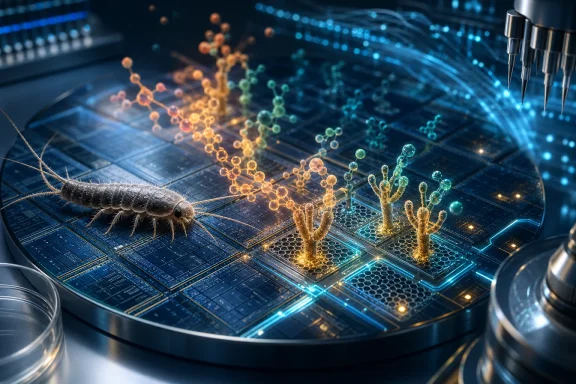
The system uses MhOR5, an olfactory receptor from the jumping bristletail Machilis hrabei, chemically coupled to a graphene field-effect transistor, or gFET. In testing, the MhOR5-functionalized devices responded to 16 chemically varied compounds, including DEET, hexanol, eugenol, octanol, acetophenone, and sulcatone. The associated Advanced Materials paper reports that the platform could distinguish eugenol from isoeugenol—structural isomers that can pose a difficult challenge for less selective electronic sensing approaches. PubMed
For Windows and PC enthusiasts, the immediate relevance may not be a chip that replaces a human nose. The more significant prospect is that biological sensing may become another input modality for edge computing, joining cameras, microphones, inertial sensors, temperature probes, and biosensors. A future inspection device, wearable, industrial gateway, lab instrument, or autonomous robot could potentially use electronic olfaction to make local decisions about chemicals, contaminants, products, or environmental conditions.
 From “Electronic Nose” Marketing to Molecular Recognition
The phrase electronic nose has been used for decades to describe systems that identify chemicals using arrays of sensors and pattern-recognition software. In practice, many such systems behave less like a biological nose and more like a collection of broad chemical detectors. They may respond to a mixture of volatile compounds, then rely on statistical models to associate the overall response pattern with a known odor class.
That approach can be useful. It has applications in food quality control, industrial process monitoring, environmental sensing, and research. But it can have limitations when the target is a small molecule that closely resembles another compound, when the ambient environment is variable, or when the sensor array must be compact, low-power, and manufacturable.
The UC San Diego work takes a different route. Rather than depending solely on a synthetic sensing material and later interpreting its electrical signature with software, it places a real insect olfactory receptor at the detection interface. The receptor is the part of the system expected to interact with a chemical compound first. The graphene transistor then translates the molecular event into an electrical measurement. UC San Diego Today
This distinction matters. A conventional gas sensor may be sensitive to the presence of a chemical class, but a receptor-based biosensor seeks to exploit the binding behavior biology has refined through evolution. The objective is not merely to build a chip that reacts to smells. It is to build a device where molecular selectivity begins at the sensor surface.
The study describes this as the first direct integration of MhOR5 onto a gFET for selective, label-free detection of small organic compounds. “Label-free” is especially important in sensor engineering because it means the target molecule does not need to be pre-tagged with a fluorescent dye, enzyme, or other external marker before detection. UC San Diego Today
Why an Insect Receptor?
Insects rely heavily on olfaction for survival. Chemical cues can help them locate food, find mates, recognize host plants, avoid predators, or detect hazards. That survival pressure has produced receptor systems able to respond to a broad range of odorants while operating under tight constraints of size, energy, and biological complexity.
MhOR5 comes from Machilis hrabei, a species described by UC San Diego as a jumping bristletail. The decision to use an insect receptor is not an aesthetic borrowing from nature. It is a practical biomimetic strategy: take a molecular component that already performs chemical discrimination and attempt to interface it with a scalable semiconductor platform. UC San Diego Today
The research team’s results suggest that the receptor does more than provide a generic coating. In the paper’s tested set, the device produced a concentration-dependent response for all 16 small organic compounds. The strongest reported binding affinity among those compounds was for acetophenone, while sulcatone was the weakest, according to the published abstract. PubMed
That does not mean MhOR5 is a universal chemical identifier. One receptor cannot substitute for the full receptor repertoire of an insect or mammal. Instead, the result points toward a modular architecture: different receptors could, in principle, be attached to different devices in a sensor array. Each element might offer a partially distinct chemical response, and software could combine the array’s signals into a richer classification result.
A useful distinction: detection versus identification
It is easy to overstate what an electronic olfaction platform can do. There are several different levels of capability:
- Detection — recognizing that a substance or odor-bearing compound is present.
- Quantification — estimating how much of it is present.
- Differentiation — distinguishing it from chemically related compounds.
- Identification in real environments — recognizing compounds amid humidity, contaminants, mixtures, changing temperatures, and background odors.
- Actionable interpretation — connecting the measurement to a safety, health, manufacturing, or security decision.
The UC San Diego research directly supports the first three categories under controlled experimental conditions. The technology’s eventual value in healthcare, environmental monitoring, food quality, agriculture, or biodefense will depend on how well it advances through the remaining stages. UC San Diego identifies those areas as potential applications, but they should be understood as future-use possibilities rather than already deployed product capabilities. UC San Diego Today
The Semiconductor Core: Why Graphene gFETs Matter
At the electronic heart of the device is a graphene field-effect transistor. A conventional field-effect transistor modulates current through a channel using an electric field. In this case, graphene serves as the conductive channel material instead of silicon.
Graphene is appealing for biosensors because its electrical properties can be highly responsive to changes occurring at or near its surface. If a target molecule binds to a receptor attached to that surface, the local electrical environment can shift. A properly configured transistor can convert that molecular-scale interaction into a measurable change in current or conductance.
UC San Diego describes gFETs as semiconductor devices that use graphene rather than silicon as the conductive material, a choice that provides high sensitivity to molecular changes. The study’s abstract also reports that the gFET chips were fabricated at wafer scale and quality-controlled for reproducibility before use. UC San Diego Today PubMed
That wafer-scale detail is one of the story’s most consequential elements. Many promising biosensors fail to progress beyond laboratory demonstrations because the fabrication process is fragile, expensive, or inconsistent. A one-off device made by highly specialized researchers may be scientifically impressive, but it is not necessarily a foundation for products.
The work here explicitly connects the biological receptor to high-performance, reproducible graphene chips. That does not establish a finished commercial manufacturing process, but it improves the research’s practical posture. Scalability has been built into the narrative from the beginning rather than added as an afterthought.
The biological-electronic handshake
The hard part is not simply placing a protein near a transistor. Proteins are complex molecular structures, and their orientation, stability, purity, density, and chemical surroundings can all affect performance. A receptor that works inside a cellular membrane may not retain the same behavior once purified and attached to an engineered surface.
The team addressed that challenge through a multi-stage workflow:
- It began with the genetic sequence for MhOR5.
- The researchers synthesized the sequence and expressed the receptor in mammalian cells.
- They purified the receptor protein from cell membranes.
- They chemically linked the purified protein to graphene.
- They then measured electrical responses as the functionalized gFET encountered different compounds. UC San Diego Today
The published work reports that MhOR5 was produced as a stable tetrameric protein at 80% purity and retained stability for up to three months. UC San Diego further reports stability after three months of storage at -80°C and after multiple freeze-thaw cycles. PubMed UC San Diego Today
Those are encouraging measurements because storage stability matters for research supply chains and eventual device assembly. Still, they should not be confused with proof of operational lifetime in a commercial sensor. A receptor stable in frozen storage is not automatically stable for months in a field-deployed device exposed to ambient air, changing temperatures, humidity, dust, vibration, and repeated analyte exposure.
How MhOR5 Was Attached to Graphene
The researchers used carbodiimide crosslinker chemistry and a linker molecule called PBASE to attach MhOR5 to the graphene surface. UC San Diego describes PBASE as a molecule capable of linking proteins and other molecules to carbon-based nanomaterials such as graphene. UC San Diego Today
This surface chemistry is not a minor implementation detail. It is central to whether the device is a sensor or merely a coated transistor. The linker has to establish a robust connection to graphene while preserving enough of the receptor’s structure and accessibility for chemical interactions to occur.
Several engineering variables could determine how far the platform can advance:
- Receptor orientation: Molecules must remain positioned so binding sites are accessible.
- Surface coverage: Too little receptor reduces signal opportunities; too much can create crowding or nonuniformity.
- Electrical coupling: Binding-related changes must be close enough to graphene to influence the transistor signal.
- Nonspecific adsorption: Unwanted chemicals attaching to the surface can obscure a receptor-driven response.
- Packaging: The sensor needs an enclosure and fluidic or air-handling architecture that delivers samples consistently.
- Calibration: Response curves must remain dependable across devices, batches, and operating conditions.
The achievement is that the team demonstrated a functioning integration, not merely a theoretical coupling scheme. Yet these follow-on questions will decide whether the technology develops into robust electronics rather than remaining an impressive laboratory platform.
The Most Important Result: Separating Similar Molecules
Among the study’s more attention-grabbing outcomes is the reported differentiation between eugenol and isoeugenol. These molecules are structural isomers: they share the same molecular formula but differ in how atoms are arranged.
Why does that matter? Chemical sensors often struggle when two compounds are similar in mass, polarity, or broad functional groups. If a sensor’s response is driven mostly by generic surface interactions, closely related molecules may generate nearly indistinguishable signals. A biological receptor can potentially offer more nuanced recognition because molecular shape and chemical features influence how the compound interacts with the receptor.
The authors report that the MhOR5-gFET sensor distinguished those two isomers, calling it a result difficult for conventional sensors. PubMed This is precisely the kind of benchmark that makes receptor-based sensing compelling: the goal is not simply to produce a large electrical response but to produce a meaningful difference between chemicals that look broadly alike to a nonselective material.
However, care is warranted when translating that finding into broader claims. Differentiating a pair of isomers in a defined experiment is not the same as identifying unknown compounds in real-world mixtures. The latter will require experiments involving interferents, background volatiles, varying humidity, and samples that have not been prepared under controlled laboratory conditions.
That gap is not a flaw unique to this research. It is the normal bridge between a novel sensing principle and an operational electronic-nose product.
What This Could Mean for Edge Computing
The long-term case for electronic olfaction is strongest when the sensor is paired with local computation. A gFET produces electrical data that can be digitized, monitored, compared with reference data, and acted upon by embedded software. This makes the technology a natural fit for the broader trend toward edge AI sensors: devices that capture and interpret signals near where those signals originate.
A mature receptor-array system could be integrated into several kinds of computing hardware:
- Industrial PCs and gateways that watch for solvents, leaks, or process deviations.
- Portable diagnostic instruments that analyze volatile biomarkers or chemical signatures from samples.
- Smart agriculture nodes that monitor plant stress, crop maturation, spoilage, or pest-related chemical cues.
- Food-processing systems that flag changes associated with freshness or quality control.
- Environmental monitors that identify hazardous or regulated compounds.
- Autonomous robots that add chemical perception to vision, sound, touch, and navigation.
- Biodefense and security equipment designed to detect particular classes of chemical indicators.
UC San Diego explicitly identifies healthcare, environmental monitoring, food quality, agriculture, and biodefense as areas the research could eventually support. UC San Diego Today
For the Windows ecosystem, that future would be mostly indirect but potentially substantial. Windows has a deep footprint in industrial automation, laboratory computing, edge deployments, robotics development, device management, and data analytics. If chemical sensing becomes more chip-scale and digitally accessible, Windows-based systems could serve as the orchestration and analysis layer: gathering sensor telemetry, performing model inference, presenting alerts, preserving audit records, and integrating results with operational workflows.
The key is that the sensing event begins in hardware but gains practical value through software. A sensor’s raw transfer curve is not a safety alert. It must be calibrated, contextualized, quality-checked, and connected to a defined response.
Manufacturing Is the Real Test
Kiana Aran, the study’s corresponding author and a UC San Diego bioengineering professor, frames the project as an intersection of engineering, biology, biomanufacturing, and semiconductor technology. Her central claim is that biological sensing functions can increasingly be integrated with scalable semiconductor chips rather than merely observed in the laboratory. UC San Diego Today
That is a persuasive vision, but biomanufacturing is also where many bioelectronic projects encounter their toughest obstacles. Semiconductor manufacturing has historically relied on highly controlled, largely inorganic materials and processes. Protein receptors are more delicate. They introduce batch variability, handling requirements, and potential degradation pathways that standard transistor fabrication does not face.
The collaboration gives the project some credibility on this point. Researchers from Eurofins CALIXAR and Paragraf contributed to the study, while the paper lists the gFETs as wafer-scale fabricated and quality-controlled. UC San Diego Today PubMed
Even so, the most important next-stage evidence will involve questions such as:
- Can receptor-functionalized devices be produced with consistent response profiles across large batches?
- How long do they remain accurate outside frozen storage?
- How do they perform in air, in liquid samples, or in mixed chemical environments?
- Can the chips be regenerated after exposure, or are they disposable?
- What level of calibration is required for each sensor and deployment?
- How easily can the design be expanded into a multi-receptor array?
- What are the cost and yield implications of adding biological functionalization to graphene chip production?
Until those questions are addressed, it would be premature to describe the device as a replacement for conventional analytical instruments. But that is not the standard the research needs to meet today. Its present contribution is a credible demonstration that a manufactured insect receptor can communicate selectively with a graphene transistor.
Risks, Limits, and the Path Beyond a Controlled Experiment
The project’s strengths are clear: direct receptor integration, label-free operation, a broad 16-compound test set, response variation with concentration, isomer differentiation, protein stability data, and wafer-scale chip fabrication. Together, those elements move the work beyond a simple proof-of-concept sketch. PubMed
The risks are equally concrete.
First, selectivity is contextual. A sensor that distinguishes compounds in individual tests can behave differently in mixtures. Real odors often contain numerous volatile chemicals, and the most valuable samples—breath, food headspace, environmental air, agricultural emissions, or industrial processes—are rarely chemically simple.
Second, sensor drift can be a major challenge. Graphene devices may be sensitive enough to detect molecular events, but that same sensitivity makes control over surfaces, contacts, packaging, and ambient conditions crucial. Receptor activity and transistor baselines can both change over time.
Third, humidity and temperature can alter chemical transport and electrical response. Any commercial electronic nose will need compensation strategies, environmental sensing, reference channels, or calibration protocols.
Fourth, a single receptor has finite scope. MhOR5 provides one biochemical recognition pattern. The broadest applications will likely require arrays containing multiple receptors, carefully selected for complementary responses, plus machine-learning models trained on representative samples.
Finally, high-stakes uses—including medical diagnosis and biodefense—will require rigorous validation. A promising chemical signal must not be mistaken for clinical evidence or an operational threat determination without appropriate controls, validation studies, and decision safeguards.
These limitations do not diminish the advance. They define the engineering agenda that follows it.
A New Direction for Chemical Sensors
The UC San Diego study is best understood as a convergence technology. It joins synthetic biology, protein production, surface chemistry, graphene electronics, chip fabrication, and sensor analysis into a single device concept. Each individual component has precedents, but the direct integration of MhOR5 with a graphene field-effect transistor creates a more specific and potentially more scalable route toward biological chemical recognition on semiconductor hardware. UC San Diego Today
Its broader promise is not that computers will suddenly “smell” in the rich, human sense. Instead, it is that electronics may gain highly targeted forms of chemical awareness. A device could be trained to detect a compound, differentiate a pair of molecules, recognize a changing chemical profile, or flag a condition that merits further analysis.
That prospect aligns neatly with the direction of modern computing. Systems are becoming more distributed, more sensor-driven, and more capable of processing data at the edge. Cameras gave machines visual inputs. Microphones gave them audio inputs. Biosensors are already giving them physiological inputs. Insect-inspired graphene sensors could help add molecular inputs to the same computational landscape.
The path to products will be long and technically demanding. Yet the core accomplishment is already significant: a living system’s odorant receptor has been manufactured, stabilized, linked to graphene, and made to generate useful electrical signals on a semiconductor platform. That is a practical foundation for a new generation of bioelectronic noses—ones designed not merely to sense chemicals, but to recognize them with biology’s help.
