
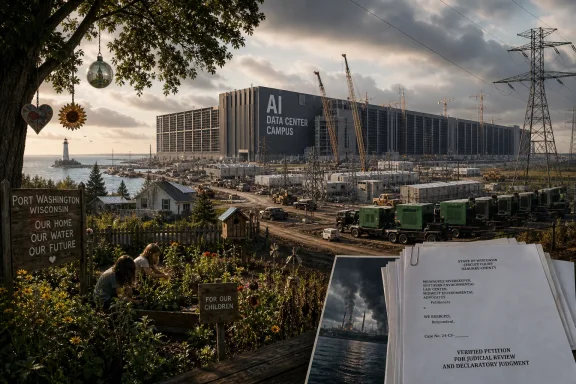
In a National Catholic Reporter guest essay, Liam Myers describes the property not as an abstract development site but as a place of Christmas gatherings, handmade ornaments, Lake Michigan views and lessons in gardening. That personal account lands as the campus moves from announcement to construction: Vantage says its four-building site will total roughly 2.5 million square feet and is targeted for completion in 2028.
The project is part of the wider buildout for AI and cloud computing, but its local footprint is unusually hard to ignore. Vantage has framed Lighthouse as a community-rooted investment inspired by Port Washington’s historic lighthouse, promising thousands of construction jobs and upgraded local infrastructure. For nearby residents, the more immediate reality is industrial-scale construction where homes, fields and wildlife habitat once stood.
 The environmental review is now in court
The opposition is no longer limited to public meetings and viral criticism. Midwest Environmental Advocates, representing Sierra Club Wisconsin, filed suit against the Wisconsin Department of Natural Resources this month, arguing that the agency improperly avoided a full environmental impact statement before permitting the project.
The DNR maintains that it conducted an environmental analysis and issued a compliance determination in December 2025, later supplementing its review in June. The legal dispute is therefore not whether the state examined the proposal at all, but whether that review met the threshold required for a project of this size.
That distinction matters to IT infrastructure planners. The Lighthouse campus is designed around nearly a gigawatt of AI capacity, with utility interconnection, water and sewer work, wetland impacts, and backup generation all becoming part of the same local permitting fight. Vantage’s plans include 45 diesel emergency generators, a point that has attracted particular concern during air-permit proceedings.
AI’s physical footprint becomes the story
Myers’ essay uses the loss of a family place to ask a question that the technology sector often abstracts away: what does an AI system require on the ground? Data centers are frequently discussed in terms of models, GPUs, cloud regions and productivity gains. Port Washington instead foregrounds land acquisition, transmission capacity, cooling, diesel resilience, construction noise and the speed at which rural or semi-rural communities can be remade.
That tension is increasingly relevant for Windows administrators and enterprise IT teams. The cloud services powering AI assistants, hosted workloads and model training do not arrive without physical infrastructure; their availability, cost and sustainability claims depend on power and water arrangements made far from the desktop or server rack.
Pope Leo XIV’s May encyclical, Magnifica Humanitas, makes a similar argument from a Catholic social-teaching perspective, warning that AI is not neutral and explicitly connecting its use to the energy, water, cables, machines and data centers behind it. Myers uses that framework to argue that communities should be able to assess whether the technologies imposed around them advance human dignity or intensify inequality and exclusion.
The next test is transparency, not branding
“Lighthouse” may be a polished name for a major AI campus, but the project’s next phase will be decided through permits, utility planning and the Wisconsin court challenge—not its branding. Vantage’s promised economic benefits and its sustainability commitments will be judged against the environmental record, local costs and whether residents believe they had a meaningful say before the land changed hands.
