
The change is real and potentially consequential for any Windows application that embeds web content through WebView2, from line-of-business desktop software to newer Microsoft 365 clients. But Microsoft’s own public records contain an important timing discrepancy: an earlier WebView2 announcement and some release-note text describe version 152 as the first two-week release and date it August 24, while the current Edge release schedule and the August 24 Edge Blog announcement place Stable 152 in the week of August 27 and identify version 153 as the first release on the shortened interval.
For administrators and application teams, the practical conclusion is straightforward: the validation clock becomes shorter after version 152, not before it. The product API is not changing with this schedule adjustment, but the time available to catch a runtime regression before the next Stable version arrives will.
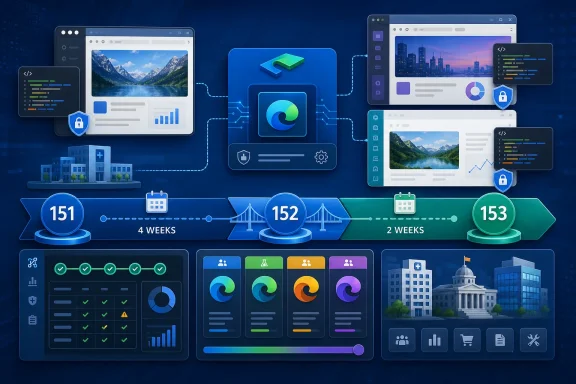 Version 152 is the bridge between two schedules
WindowsReport first highlighted Microsoft’s plan to accelerate WebView2 Runtime delivery. Microsoft’s own announcement confirms the broad outline: WebView2 will follow Edge’s major-version train as Edge moves from four-week to two-week Stable releases.
The detail that matters is the gap between releases. Version 151 shipped on the previous four-week cadence. Version 152 is scheduled four weeks later, in the week of August 27. Version 153 follows in the week of September 10, only about two weeks later, with later major versions expected roughly every two weeks.
That makes version 152 the bridge release: it carries the version number associated with the new policy but is still separated from its predecessor by the older four-week interval. Teams building a calendar around version numbers alone could easily misread the transition and schedule their first shorter-cycle test pass too early.
Microsoft’s documentation has not presented this consistently. A July announcement in the company’s WebView2 announcements repository characterized August 3 as the final four-week release date for version 151, August 24 as the first two-week release for version 152, and September 7 as the start of subsequent releases every two weeks. Separately, current release-note text also identifies August 24 for version 152 and says version 151 was the final four-week release.
Those dates do not match Microsoft’s newer public Edge schedule, which lists the Stable release of Edge 152 for the week of August 27 and Edge 153 for the week of September 10. The August 24 Edge Blog post uses those same later dates. Microsoft has not publicly explained the discrepancy, but the current schedule and post-release announcement are the better planning references because they were published or refreshed closer to the actual transition.
Evergreen users get faster servicing, whether they prepare or not
For applications using the default Evergreen WebView2 Runtime, Microsoft says no code or packaging change is required. The Runtime updates itself on users’ machines through the same underlying update system used by Edge, so those applications will receive the newer Chromium platform and security fixes more often.
That is good news for exposure to known browser-engine vulnerabilities. WebView2 is not simply a browser installed for a user to open; it is the embedded rendering and scripting engine inside applications. A security fix delivered through the Runtime can therefore affect many distinct Windows programs on a machine without each vendor shipping a full application update.
It also means Evergreen application owners do not control the moment a new Stable runtime reaches their users in the way a Fixed Version Runtime customer does. Microsoft’s enterprise guidance already warns against leaving WebView2 on older releases: security and servicing updates are supplied for the current Edge Stable and Beta releases, rather than indefinitely maintained older Runtime builds.
The shorter cadence doubles the number of major-version transitions an Evergreen application may encounter over a year. A team that has been performing informal monthly compatibility checks is now likely to discover defects after users have received the new Runtime unless it moves that work into preview testing.
Microsoft has not announced a separate WebView2 equivalent to Edge’s Extended Stable channel as part of this change. Edge’s browser release policy retains an eight-week Extended Stable option for managed environments, but the WebView2 announcement instead points developers toward either the automatically updating Evergreen Runtime or a Fixed Version Runtime that the application vendor must validate and deploy itself.
Fixed Version deployments gain control, not a longer support window
The biggest operational effect falls on developers that ship a Fixed Version Runtime alongside their application. Fixed Version packaging remains useful for tightly controlled software, offline environments, regulated deployments, and products that must certify an exact browser-engine build. But it shifts responsibility for timely upgrades from Microsoft’s updater to the application vendor.
Under the new schedule, a Fixed Version team will see new major Runtime candidates roughly twice as often. Microsoft’s advice is explicit: validate and adopt them more frequently so users do not fall behind on security fixes. The more frequent train does not mean every application needs to package every major Runtime release immediately, but it does remove the comfort of treating a four-week validation cycle as the default.
There is a distinction here that matters in procurement and operations meetings. A Fixed Version Runtime can keep an application pinned for compatibility, but it is not a substitute for a supported security-maintenance branch. Microsoft’s enterprise documentation says older Runtime releases do not receive the latest quality and security updates. Delaying a rollout may be warranted while a regression is investigated; making that delay a standing policy creates a browser-engine patch lag inside every application using the pinned Runtime.
Enterprises can manage WebView2 update behavior through Edge update policies, because Edge and WebView2 use the same updating mechanism. Microsoft also documents temporary update suppression for bandwidth and operational scheduling. Those controls can smooth a deployment window, but they do not change the vendor’s recommendation to remain current.
The real work for Fixed Version owners is therefore not downloading more installers. It is reducing the cost of certifying a new embedded-web-platform build: repeatable smoke tests, defined escalation paths, and a clear decision about which applications can adopt a Runtime release quickly and which require longer release gates.
SDK releases no longer track every Runtime version
Microsoft is changing the SDK policy at the same time, but the SDK will not become a biweekly package release. Instead, Microsoft says it will publish WebView2 SDK updates when new APIs, bug fixes, security fixes, or other SDK changes warrant a release.
When an SDK package does ship, Microsoft says it will be released on the same date as its corresponding Runtime release. The missing implication in many summaries of the cadence change is that developers should no longer expect one new Microsoft.Web.WebView2 NuGet package for each new Runtime major version.
That is sensible because the Runtime and SDK serve different roles. The Runtime supplies the underlying embedded browser engine on the endpoint. The SDK supplies the APIs an application compiles against. A Runtime security update may need to reach every Evergreen installation promptly even when no new public API requires developers to update a NuGet dependency or rebuild their software.
Microsoft’s July WebView2 announcement also says this is a release-timing change only and does not itself alter the WebView2 API. That should prevent unnecessary SDK churn. Teams should upgrade an SDK because a required API, bug fix, or supported dependency change calls for it—not simply because the installed Evergreen Runtime advances from 152 to 153.
Applications using prerelease SDK packages remain a separate case. Microsoft’s documentation says prerelease SDKs are intended for development with Edge preview channels and should not be treated as the production default. Release SDKs are designed to work with the production WebView2 Runtime, including higher Runtime build numbers that add platform updates without requiring an SDK refresh.
Preview testing needs to become part of the release process
Microsoft recommends testing WebView2 applications against the Edge Beta preview channel before a Stable release reaches customers, and it also recommends automated workflow checks with Microsoft Edge WebDriver. That recommendation is more urgent under the two-week schedule, although Microsoft’s fuller testing guidance points to Canary and Dev for catching changes earlier still.
The company’s own WebView2 documentation says regressions tend to be application-specific. A general browser-engine test suite cannot fully cover an organization’s authentication flows, custom JavaScript bridges, print paths, kiosk restrictions, downloads, media handling, certificate behavior, accessibility tooling, or embedded legacy web applications.
The useful response is not to run every UI test manually twice a month. It is to identify the few workflows that prove the application can still start, authenticate, render its key pages, exchange data with native code, and complete its most important transaction. Those tests should run against a preview Runtime continuously or at least before the next Stable promotion.
A practical preparation plan should include the following:
- Teams using Evergreen should add WebView2 preview-channel testing to their existing CI or release-validation process before version 153 reaches Stable in the week of September 10.
- Teams using Fixed Version should define the maximum acceptable lag behind the current Runtime and assign ownership for approving or rejecting each major-version update.
- Administrators should inventory applications that depend on WebView2 before changing update-suppression or rollback policies, because a Runtime change can affect multiple vendors’ applications at once.
- Developers who find a regression should submit a minimized report through Microsoft’s WebView2Feedback repository early enough for Microsoft to assess it before the next Stable train.
Microsoft’s two-week WebView2 cadence starts as Edge 153 follows version 152 in September. For users of the Evergreen Runtime, the immediate effect will mostly be invisible: newer browser-platform and security changes arrive sooner. For developers and IT teams, the change is a deadline problem. A compatibility process designed around four weeks now has roughly half the time to find the bug before the next Runtime is already on its way.