
That distinction does not make the milestone unimportant. It makes it more revealing. WEKApod 3 is not simply a denser array of SSDs; it is a deliberately integrated hardware-and-software appliance whose economic proposition depends on extracting substantially more usable capacity from very expensive flash. For Windows-centric enterprises moving beyond proof-of-concept AI and into retrieval-augmented generation, model serving, data pipelines, and private AI clouds, that difference is central to evaluating what “exabyte-scale storage” actually means.
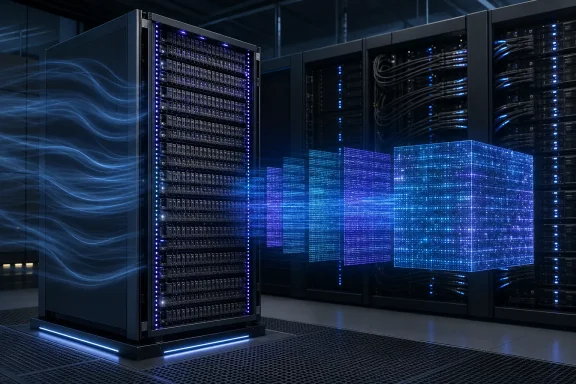 An Exabyte Claim Built on Effective, Not Raw, Capacity
The flagship WEKApod Prime Max configuration uses Micron’s 245.76TB 6600 ION NVMe SSDs. At approximately 1,800 drives per rack, the simple arithmetic produces around 442PB of installed flash before formatting, protection schemes, metadata, and reserve capacity are considered. WEKA’s published 441.5PB raw-capacity figure is therefore credible as a practical appliance-level total rather than an arbitrary marketing number. Micron’s product documentation lists the 245.76TB model as the largest capacity point in the 6600 ION family.
The leap from 441.5PB raw to 1.1EB effective represents approximately a 2.5:1 effective-capacity multiplier. In other words, WEKA is not claiming to have physically inserted an exabyte of NAND flash into a single rack. It is claiming that the system can logically accommodate data whose unreduced size totals 1.1 exabytes, assuming its reduction technologies deliver the required savings on the customer’s particular data.
That is a normal distinction in enterprise storage, but it deserves unusually prominent treatment because the word exabyte tends to imply raw media capacity. Deduplication, compression, thin provisioning, snapshots, and metadata efficiency have long allowed storage suppliers to advertise effective figures. What is different here is the scale of the claim and the fact that it is being attached to a single rack packed with very high-capacity QLC NVMe drives.
The company’s own technical material says that the 1.1EB figure assumes always-on data reduction at a 3:1 effective-capacity ratio for the Prime Max configuration. WEKA’s explanation of the capability stack also states that the rack-level claims are based on fully populated 56U systems. That is the appropriate way to read the announcement: as a dense, fully configured system under a defined software-efficiency assumption, not as an unconditional raw-flash record.
Background: Why Rack Density Has Become an AI Infrastructure Metric
The WEKApod 3 launch arrives as enterprise AI architecture changes its emphasis. Training still needs huge sequential bandwidth, periodic checkpoints, large-scale data ingest, and rapid parallel reads. But production inference presents a different operational profile: more tenants, more unpredictable request patterns, larger contextual data sets, more object access, more model versions, and more repeated movement between GPU memory, system memory, and persistent storage.
An idle GPU is a costly asset, and storage latency or data-path congestion can turn an expensive AI cluster into an underutilized one. TechTarget’s examination of the announcement notes that WEKA’s pitch is rooted in the need to reduce storage bottlenecks and improve GPU efficiency as inference workloads become more complex and less predictable than training jobs.
This is where rack density becomes more than a real-estate talking point. In a conventional expansion model, a buyer facing capacity pressure can add more arrays, more storage servers, more networking equipment, and more cooling. That model becomes much harder when:
- Available data-center power is limited.
- Rack space is already reserved for GPU servers.
- Cooling design is constrained by high-density compute.
- AI infrastructure lead times are affected by component availability.
- Operators want to keep data physically close to the accelerators consuming it.
WEKA’s response is a tightly integrated appliance rather than its earlier dependence on third-party OEM chassis. That change gives the company more influence over the internal fabric, cabling, cooling behavior, flash selection, network topology, and procurement path. NAND Research’s analysis identifies WEKApod 3 as the company’s turnkey platform, while noting that NeuralMesh 6 can still be deployed on customer-selected hardware.
For buyers, that creates a strategic trade-off. A full appliance can reduce integration work and make performance accountability clearer. It can also increase platform dependence, especially where the hardware design, reduction guarantees, observability tooling, and storage software are sold as a coordinated whole.
What Is Inside WEKApod Prime Max?
The Prime Max appliance configuration is designed for capacity density first. Independent reporting describes it as a two-node, 2U chassis with up to 70 NVMe drives, using Micron 245.76TB 6600 ION drives for the highest-capacity design point. NAND Research reports that this is the configuration behind the 1.1EB and 10.2TB/s rack-level claims.
The published hardware architecture includes several design choices intended to preserve bandwidth and serviceability at extreme density:
- PCIe Gen 6 internal fabric for high-bandwidth drive connectivity.
- A cable-based, backplane-free interconnect rather than one shared drive backplane.
- NVIDIA ConnectX SuperNIC networking designed for Spectrum-X Ethernet environments.
- A software-managed thermal approach intended to prevent a localized problem from becoming a rack-level interruption.
- A two-rack-unit form factor that maximizes the number of storage nodes and drives per vertical rack unit.
WEKA’s announcement says the design includes patent-pending work around the chassis, drive interconnect, thermal management, and serviceability. The important practical point is not the patent language; it is the removal of shared infrastructure that could otherwise become a bottleneck or a larger failure domain.
A backplane-free architecture has an intuitive appeal in a system containing dozens of drives per chassis and roughly 1,800 drives per rack. If a shared bus, connector assembly, or backplane is a common point of failure, a fault can affect more than one SSD. Individual cabled connections may add mechanical complexity, but they can improve fault isolation and make replacement procedures more granular.
Micron’s 245.76TB SSDs Are the Density Enabler
The flash media matters just as much as the enclosure. Micron began shipping its 245TB-class 6600 ION SSD in May, calling it the highest-capacity commercially available SSD at the time of its announcement. Micron’s release describes the drive as available in U.2 and E3.L formats and targeted at AI, cloud, enterprise, hyperscale, and large file- and object-storage deployments.
The 245.76TB 6600 ION is built around Micron G9 QLC NAND, uses a PCIe Gen5 x4 NVMe interface, and is specified for up to 13.7GB/s sequential reads and 3GB/s sequential writes at its highest capacity tier. Micron also lists 1.78 million random-read IOPS for the 245.76TB model, alongside endurance figures that vary sharply by write pattern. Micron’s 6600 ION product brief cautions that the listed values are reference specifications and that real-world lifetime and power consumption vary by workload.
That caveat deserves attention. QLC flash is optimized for capacity economics, not for unlimited high-intensity random-write workloads. A system designed around huge QLC SSDs can be excellent for model repositories, object stores, synthetic data, long-term checkpoints, AI data lakes, and bulk contextual data. But buyers should validate endurance, sustained write behavior, garbage collection impact, and recovery performance against their own workload mix instead of treating capacity alone as proof of suitability.
NeuralMesh 6 Is Responsible for the Exabyte Math
The hardware creates the physical foundation, but NeuralMesh 6 creates the effective-capacity argument. WEKA describes the sixth-generation software as adding native multi-tenancy, unified file-and-object access, data resiliency features, Kubernetes-native operations, observability, intelligent replication, and data reduction. WEKA’s launch materials characterize the appliance and software release as one unified AI inference infrastructure platform.
The key efficiency functions include:
- Fingerprinting to identify data patterns.
- Similarity hashing to recognize related content.
- Deduplication to avoid storing duplicate blocks or objects repeatedly.
- Compression to reduce the physical footprint of suitable data.
- Background processing intended to prevent reduction tasks from blocking the primary write path.
WEKA says its data reduction runs by default and that it offers contractual coverage for both reduction behavior and performance impact. NAND Research reports that the contract is intended to cover the reduction ratio and performance ceiling, a notable effort to turn an otherwise variable efficiency claim into a commercial commitment.
Why Data Reduction Can Work Well for AI Data
AI environments often create patterns that are favorable for data reduction. Teams may retain repeated model checkpoints, multiple versions of datasets, similar source documents, cloned development environments, replicated object repositories, and derivative artifacts created by training or fine-tuning workflows.
If an organization stores multiple near-identical model builds, document collections, and checkpoint sets, deduplication and similarity-based techniques can have a substantial effect. WEKA claims that NeuralMesh can provide up to 6x capacity savings on AI training data in suitable scenarios. WEKA’s technical overview says the platform runs similarity-based compression and cross-filesystem deduplication outside the primary write path.
However, reduction is not a universal property of data. Encrypted files, already-compressed media, compressed archives, random data, highly unique research outputs, and some database formats may yield modest savings. An enterprise considering the Prime Max system should view the 1.1EB number as a capacity-planning scenario that requires workload validation—not as capacity that every deployment will automatically receive.
A disciplined evaluation should ask for a proof of concept using representative data, including:
- The actual mix of model artifacts, object data, documents, images, checkpoints, and logs.
- Encryption and key-management requirements.
- Snapshot and replication retention policies.
- Expected reduction ratio after protection and metadata overhead.
- Sustained ingest and random-write behavior during peak periods.
- Rebuild, drive replacement, and failure-domain behavior at maximum density.
- The specific terms and exclusions of the data-reduction guarantee.
That is not skepticism about the underlying platform. It is the proper procurement response to a headline number whose value depends on software behavior as much as hardware capacity.
Performance Claims Need the Same Careful Reading
WEKA quotes 10.2TB/s throughput and 210 million IOPS per rack for the WEKApod family’s dense configurations. These are extraordinary figures, and the company says they exceed the next-best publicly available alternative on a throughput-density basis. WEKA’s product announcement attributes those rack-level figures to the new platform.
There are two important qualifications. First, performance figures at this scale are inevitably workload-sensitive. Sequential reads, small-block random reads, concurrent object operations, metadata-heavy access, and mixed read/write activity stress very different elements of the stack. A figure in TB/s does not directly predict application responsiveness, time to first token, checkpoint duration, or the number of inference sessions a customer can support.
Second, the most detailed WEKA material distinguishes between the Prime Max capacity configuration and the Nitro performance configuration. WEKA’s capability-stack article describes Prime Max as the 441.5PB raw / 1.1EB effective capacity platform while associating the highest throughput and IOPS claims with the Nitro configuration in the same rack footprint. That means buyers should insist on configuration-specific data sheets and tested workload profiles rather than assuming every top-line figure can be achieved simultaneously by every appliance variant.
This is a broader lesson for AI storage benchmarking. “IOPS” is not a complete measure of inference economics. The useful metrics increasingly include:
- Tokens served per rack
- Tokens served per GPU
- Time to first token
- P99 storage latency
- S3 and POSIX concurrency
- GPU wait time caused by data access
- Cost per inference request
- Watts per usable terabyte
- Rack units consumed per petabyte of protected data
A platform able to raise useful GPU work per watt and per rack unit may deliver better business outcomes than a system with a larger isolated benchmark result.
Unified File and Object Access Is a Practical Strength
One of NeuralMesh 6’s more consequential features is its attempt to unify traditional file access and object access on the same physical NVMe data set. WEKA says an object written through S3 can be accessed through POSIX, while a file written through a file protocol can become accessible through S3 without creating a separate copy or operating a synchronization job. WEKA’s explanation describes the feature as a native, shared-block implementation rather than a translation gateway between separate tiers.
For Windows and hybrid enterprise estates, that proposition may be particularly relevant. Large organizations rarely move all data immediately into a single AI-native object store. They often have existing file-based workflows, Windows Server-based systems, NAS shares, data-science toolchains, container platforms, and cloud object repositories operating in parallel.
A shared file-and-object model could reduce the operational friction of maintaining multiple copies for different consumers. It could also simplify pipelines where data moves from preparation to training to inference. But interoperability still requires careful validation around client protocols, identity systems, file semantics, access control lists, audit requirements, backup software, ransomware recovery, and the behavior of applications that were built around conventional SMB or NFS assumptions.
The new multi-tenancy capabilities are similarly relevant for service providers and enterprise platform teams. NeuralMesh 6 introduces both dedicated resource allocation and virtual isolation mechanisms. NAND Research reports that the platform supports physical resource allocation through Composable Clusters and network-level isolation through its Virtualized RDMA Data Fabric. In a shared AI environment, these are not cosmetic features: tenant isolation, encryption boundaries, authentication, performance controls, and billing visibility are prerequisites for safely serving multiple internal business units or external customers.
The Risks of Extreme Density
WEKApod 3’s greatest strength—its extraordinary density—is also where operational risk becomes concentrated. A 56U rack containing approximately 1,800 high-capacity SSDs can deliver major benefits in footprint and cabling reduction. It also concentrates a remarkable amount of logical capacity into a small physical space.
Power and Cooling Remain Non-Negotiable
Micron specifies maximum active power of up to 30W for the largest 6600 ION model. Micron’s release argues that the drive improves capacity-per-rack and can reduce the power burden compared with HDD alternatives, but SSD density does not eliminate thermal engineering requirements.
At 1,800 drives, even a partial fraction of maximum per-drive consumption becomes a material rack-level power and cooling consideration before accounting for CPUs, NICs, memory, PCIe switching, fans, and network equipment. The solution may still be vastly more efficient than achieving comparable capacity with many more lower-density systems, but “dense” should never be misread as “thermally simple.”
Failure Domains Grow With Capacity
A modern NVMe SSD is highly reliable, yet a large fleet makes drive replacement a routine operational event. In an exabyte-scale logical system, administrators need clear answers about:
- The protection scheme and usable-capacity impact.
- Rebuild behavior with very large-capacity SSDs.
- Failure handling during simultaneous drive, node, network, or power events.
- Upgrade and firmware rollout processes.
- Service access in densely packed 2U chassis.
- The availability of replacement drives over the life of the appliance.
The cable-based drive design may reduce the blast radius of a shared backplane failure, which is a genuine engineering advantage. But buyers should demand a complete availability model, not just raw-capacity and peak-throughput numbers.
Vendor Integration Is Both Advantage and Commitment
WEKA controlling its own component supply chain can offer more predictable delivery and tighter appliance validation. TechTarget reports that the company views direct sourcing and custom hardware as a way to reduce the delays associated with conventional storage supply chains.
The trade-off is a deeper relationship with one supplier’s hardware architecture, software roadmap, support model, and availability commitments. Organizations that prefer a disaggregated model with independently selected servers, drives, operating systems, and storage software may see that as a limitation. Organizations that prioritize time to deployment and a single point of accountability may see it as the main benefit.
A Meaningful Milestone, With the Right Definition
WEKApod 3’s exabyte milestone is real in the way that matters for modern software-defined storage: it is an effective, application-visible capacity milestone enabled by a specific combination of dense QLC flash and data-reduction software. It is not a claim that 1.1 exabytes of raw NAND sit in a single rack.
That distinction should improve—not diminish—the conversation around the product. The most interesting part of WEKA’s announcement is that it openly illustrates where AI infrastructure is heading. The limiting factor is no longer merely how many drives can fit in a chassis. It is how efficiently a platform can use every rack unit, watt, PCIe lane, GPU cycle, and stored copy of the same underlying data.
The WEKApod Prime Max configuration makes an ambitious case that storage efficiency can be treated as an AI performance feature. Its combination of 245.76TB Micron SSDs, highly dense custom hardware, integrated networking, unified file-and-object access, multi-tenancy, and background data reduction is a serious response to the physical constraints facing large inference deployments.
For prospective buyers, the path forward is clear: evaluate the raw number, the effective number, and the workload conditions that connect the two. If a customer’s data set reduces well and its operational model benefits from appliance-level integration, WEKApod 3 could materially change the capacity-per-rack equation. If the data is resistant to reduction or the organization needs maximum hardware flexibility, the 1.1EB headline will be less meaningful than the system’s raw 441.5PB foundation, endurance profile, protection design, and demonstrated performance under production workloads.
