
The Welsh Government’s report also claims progress on bilingual Teams transcription, Welsh support in Microsoft 365 Copilot, internal Windows 11 configuration, open training data and research projects. Much of that work is real and independently documented by RNIB, Microsoft, the Senedd and universities. But the summary bundles together three very different things — Windows features available today, services limited to Welsh Government or Hwb environments, and research infrastructure intended to improve future tools — without always drawing the line between them.
For Windows administrators and organisations supporting bilingual users, that distinction decides what can be deployed now and what remains a programme to watch.
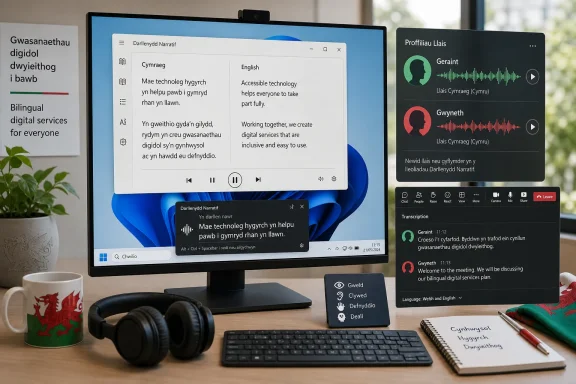 Geraint and Gwyneth are a real Windows accessibility deployment
RNIB confirms that Geraint and Gwyneth are Welsh synthetic voices developed with IVONA funding from the Welsh Government. They are explicitly Windows-only SAPI 5 voices, which means they work through the Windows speech-voice framework rather than through a single proprietary reader. The published compatibility list includes major screen-reading, magnification and literacy products: JAWS, NVDA, Supernova, ZoomText, Read&Write, Clicker 8 and Tobii Dynavox.
That is a better outcome than a browser-only demonstration or an online speech service. A SAPI voice is available to any installed Windows application that can call the native speech stack, so it can support locally opened documents and accessible content without requiring every software vendor to build Welsh speech support independently.
The use terms also matter. RNIB says the voices are free for individuals and organisations when used on a non-commercial basis, and says educational staff and learners can use them on school and home devices. Hwb users can download them through that platform, while RNIB separately directs other potential users to request the voices. The Welsh Government summary correctly identifies the Hwb distribution change as an accessibility improvement, but it does not spell out the administrative boundary: this is not a new voice that appears automatically in every Windows 11 installation or in Microsoft’s consumer voice catalog.
IT teams should therefore treat the deployment as a conventional endpoint-management task. Test the voice installer on representative Windows 10 and Windows 11 devices, verify that the required assistive application discovers it under the Windows voice settings, and establish whether the organisation’s use fits the non-commercial licensing condition before broad rollout. The availability is meaningful, but “free” does not eliminate licence review, packaging work or compatibility validation.
Teams has a Welsh capability, but it is not the global multilingual feature Microsoft documents
The Welsh Government says Microsoft Teams can now transcribe Welsh and English at the same time, describing the change as an extension of its partnership with Microsoft. Hwb published a notice on March 11, 2025 saying users could enable English-and-Welsh transcription for meetings, and a Senedd transcript from June 4, 2025 records then Cabinet Secretary Mark Drakeford describing simultaneous Welsh and English transcription as operational.
That establishes the feature’s existence in the Welsh education and government context. It should not, however, be read as a blanket statement that every commercial Microsoft 365 tenant can enable Welsh as part of Microsoft’s standard multilingual speech recognition offering.
Microsoft’s current support page for multilingual speech recognition in Teams names English, Spanish, French, German, Italian, Portuguese, Chinese, Japanese and Korean. Welsh is absent from that list. Microsoft’s separate documentation does list Welsh as a language code in some Teams administration and notification settings, but that is not evidence of Welsh simultaneous transcription support in the standard multilingual-meeting product.
The difference is more than documentation trivia. Microsoft’s global multilingual-meeting feature requires Teams Premium or Microsoft 365 Copilot licensing and has its own limits; the company says the translated captions and translated transcripts available during a meeting are not retained after it ends. Its AI Interpreter agent also does not list Welsh among the languages it can output. Welsh Government’s older Teams partnership, meanwhile, began with human simultaneous interpretation in scheduled meetings, not machine speech-to-speech translation.
In other words, Welsh-English bilingual transcription should not be confused with either Teams’ human interpreter channels or the newer Copilot-powered Interpreter agent. They solve different problems, have different language coverage and may have different licensing and tenancy requirements.
For admins outside the Welsh Government and Hwb estates, the practical action is to test rather than assume. Check whether Welsh appears under the meeting transcription language and whether the tenant can recognize language switching within the same recording. Confirm where the transcript is stored, who can access it, whether it becomes a Copilot grounding source and whether retention policies apply. The Welsh Government summary contains no rollout scope, SKU requirement, tenant configuration, accuracy data or availability date for organisations beyond its own partnership.
That missing detail is the story’s central limitation. The stated capability is valuable, especially in workplaces where speakers move naturally between Welsh and English, but it is not yet a general deployment guide for the wider Microsoft 365 installed base.
Copilot’s Welsh support arrived before the current review period
The summary says Microsoft supports Welsh and Catalan in Copilot. Microsoft announced that support in August 2024 and said Welsh and Catalan began rolling out in early October 2024. Welsh Government’s own digital-and-data blog wrote about the development in December 2024, saying users could submit prompts in Welsh and receive Welsh responses.
So the 2025-to-2026 report is right to include the capability in its current programme, but it is not a 2025-to-2026 Copilot launch. It is a progress report on a feature released before the period described in the headline.
That timing matters for procurement and support teams. A language appearing in a Copilot announcement means Microsoft has committed to prompts and responses in that language; it does not mean every connected Microsoft 365 workload, meeting artifact, agent, model-driven summary or compliance control behaves identically in Welsh. The language support matrix still varies by product and feature, as the Teams documentation demonstrates.
Welsh Government is continuing to work with Microsoft on how Copilot processes Welsh, and that is a sensible description of the state of play. Copilot’s ability to answer in Welsh should be treated as an enabled capability that still needs local quality testing, particularly for policy, education, legal, medical and public-service material. Bilingual prompts, names, place names, mutations and code-switching are the conditions that should be in an organisation’s acceptance tests — not merely a single Welsh-language prompt that produces a plausible answer.
The report also gives no accuracy results, no benchmark, no model-evaluation method and no disclosure of whether Welsh Government has provided Microsoft with data beyond open resources. That is not a reason to dismiss the work. It is a reason not to turn a vendor-supported language label into a guarantee of production-grade performance in every Copilot feature.
Cymraeg mewn Clic is a Windows 11 configuration tool, not a public app release
The report presents Cymraeg mewn Clic as a one-click app that removes “friction” from using Welsh on work laptops. Welsh Government’s 2024-to-2025 Welsh Language Standards report provides the concrete technical context: the tool was developed during its Desktop 2.0 Windows 11 upgrade to let staff switch their laptops to Microsoft’s Welsh-language interface with one click.
That makes it an example of something enterprise IT departments often neglect: the language pack may exist, but permissions, keyboard layouts, display-language settings, input methods and user uncertainty prevent employees from using it. A tool that configures those elements together can generate more Welsh-language usage than a new AI model that employees never encounter in their daily workflow.
But the wording “published” needs care. The public record describes Cymraeg mewn Clic as operating on the Welsh Government corporate network. Welsh Government has said it intends to roll it out across the organisation and share its code and background information with other organisations. Those are future-facing commitments; neither the summary nor the supporting public material identifies a downloadable public package, a Git repository, device-management template, Intune configuration, installer, supported Windows build list or source-code licence.
For now, it is best understood as an internal Windows configuration solution rather than a tool other employers can immediately deploy. The government’s own compliance report said it would evaluate the project during the year, and the later policy material still frames broader sharing as planned work. The summary would have been stronger had it reported adoption figures, support incidents, the settings changed by the app and whether the evaluation found that staff remained in Welsh after switching.
The grants are building the inputs that commercial AI lacks
The most durable part of the programme is less visible than a Copilot prompt or a Windows setting. The technology grants concentrated on data, models and open resources that Welsh language systems need in order to exist at all.
Bangor University’s Iriaith work reportedly gathered nearly half a million English-Welsh sentence pairs, developed Welsh machine translation and large-language models, and advanced Welsh transcription and synthetic speech through services including Macsen and Trawsgrifiwr. Such corpora matter because smaller-language tools cannot simply inherit English-scale training data; translation, recognition and generative systems improve only when they have relevant, lawful and sufficiently varied Welsh material.
Mapio Cymru, run by Data Orchard, focuses on Welsh-language geographic data. Welsh Government’s annual Cymraeg 2050 reporting records more than 30,000 Welsh tags in OpenStreetMap by the end of its reporting period, nearly triple the total when the project began in 2018. The 2025-to-2026 summary reports more than a million unique visits to the project website and use by organisations including the Senedd and Estyn, but it does not state the measurement period or distinguish site traffic from use of the underlying map data. The verifiable point is that open Welsh place-name data has expanded; the one-million-visit claim needs that missing methodology before it can be used as a measure of impact.
The National Library of Wales’s Wici-Fflics project takes a related approach: build Welsh content that human readers can use and that future language technologies can learn from, while retaining human editing over AI-assisted work. Cardiff University’s CEFR-Cymraeg project is more narrowly targeted but concrete. The public dataset contains 2,658 Welsh entries labelled from A1 to B2 proficiency levels, and the associated research was presented at LREC 2026. That creates a foundation for Welsh-learning and assessment tools, but it is not itself a certified exam, a national grading service or proof that an AI can reliably judge any learner’s Welsh.
The policy consequence is clear: the government is funding the inputs to Welsh technology — speech data, bilingual text, open geographic names, encyclopedic content and evaluation datasets — alongside applications. That is a longer-term strategy than buying one assistant from one vendor, and it gives Welsh organisations more leverage when Microsoft, OpenAI or another platform changes product direction.
The immediate Windows payoff remains specific: deployable Welsh SAPI voices, a reported Welsh-English Teams transcription capability in Welsh Government and Hwb environments, and an internal Windows 11 language-switching tool. The larger programme may improve Welsh AI over time, but its next meaningful milestone is public evidence of how these capabilities work outside the government’s own managed estate — with supported tenant configurations, licensing, accuracy figures and reusable deployment material.
