
Wharton’s own support documentation confirms that Claude Enterprise is part of a larger institution-managed AI stack alongside its existing ChatGPT Edu workspace. The documentation says MBA students have already been provisioned and that Claude access includes the Haiku, Sonnet, and Opus model families plus Claude Code. For Windows users, Wharton provides instructions for installing Anthropic’s desktop application and signing in through PennKey single sign-on.
The important operational detail is that this is not simply a recommendation that students use Claude. It is a centrally licensed workspace with identity, data agreements, and rules around which institutional material can enter the service. That makes Wharton’s rollout a useful example of how large organizations are trying to move users from unmanaged consumer AI accounts to governed enterprise tenants—while discovering that “AI access” is really a bundle of identity, endpoint, security, academic, and cost-management decisions.
 The undergraduate rollout is real, but its activation timetable is still unclear
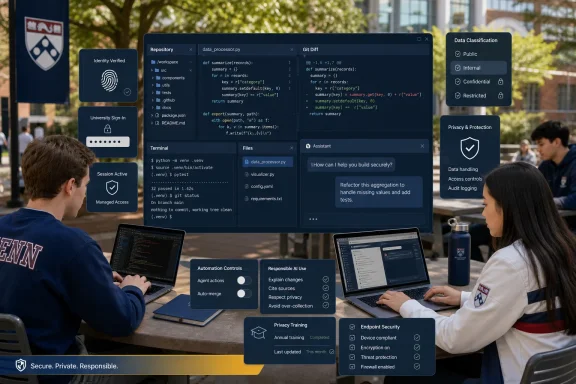
The immediate news is that Wharton undergraduates will receive Claude Enterprise accounts, with additional account-use guidance expected shortly. The Daily Pennsylvanian reported that students must complete a course on rules, risks, and privacy measures connected to agentic coding tools before activating accounts.
Yet Wharton’s public materials are not fully synchronized on the rollout state. Its AI Tools Guide, last modified August 17, lists enterprise Claude as available by default to Wharton MBA, Executive MBA, and undergraduate students. A separate Claude and Claude Code page, updated August 20, says MBA students have already been provisioned while “eligibility and ordering details” for other Wharton community members are still being finalized.
Those statements are not necessarily contradictory; the most plausible reading is that Wharton has decided on undergraduate eligibility but is still working through account activation, quotas, training, and the support process. But it does mean students and IT staff should not assume that “available by default” equals immediate, unrestricted access on day one. Wharton has not publicly specified the completion threshold for the required training, the undergraduate rollout sequence, the size of any message allocation, or whether all accounts receive the same Claude Enterprise service tier.
That gap matters because controlled provisioning is one of the few practical guardrails available when deploying AI at student scale. If an organization gives users a capable coding agent before it has completed training, set roles, and clarified data classifications, the license becomes an invitation to experiment first and learn policy afterward.
Claude Code changes the endpoint-security discussion
Claude Enterprise is often described as a privacy and productivity offering, but Claude Code brings a different risk profile from browser-based prompting. Wharton’s documentation describes it as a local code-focused agent available in the command-line interface, IDE extension, or desktop app. It can support code editing, debugging, Git workflows, and terminal-based task execution in a user’s local development environment.
That is why Wharton’s planned training is a substantive control, rather than a ceremonial orientation. An AI assistant that drafts text can produce bad information; an agent with access to a local project and a terminal can also make file changes, suggest destructive commands, introduce dependencies, expose credentials, or modify a Git working tree before a student fully understands what it has done.
Wharton’s security guidance draws a bright line: Claude Code is approved for code-only work up to its “Moderate, non-PII/non-FERPA” data tier. It specifically prohibits secrets, passwords, API keys, personally identifiable information, FERPA data, sensitive institutional information, and non-code material at that tier. In practical Windows terms, students should not point Claude Code at a repository containing a .env file, cloud credentials, database exports, private test fixtures, or downloaded coursework with identifiable student data simply because the repository itself is a coding project.
The school also cautions that Claude Code can inspect and edit code, run terminal commands, and interact with local repositories. That is exactly the behavior that makes it useful to developers—and why Windows device owners should treat it more like a development tool with automation privileges than a writing assistant. Review proposed edits, check diffs before committing, use least-privilege development accounts where possible, and avoid running shell commands that are not understood.
Wharton’s Windows installation guide notes that the Claude desktop installer may request Windows administrator credentials. Students should not interpret that prompt as a requirement to grant broad access casually. On managed devices, campus IT administrators will need to decide whether the application belongs in approved software catalogs, whether standard users may install it independently, and whether endpoint security tooling can distinguish the sanctioned Penn workspace from personal Claude usage.
Enterprise privacy does not mean every category of data is approved
Wharton says data entered into Penn’s Anthropic Enterprise workspace is not used to train Anthropic’s models. That is a meaningful improvement over directing university work into a personal free or paid AI account, and it is the foundation for the school’s claim that some confidential university data can be used in its approved enterprise environment.
But the school’s own classification table makes clear that “not used for model training” is not a blanket authorization. Low-risk data is permitted. Moderate non-PII/non-FERPA information is allowed, with Wharton recommending consultation with its Information Security Office for certain uses. Material containing PII or FERPA information requires an ISO risk review of the broader initiative’s data architecture and flow outside the AI service. High-risk data is not currently allowed, and HIPAA-protected health information is explicitly prohibited.
This distinction is the part other enterprises should copy. A vendor’s contractual promise not to train on customer prompts answers one privacy question. It does not answer whether a user has authority to disclose the information, whether an external connector changes the data flow, whether a model output is appropriate for a course or business decision, or whether local endpoint artifacts create another exposure.
Wharton’s policy also says that university confidential, regulated, or contracted data must use a Penn- or Wharton-approved enterprise generative-AI tool. That is a deliberate attempt to reduce shadow AI: students or staff putting sensitive information into personal accounts because the approved option is slow, unavailable, or poorly understood. The undergraduate rollout should make the approved path more accessible, but only if the school delivers training and support quickly enough to compete with consumer tools students already use.
Cowork is disabled while Wharton evaluates the higher-risk features
Wharton’s Claude knowledge-base page identifies another important limitation: Claude Cowork will be disabled at launch. Anthropic markets Cowork as a tool for delegating multi-step work, but Wharton says it is still determining how the feature can be enabled more broadly.
That restraint is notable because the difference between a chat model and a tool-using agent is not cosmetic. Multi-step automation can pull in more files, make more consequential changes, and generate a harder-to-audit chain of actions. Disabling it while access rules and controls are still being finalized is a more defensible rollout posture than enabling every enterprise feature on the same day as undergraduate provisioning.
The official materials also say Wharton has Standard and Premium Claude Enterprise service levels, with pricing, message allowances, and API allocations managed centrally by Penn Information Systems and Computing under the university’s Anthropic contract. The school has not publicly said which tier undergraduates receive, what their usage limits will be, whether those limits vary by program, or whether API access accompanies the accounts.
Those omissions affect real-world use. Model availability is one thing; sustained access to a higher-cost model such as Opus, use of coding-agent features, and developer API quotas are another. Students building class projects or experimenting with large repositories will need to know where campus-backed access ends and personal spending begins.
Penn is building a multi-vendor AI environment, not choosing one assistant
Claude Enterprise is not replacing Wharton’s ChatGPT Edu environment. Wharton explicitly says the two workspaces will coexist. The university also offers Microsoft Copilot Chat through Penn accounts, while Penn Information Systems and Computing began a PennChat pilot in July that brings multiple OpenAI and Anthropic models into a customizable portal hosted in Penn’s AWS environment.
PennChat’s design is relevant to the Claude rollout because it shows the university is avoiding a single-vendor AI bet. Penn has described the portal as using LibreChat and providing Anthropic models through Amazon Bedrock and OpenAI models through Microsoft Foundry. Its architecture is intended to keep Penn data inside a managed environment where providers cannot use it for model training.
For students, that creates a more complicated but healthier reality: different tools will have different approved data tiers, features, identity models, and academic-use rules. A Claude Enterprise account does not automatically make Claude appropriate for every assignment, and a managed AI workspace does not override an instructor’s course policy. Penn’s general policy leaves instructors responsible for setting their own classroom AI guidelines, a decentralization that can produce very different rules between courses using the same institution-provided account.
Wharton is offering the access layer, but it has not resolved the harder governance issue of consistent academic expectations. Penn’s Faculty Senate has already recommended broader centralized guidance on acceptable and unacceptable AI use. Until that happens, students will need to distinguish between what the platform technically permits, what Wharton’s data rules permit, and what a particular instructor permits.
For Windows enthusiasts and campus IT teams, Wharton’s move is a reminder that enterprise AI deployment is now reaching beyond employees and developers to large student populations with unmanaged personal devices. The immediate consequence is broader access to Claude and Claude Code; the lasting test will be whether account provisioning, required training, endpoint safeguards, usage limits, and course-level policy arrive with enough clarity to make that access safer than the consumer AI tools it is meant to replace.