

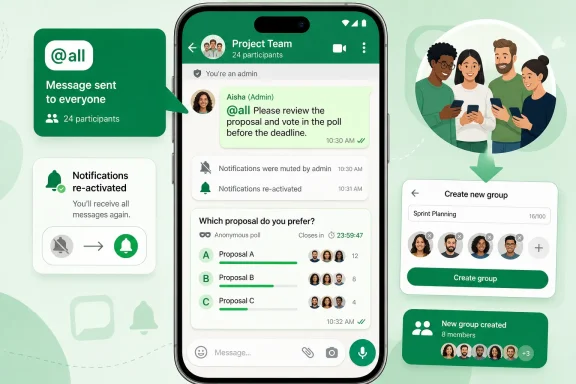
Engadget first reported the package of changes on August 4, and Meta’s own WhatsApp announcement confirms the core details. The practical change is larger than the tidy feature list suggests: WhatsApp groups have gained a broadcast mechanism that can override the reason many people mute high-volume chats in the first place.
For small groups, any participant can use @all. In groups with more than 32 members, WhatsApp restricts the command to administrators. Members can separately mute @all alerts in notification settings, but Meta has not published app-version requirements, a country-by-country rollout schedule, or a clear statement on whether every desktop and web client receives the controls at the same time.
That missing deployment information is important. Users may see the new mention behavior before they see the opt-out setting—or before a group administrator realizes that a muted chat is no longer completely quiet.
@all makes muted groups interruptible again
WhatsApp describes @all as a way to flag urgent information: closures, deadlines, schedule changes, and other messages that should not disappear beneath a fast-moving conversation. In use, the sender types the mention rather than tagging each person individually, and the service alerts the entire group.
The significant part is Meta’s confirmation that these alerts can reach members even when the group itself is muted. WhatsApp has long treated direct mentions as higher-priority events than routine group traffic; the new command converts that exception into a group-wide tool. A user who muted a parent group, neighborhood chat, volunteer team, or work-adjacent social group to stop dozens of daily notifications may now receive alerts whenever someone invokes @all.
WhatsApp does provide an escape hatch: members can mute @all notifications independently. But Meta’s announcement does not explain whether that preference is enabled by default for muted groups, whether it applies across all groups or needs to be configured per group, or how consistently it is exposed on Android, iPhone, Windows, Mac, and WhatsApp Web.
For anyone using WhatsApp as a work coordination channel, the immediate action is simple: open the notification settings for the groups that are intentionally muted and check whether an @all control is available. Group administrators should also establish a rule before the feature becomes routine. A mass mention intended for an outage notice or an event cancellation loses its purpose quickly if it becomes the preferred way to announce a lunch order.
The 32-member cutoff is WhatsApp’s main anti-spam safeguard. In a group of 32 people or fewer, every participant has the ability to interrupt everyone else. At 33 members, only admins retain the privilege. That is a blunt but sensible distinction: smaller groups are more likely to be family, friend, or active project chats where all participants have a legitimate reason to call for attention; larger groups need a moderation layer.
It is also not a brand-new concept technically. WABetaInfo documented @all in WhatsApp’s Android beta channel in October 2025, identifying the same over-32-members admin restriction and separate mention-notification control. Meta’s August 4 announcement marks the point where the feature has become an official product rollout rather than a limited beta observation.
Polls finally gain deadlines and private votes
The polling changes carry more weight for groups that use WhatsApp to make actual decisions instead of merely discuss them. Poll creators can now set an end time that locks further voting, choose anonymous voting, and edit the poll question for 15 minutes after posting it.
Until now, WhatsApp’s built-in polls were comparatively rigid. Meta’s previous poll update in 2023 added single-vote polls, poll search, and notifications for poll creators when people voted. It did not provide a native closing date or anonymous-ballot option. Users seeking either feature had to settle for informal deadlines in the chat, recreate a poll, or send people to an external survey service.
A deadline resolves a mundane but persistent failure mode: a group reaches a decision, then late votes change the apparent result after bookings are made or an event is announced. Anonymous voting addresses a different problem. Group polls today expose who voted for what, which works well for attendance and task assignments but is a poor fit for sensitive choices, internal feedback, or any vote where hierarchy and social pressure can distort participation.
The 15-minute poll-edit window is narrower than it first sounds. Meta says it applies to the poll question, allowing a creator to correct a typo or clarify wording. The company has not said that creators can alter answer choices after voting begins. That restraint is necessary: changing an option after members have voted would make the resulting tally hard to interpret.
The time limit also mirrors WhatsApp’s existing 15-minute window for editing ordinary sent messages, introduced in 2023. For polls, however, it addresses a more consequential problem. Before this update, a malformed question could mean deleting the poll and starting again, forcing everyone to re-vote and leaving the earlier, potentially misleading result in the chat history.
WABetaInfo reported in March that WhatsApp was developing anonymous voting, poll expiration, and poll editing for Android. At that stage, the features were described as under development rather than available to beta testers. Meta has now publicly announced them, but again has avoided stating the exact versions required or how rapidly the functions will arrive across platforms.
A new group without rebuilding the member list
The third addition is a one-tap way to create a new group chat from an existing group. Rather than manually selecting every participant again, a member can start a separate conversation using the current group as the starting point.
Meta pitches the feature for surprise-party planning, event logistics, and deeper discussions that would otherwise clog the main thread. Its more practical value is that it lowers the friction of moving a topic into the right-sized audience. Large groups tend to accumulate conversations that concern only a few people: a subgroup arranging transportation, a project team handling an implementation detail, or a set of friends making plans that do not require everyone’s input.
That does not mean the new chat is necessarily a hidden or private offshoot. Meta has not specified whether original-group administrators receive notice, whether every existing member is selected by default, whether a creator can remove people before the new chat is made, or whether a new group inherits settings such as disappearing messages and admin controls. Those details determine whether this is merely a membership-selection shortcut or a genuine group-management feature.
The announcement also does not state whether shared media, prior messages, polls, or pinned material carry over. They should not be assumed to. WhatsApp describes the feature as creating a new group chat, not splitting an existing conversation into threads or cloning its history.
The rollout has more policy impact than visual impact
None of these changes alter WhatsApp’s end-to-end encryption model for personal and group messages. But they do change the social and administrative rules around a group. A new broadcast mention determines who may demand attention; anonymous polls reduce the visibility of members’ preferences; deadlines turn polls into decisions with a hard cutoff; and subgroup creation makes it easier to reorganize a sprawling chat without asking everyone to rebuild a contact list.
For group admins, the most useful preparation is modest:
- Set a clear standard that reserves
@allfor messages requiring action or immediate awareness. - Review the notification settings in muted high-volume groups, especially if those groups include people who expect muting to mean no interruptions.
- Use poll deadlines for decisions tied to reservations, schedules, or other actions that cannot remain open-ended.
- Treat anonymous polls as appropriate for preference gathering, not for votes that require accountability or confirmation of attendance.
- Confirm the membership of a newly created side group before discussing material that was intended for only a subset of the original chat.
Meta’s announcement turns an Android beta feature first seen in October 2025 into an officially supported tool, but the company is still treating availability as a gradual rollout rather than a clean, versioned release. The immediate consequence is straightforward: muting a WhatsApp group is no longer enough to guarantee silence unless the new @all alert setting is also configured.