
PetaPixel first reported the renewed interest on August 2, pointing to the creators’ reaction to seeing the cave, dunes, sea arches, and Archway Islands in person at the northern end of New Zealand’s South Island. The video’s appeal is obvious to anyone who spent years signing in to a Windows 10 PC: the view through the dark cave mouth toward the offshore stacks looks uncannily like the image, because it is the image’s real-world setting.
The important practical detail for Windows users is that the photograph was a lock-screen and sign-in image, not Windows 10’s default desktop wallpaper. Microsoft’s standard desktop image was the blue, illuminated Windows logo. The beach scene appeared among the images Windows 10 used for the lock screen, where many users saw it repeatedly but had little reason to identify or investigate its location.
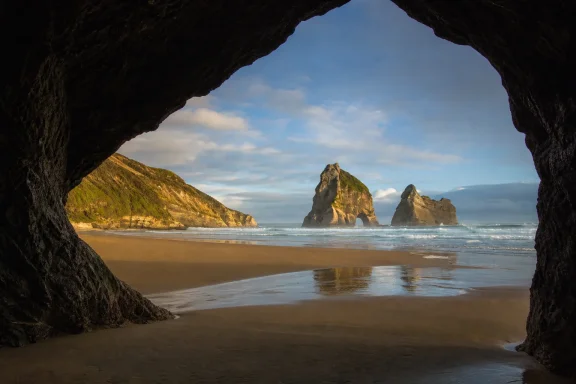 A Windows Image With a Longer Public History Than the Viral Clip
Wharariki Beach was not obscure to the internet until this week. Travel Stack Exchange users identified the scene as the Archway Islands at Wharariki Beach as early as March 2016, less than a year after Windows 10’s July 29, 2015 release. Microsoft Community threads from the same period show users asking where the striking beach-and-cave login image had been taken and receiving the same answer: Wharariki Beach near Pūponga in Golden Bay.
That history matters because it puts the recent surge in context. PetaPixel’s report documents a viral piece of travel content and a renewed wave of recognition; it does not provide visitor figures, park-count data, hotel occupancy, or a statement from New Zealand conservation or tourism authorities showing that arrivals have materially increased. No independent outlet located in reporting on the story has published a count demonstrating that Windows nostalgia has converted into a new influx of visitors.
The beach has also carried the Windows connection in travel posts, online maps, and user discussions for roughly a decade. A 2016 New Zealand infrastructure document even listed Wharariki Beach among tourism locations, indicating that it was already a recognized destination independent of the more recent clip. The fresh video may well prompt more people to put it on an itinerary, but “becoming a travel destination” is, at present, an assertion about online attention rather than a verified change in visitor volume.
That distinction is more than semantic. A meme travels at internet speed; a trip to Golden Bay requires a real plan, transport, weather tolerance, and a willingness to visit a remote coast. The social-media post is a useful reminder that the place exists. It is not evidence that the beach has suddenly become New Zealand’s next mass-tourism site.
The Steve McCurry Credit Is Strongly Plausible, but the Exact Asset Record Is Thin
PetaPixel identifies Steve McCurry as the photographer behind the famous cave view and says Microsoft commissioned him to photograph in New Zealand for Windows 10. The broader commission is well supported. A New Zealand production company that worked on the campaign published a 2015 portfolio entry naming Microsoft as the client, “Windows 10 Wallpaper Photography” as the campaign, Steve McCurry as the photographer, and eight South Island locations as the shoot footprint.
That is meaningful corroboration that Microsoft hired McCurry for Windows 10 landscape photography in the South Island. It is also consistent with the familiar image’s provenance. But the public record available today does not include a Microsoft asset-credit page, a published EXIF record, or a McCurry portfolio page that unambiguously names the precise Wharariki cave file used by Windows 10.
In other words, the campaign attribution is documented; the exact-photo attribution has largely been carried by wallpaper databases, community posts, and repeated secondary reporting. That does not make the McCurry identification wrong. It does mean readers should separate the confirmed commission from the harder-to-audit claim that a particular bundled Windows image was authored by him.
The distinction becomes relevant because Windows images have often had murky public credits. Windows 10 distributed a mixture of still backgrounds, lock-screen art, Spotlight images, and pictures commissioned from different photographers and production teams. Users tend to call all of them “the Windows wallpaper,” while the operating system treats those categories differently. Microsoft’s current personalization documentation still distinguishes among a fixed Picture, a Slideshow, and Windows Spotlight’s rotating content.
The practical result is that a photograph can become globally familiar without retaining a clear, visible creator credit in the Windows experience itself. A person may have seen the Wharariki image thousands of times without ever seeing “Steve McCurry,” “Archway Islands,” or “Pūponga” attached to it.
Wharariki Is a Conservation Area, Not a Wallpaper Set
The Windows framing can create a misleading expectation: a perfectly composed, calm beach scene with a conveniently placed cave and sea stacks. The New Zealand Department of Conservation describes Wharariki Beach as a coast of caverns, islands, dunes, and long beach, but it also emphasizes the conditions that do not appear in the Windows image.
The official Wharariki Beach Track begins at the car park at the end of Wharariki Road, crosses farm paddocks and coastal forest, and takes roughly 20 minutes to reach the beach. At low tide, visitors can extend the outing along the beach and return by the Green Hills Track. Those are access conditions, not a promise that the exact frame will be available, dry, empty, or lit like the Windows image.
The Department of Conservation specifically says Wharariki is not a swimming beach because of strong currents and rips. It prohibits dogs and camping in the adjoining Farewell Spit Nature Reserve and Pūponga Farm Park, and asks visitors to keep at least 20 metres away from seal pups that use pools on the beach. Leaving gates as found also matters: access crosses working farmland, and a picturesque route is still part of a managed landscape.
This is the part a viral travel clip can leave out. The beach’s visual power comes partly from its exposure to wind, surf, tide, and weather. Treating the location as a backdrop for re-creating a computer image can put visitors in conflict with the reasons the place looks that way and with the rules intended to protect it.
A Post-Support Windows 10 Memory Is Carrying the Story
There is an irony in the timing. Windows 10 reached end of support on October 14, 2025. Microsoft says ordinary Home, Pro, Enterprise, and Education installations no longer receive free security updates or technical support, though eligible organizations and users may have Extended Security Updates arrangements. The famous lock-screen scene is now circulating as a cultural artifact from an operating system Microsoft has formally retired from normal support.
That does not mean the image itself has disappeared. Microsoft’s personalization controls continue to let users choose a local picture, a slideshow, or rotating Spotlight content, and a saved copy can still be used on a supported Windows 11 PC. But Microsoft is not presenting Wharariki Beach as a new Windows 11 identity image or conducting a new campaign around the 2015 photograph.
The renewed attention therefore belongs less to a Microsoft product moment than to the unusually durable reach of preinstalled imagery. Windows 10 put one carefully composed landscape in front of hundreds of millions of people, then stripped away most of the surrounding context: the location name, the route, the conservation rules, and even a clear on-screen credit trail.
PetaPixel’s viral-video report has restored some of that context. The responsible next step is not to assume the coast is a new tourist attraction because it has become newly visible online, but to recognize Wharariki Beach as a real, managed place whose appeal long predates the latest Windows nostalgia cycle.
Update: Viral reel reaches 142 million views as Microsoft joins the comments (August 3, 2026)
Windows Latest reports that Sagar and Ami’s Instagram Reel has reached 142 million views and 8.5 million likes within roughly a week, quantifying the online attention behind the Wharariki Beach rediscovery. Microsoft’s official Instagram account also commented that the location is “even better in person,” a reply the outlet says received about 150,000 likes.
The figures demonstrate an unusually large social-media moment, but they still do not establish a measured increase in physical visits to the beach. Windows Latest also notes an earlier Wharariki-related Reel from travel account Get Lost With Liam, posted about a year earlier, had already drawn more than 746,000 likes—further evidence that the Windows connection predates the current spike.

