
Phoronix first reported the release on August 27, citing Werner Koch’s announcement and highlighting new Intel acceleration for SM3, SM4, and SHA-512. The release archive independently confirms those implementations landed in the 1.12.3 source tree, alongside a fix intended to prevent a theoretical drive-by DLL loading condition involving netapi32.dll and shell32.dll.
The practical split is clear: the Intel work is a workload-specific performance opportunity, while the DLL-loading change is the part Windows maintainers should treat as an update priority.
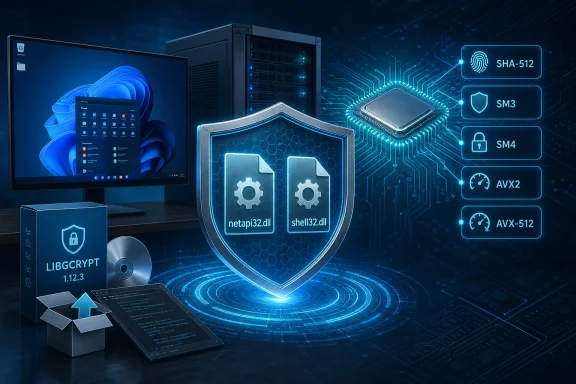 The Windows fix is more important than the benchmark-free speed claims
Libgcrypt’s 1.12.3 release notes list a change to avoid theoretical drive-by loading of netapi32.dll and shell32.dll. The wording is restrained, and neither the project nor Phoronix has published a CVE identifier, exploit demonstration, affected build configurations, or a severity assessment. Administrators should not inflate that into a confirmed remote-code-execution vulnerability.
But the fix addresses a familiar Windows deployment hazard. DLL search-order problems can arise when an application loads a system-named library without constraining the search path appropriately, allowing an attacker-controlled DLL in a searched directory to be loaded before the intended system copy. Whether that becomes exploitable depends on the application’s working directory, launch method, permissions, the exact Windows loader behavior, and whether an attacker can place a file in a relevant location.
The important operational point is that this is a library-side hardening fix, not a patch that appears automatically through Windows Update. Organizations using a vendor-supplied application will need that vendor to rebuild or redistribute the application with an updated Libgcrypt runtime. Developers who statically link Libgcrypt must rebuild; updating a DLL elsewhere on a machine does nothing for a statically linked executable.
Libgcrypt’s January 2026 1.12.0 announcement also demonstrates that Windows support is an active concern for this branch: that release changed the Windows location used for common application data and fixed a Win64/Wine stack-overflow crash in the McEliece implementation. Version 1.12.3 continues that platform-specific maintenance rather than simply adding processor tuning.
Intel’s new instructions need the right CPU and the right crypto workload
The headline additions are implementations for Intel’s SHA-512 and SM3 instruction extensions, plus Intel-targeted SM4 paths using AVX2 and AVX-512. Intel’s architecture documentation lists SHA512, SM3, and SM4 support for Arrow Lake-S and Lunar Lake, and GNU’s compiler documentation similarly identifies those instruction extensions for Arrow Lake-S and Lunar Lake targets.
That hardware availability does not mean every Core Ultra-branded PC receives the same benefit. The extension set is tied to specific processor designs, not a marketing badge alone. A system with an older Intel processor, an AMD processor, or an unsupported Arrow Lake variant will use Libgcrypt’s existing implementation instead. Windows 11 itself also does not cause the acceleration to appear; Libgcrypt must detect the CPU capability and select the matching implementation at runtime.
The second limit is algorithm use. SHA-512 is widely recognizable, but its use depends on the protocol and application configuration. SM3 and SM4 are Chinese national cryptographic algorithms and are relevant in particular for interoperability requirements, regional deployments, and products that explicitly use them. An OpenPGP workflow or ordinary Windows application does not suddenly begin using SM3 or SM4 because Libgcrypt now accelerates them.
Phoronix reported the new code as a performance advance but did not publish benchmark results, and the official release material available through the project’s distributed archive provides no percentage improvements. That omission matters. New instructions can reduce the CPU cost of the covered primitives, but there is no published basis for promising a particular end-to-end improvement in GnuPG operations, encrypted storage, signing, or a specific Windows application.
The SHA-512 implementation has broader potential than SM3 and SM4
Of the three instruction additions, SHA-512 is likely to matter to the broadest set of Libgcrypt consumers because it is a standard-purpose hash function used across signing, integrity, password-related constructions, and cryptographic protocols. Still, the performance effect depends on data size and call patterns. Applications processing large buffers repeatedly are more likely to notice a faster compression routine than interactive tools that spend most of their time waiting on disks, networks, user input, or public-key operations.
Intel has separately added SHA-512, SM3, and SM4 acceleration to its own cryptographic primitives software for Lunar Lake and Arrow Lake-S-class processors. That is useful corroboration that these extensions are real, production-targeted hardware capabilities rather than speculative compiler flags. Libgcrypt is now joining that wider software enablement effort.
The AVX2 and AVX-512 SM4 work is somewhat different from the SHA-512 and SM3 paths. Phoronix described it as Intel acceleration, but the source archive shows distinct AVX2 and AVX-512 implementations rather than a file named for the dedicated SM4 instruction extension alone. In practical terms, that means SM4 acceleration may apply across a broader range of suitably capable x86-64 CPUs than the dedicated SHA512 and SM3 instructions, subject to Libgcrypt’s runtime dispatch rules and the processor’s supported vector features.
That distinction is why organizations should test their own builds rather than use the release headline as a capacity-planning number. An Intel desktop with AVX2 may exercise an SM4 vector path while lacking the newer SHA512 and SM3 extensions; an Arrow Lake-S or Lunar Lake machine can potentially use all of the new Intel-oriented work.
Other changes are real, but mostly matter to upstream builders
Libgcrypt 1.12.3 also includes better use of unaligned vector memory accesses on RISC-V where appropriate, an optimization for the sntrup761 post-quantum key-encapsulation code, and an internal option allowing cipher and hash users to avoid a fast random poll. Those changes are relevant to cross-platform library maintainers and projects building their own crypto stacks, but they are not a Windows PC performance upgrade in the ordinary sense.
The release additionally tightens validation in several sensitive areas. The changelog records validation of hash algorithms for RSA modulus use, parameters for the Balloon key-derivation function, and Argon2 parallelism. It also corrects RSA PKCS#1 processing around padding-string and frame-length validation. The project has not classified these fixes as a security advisory, so they should be reported as correctness and input-validation hardening rather than assigned an unsupported vulnerability label.
For Windows software vendors, the release creates a straightforward maintenance task:
- Inventory applications that bundle
libgcrypt-20.dll, ship GnuPG-related components, or statically link Libgcrypt. - Determine whether the product actually uses Libgcrypt 1.12 rather than another maintained branch or a platform crypto provider.
- Rebuild or obtain the vendor update, then verify that the deployed binary contains the updated library rather than an older private copy.
- Test cryptographic operations on representative older hardware as well as Arrow Lake-S and Lunar Lake systems, because runtime CPU dispatch is central to this release.
The immediate consequence is not that Windows PCs become faster at cryptography across the board. It is that projects using Libgcrypt now have a current release that removes a Windows DLL-loading concern and can finally use Intel’s newer SHA-512 and SM3 instructions when their code, algorithm choices, and hardware line up.
