

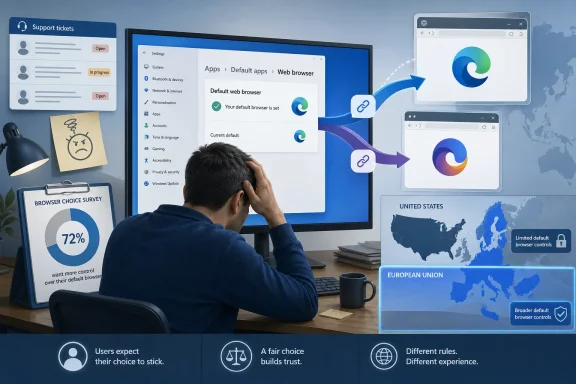
Windows Central first reported the results, which came from a Browser Choice Alliance-commissioned Savanta poll of 2,000 U.S. adults who use a Windows laptop or desktop. The alliance says 86% believe they should have primary control over their default browser, while 80% favor a one-click setting that would apply their choice consistently.
The polling warrants attention, but its framing needs tightening. This is not global research, despite how the story has been characterized: it is a national U.S. survey. And it was paid for by an advocacy group whose members compete with Edge, including Chrome, Opera, and Vivaldi. That does not invalidate respondents’ experiences, but it does mean the survey is evidence of user-reported friction—not independent proof that Microsoft intentionally reset or overrode every reported preference.
The gap is between a browser setting and Windows behavior
The sharpest figure in the survey is the mismatch between the browser respondents say they prefer and the browser they say is set as their default. Twenty-six percent reported Edge as their default browser, while 19% said Edge would be their preferred choice.
That seven-point difference does not establish why Edge is set as the default. Some users may accept the preinstalled option, use a different browser occasionally, or not distinguish between a preferred browser and the app registered for web links. But it is a meaningful warning that a default setting is only useful when a person can locate it, understand it, change it once, and trust it afterward.
The Browser Choice Alliance labels this the “Browser Choice Gap.” The term is advocacy language, but the underlying problem is recognizable to anyone who has supported a Windows PC remotely: a user says “Chrome is my browser,” then a search result, widget, PDF, sign-in flow, or Microsoft application opens somewhere else. The support ticket is rarely about protocol associations. It is about the computer appearing to disregard an instruction that seemed unambiguous.
Microsoft has publicly committed to the opposite principle. In a March 2023 Windows Experience Blog post, the company said people should control changes to pins and defaults, and that Microsoft apps would use the same supported methods as third-party applications for default and taskbar-pinning requests. The survey is therefore not merely a complaint about Edge prompts. It tests whether that stated design goal is reaching ordinary users.
The survey measures frustration, not causation
The alliance says 29% of respondents believe Windows system updates contributed to a browser preference being changed or reset. That is the claim most likely to resonate with administrators—and the one that needs the most care.
The published survey summary does not provide the questionnaire, field dates, weighting method, margin of error, response distributions, or a technical audit of affected PCs. It also does not separate a confirmed Windows change to HTTP, HTTPS, PDF, or HTML associations from a user encountering an Edge prompt after an upgrade, installing another browser version, resetting an app, or seeing a Microsoft-owned feature that opens web content separately from the normal default-browser route.
Those distinctions matter. Windows must protect file and protocol associations from silent takeover by unwanted software, a security and usability objective that Microsoft has emphasized for years. At the same time, protecting a setting is different from making the setting easy to review, comprehensively apply, and understand. A user should not need to know the difference between a default for https, .html, .pdf, or a proprietary Windows link handler to answer a basic question: “What opens when I click a web link?”
The survey cannot determine which layer caused each reported failure. It can establish something more limited but still important: respondents who attempted the change often experienced enough inconsistency to conclude that Windows had made their preferred browser difficult to use.
Mozilla’s separate usability research points in the same direction. Its recent study of Windows 10 and Windows 11, alongside iOS, found that participants struggled to discover default-browser controls, that Settings search terms could fail to surface the necessary option, and that users’ confidence often exceeded their ability to complete the task. Mozilla, like Browser Choice Alliance members, has a commercial interest in browser competition. Still, two separate browser-industry research efforts arriving at the same usability complaint makes the issue harder for Microsoft to dismiss as one company’s marketing campaign.
Europe received a broader fix than the United States
Microsoft has already shown that Windows can treat browser choice more broadly—when regulation requires it.
In its June 2025 Digital Markets Act update, Microsoft said that selecting “Set default” in the European Economic Area would apply additional link and file types beyond the usual HTTP, HTTPS, .htm, and .html defaults. The EEA version could also pin the chosen browser to the taskbar and allow a browser to become the PDF default if it registered for that capability. Microsoft also said Bing app web results and Windows 11 Widgets Board content would open in the user’s default browser in the EEA, while Edge would stop asking to become the default unless a person opened Edge directly.
Those changes were tied to the European Union’s Digital Markets Act, not rolled out globally as a universal Windows design improvement. That regional split is the central fact behind the new survey. Microsoft has acknowledged that a wider default-browser setting and fewer Edge-directed paths are technically possible. U.S. users, who are the entire sample in this poll, have reason to ask why the same baseline has not been made standard everywhere.
This is more than an argument about consumer preference. A different browser can mean a different password manager deployment, extension policy, enterprise identity workflow, accessibility setup, privacy posture, management console, or support standard. For an IT department, browser choice is often configured policy rather than personal taste. A Windows interface that weakens the distinction between “Edge is installed” and “Edge is the selected default” creates avoidable support work.
Older users bear the cost of fragmented defaults
The poll’s age breakdown is more convincing than its broad rhetoric. Forty-four percent of respondents aged 65 or older said changing their browser was complex, compared with 15% of respondents aged 18 to 44. Sixty-one percent of the older group said they had little or no confidence in their ability to consistently select and run the browser they wanted.
Those results do not mean older users cannot manage Windows. They show that a multi-step, poorly explained setting penalizes people who have less appetite for trial and error. A default-browser control should be judged by whether a person can complete it without a web search, a tutorial video, or a family member on the phone.
For Windows enthusiasts and help-desk staff, the immediate response is practical rather than ideological. After setting a browser default in Settings > Apps > Default apps, test the actual link and file types that matter in the environment: HTTP, HTTPS, HTML files, PDFs, mail-client links, Windows Search results, and links surfaced from Microsoft applications. A green confirmation message in Settings is not sufficient validation if the user’s regular workflow still launches Edge.
Administrators should use supported default-association policies where consistency is required, rather than relying on individual users to configure each machine. Microsoft’s Edge deployment documentation continues to support managed default associations through Group Policy and mobile device management configurations. Organizations should also test behavior after feature updates and browser-version changes, especially where a PDF handler or more than one browser channel is installed.
Microsoft needs to make the choice durable
The Browser Choice Alliance is pursuing a policy objective and its survey is not a forensic record of every Windows configuration. Its public summary leaves too much methodology unpublished to treat percentages about resets as a definitive account of Windows update behavior.
But its main result survives that caveat: a large share of people who tried to change browsers say Windows made the task confusing or unreliable. Microsoft’s own EEA changes demonstrate a more comprehensive model—one action that applies more associations and sends more Microsoft surfaces to the selected browser.
For U.S. Windows users, the concrete consequence is that browser choice remains something to verify after setting it, not a one-time preference they can safely forget.