
Microsoft said Jha, the executive vice president leading Experiences + Devices, would transition out on July 1, 2026 after more than 35 years at the company and remain in an advisory role. The March 12 announcement was independently reported by GeekWire, CRN, The Register, and others. A version dated March 13 is consistent with publication in other time zones; the August 27 publication date on the supplied MediaPost story does not mark a new Microsoft reorganization.
More importantly, the official Microsoft announcement did not say that Microsoft Advertising was being reorganized, did not announce new advertising inventory in Copilot, Bing, Edge, or Windows, and did not describe any plan to insert ads into AI-driven workflows. That interpretation in MediaPost’s report goes beyond the company’s public record. The documented change was a management restructuring around product, platform, and AI ownership.
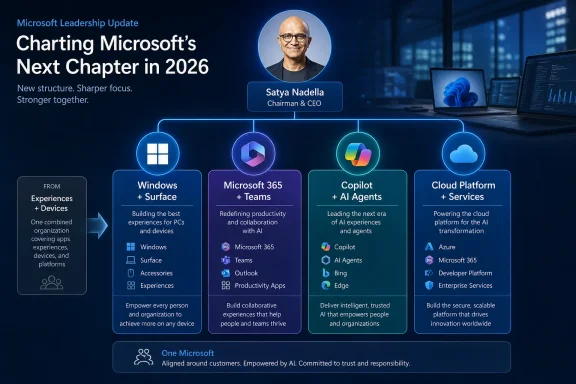 Rajesh Jha’s successor is a group of executives, not one replacement
Jha’s departure did not produce a conventional successor. Microsoft named four executives as direct reports to CEO Satya Nadella: Perry Clarke, Charles Lamanna, Pavan Davuluri, and Ryan Roslansky. That change is the central organizational fact behind the announcement, and it is more consequential than the title promotions alone.
Davuluri’s position is the clearest one for Windows users and PC administrators. He was identified in reporting by GeekWire and CRN as the leader for Windows and devices, putting Windows and Surface ownership nearer to Nadella’s office rather than under a broad Experiences + Devices umbrella. That does not promise a new Windows roadmap, but it gives the Windows organization a more direct executive route at a time when Microsoft is trying to make AI features, security engineering, and device strategy move faster.
Clarke was associated with Microsoft 365 core infrastructure; Lamanna with business and industry Copilot; and Roslansky, already LinkedIn CEO, had a growing remit over Office and Microsoft 365 experiences. The distribution of responsibility shows Microsoft separating the underlying Microsoft 365 platform, business AI, Windows and Surface, and work-oriented apps rather than treating them as one giant end-user-products division.
For customers, this distinction is more than org-chart trivia. Windows feature delivery, Microsoft 365 application changes, Copilot capabilities, and service-platform decisions can now be driven by different executive organizations with separate priorities. A Windows feature may be designed under Davuluri’s Windows and Devices organization, while the data, identity, Microsoft 365 application, or Copilot components connected to it may be owned elsewhere.
The March announcement was followed by a more specific Copilot consolidation
Microsoft’s own March 12 memo was deliberately incomplete. Jha said leadership would spend the period through June defining “operating rhythms,” decision ownership, and the future structure, with the intent of being ready for fiscal year 2027, which began July 1, 2026. The company disclosed the destination at the top level but left most reporting lines and team boundaries unresolved at the time.
Five days later, Microsoft announced a separate Copilot leadership update. Nadella said Microsoft was combining its commercial and consumer Copilot efforts into one organization covering the Copilot experience, platform, Microsoft 365 apps, and AI models. Jacob Andreou became executive vice president of Copilot, while Roslansky, Clarke, and Lamanna were assigned leadership over Microsoft 365 apps and the Copilot platform.
That follow-up matters because it prevents an overbroad reading of the Jha transition. The company did not simply hand all of Experiences + Devices to a new leader and declare AI the new center of gravity. It created overlapping product and platform leadership around Copilot, with a dedicated Copilot leadership team involving Andreou, Roslansky, Clarke, Lamanna, and Microsoft AI chief Mustafa Suleyman.
For enterprise IT, the likely result is continued pressure to connect Microsoft 365, Copilot, and agent services more tightly. Microsoft’s public language emphasized agents performing multi-step tasks with user control points, plus governance and security controls. Those ambitions will affect how Microsoft packages and integrates tools, but they are not themselves a mandate for customers to enable Copilot, expand licenses, or change tenant configuration.
Later reporting shows where Teams and collaboration landed
The fuller operational cascade began to emerge in May. The Verge reported that Roslansky’s remit expanded to include Microsoft Teams within a new Work Experiences Group, while Lamanna took charge of a Copilot, Agents, and Platform organization. Reuters also carried the reporting on Roslansky’s expanded Teams role.
The May structure is a more useful guide than the original promotion notices. It places Teams alongside Office and LinkedIn-related work experiences under Roslansky, while concentrating Copilot, agent, platform, Microsoft 365 services, and Dynamics 365-related responsibilities around Lamanna. In that arrangement, Teper’s promotion to executive vice president does not make him the singular owner of Microsoft’s collaboration stack; it recognizes a senior role inside a reorganized leadership model.
Kirk Koenigsbauer’s position also became clearer after the March announcement. Microsoft event material from May listed him as president of Data Platform and Growth and chief operating officer for Microsoft 365. That title points toward platform usage, data services, and operational execution—not a separate consumer advertising command. Sumit Chauhan, elevated to president, remains associated with Office’s core applications and authoring experiences.
These reporting lines help explain the company’s repeated emphasis on “decision ownership.” Microsoft is trying to align applications such as Teams, Word, PowerPoint, and Excel with the services, data, agents, and Copilot layers that increasingly sit behind them. That is a coordination problem inside a company whose products historically developed in sizable, semi-autonomous divisions.
Microsoft Advertising was not the subject of the confirmed announcement
The MediaPost report calls Experiences + Devices the parent engineering group for Microsoft Advertising and suggests the transition signals a future in which advertising appears more deeply in AI-driven experiences. The first half of that statement may reflect how parts of Microsoft’s search and advertising work were associated with the division, but the conclusion is unsupported by the March announcement.
Microsoft’s published messages from Jha and Nadella do not mention Microsoft Advertising, ad formats, ad targeting, Bing ads, Edge promotions, Copilot monetization, advertiser tools, or changes for consumers. The separate March Copilot announcement likewise focuses on product experience, platform, Microsoft 365 apps, models, agents, and governance. It contains no advertising plan.
That absence does not rule out future commercial changes. Copilot, Bing, Edge, Windows, and LinkedIn all have revenue models that Microsoft can alter over time. But readers should distinguish an inference about possible monetization from an announced product policy. No documented change from this leadership shuffle tells an advertiser where new inventory will appear, tells an IT department that Copilot will carry ads, or tells Windows users that AI features will gain additional commercial placements.
What Windows and Microsoft 365 administrators should do
There is no deployment task tied directly to Jha’s retirement or the executive promotions. Organizations should avoid treating the March memo as a reason to reconfigure Microsoft 365 tenants, change Windows servicing rings, purchase Copilot licenses, or revise advertising policies.
The sensible response is to monitor the product-specific notices that follow from the new structure:
- Windows administrators should track Windows release health, Microsoft Intune documentation, and Windows feature announcements rather than infer policy changes from the Experiences + Devices reshuffle.
- Microsoft 365 administrators should watch the Microsoft 365 admin center, Message Center, and Copilot service documentation for actual changes to licensing, data access, agent governance, Teams, SharePoint, and OneDrive.
- Security teams should continue to evaluate Copilot and agent features through existing identity, data-loss prevention, audit, retention, and least-privilege controls. Jha’s memo explicitly said the Secure Future Initiative and Quality Excellence Initiative remained priorities, but it did not add a new control or compliance requirement.
The organizational transition date—July 1, 2026—has already passed. What remains relevant is the structure it produced: Windows and Surface under Pavan Davuluri; workplace experiences including Teams under Ryan Roslansky; and Copilot, agents, and platform work concentrated around Charles Lamanna and the broader Copilot leadership team. The March announcement was the starting signal, not an advertising product launch.
