
The latest snapshot was tracked manually through 2026 by KoreaXboxNews and highlighted by Windows Central, which says the share of newly listed Xbox games carrying the Xbox Play Anywhere tag is approaching 50%. Microsoft has not published a matching monthly denominator, methodology, or current percentage of new launches. The tracker is useful evidence of direction, not an audited measure of the whole store.
Microsoft’s own public material does confirm the broader momentum. In July 2025, Xbox said more than 1,000 games supported Play Anywhere and that more than 100 had launched with the feature during that year alone. That is a substantial improvement over the period when Play Anywhere was often limited to Microsoft-published games and a relatively small group of ID@Xbox titles.
The catch is that a rising flow of new compatible games does not repair the installed base. A customer with hundreds of digital Xbox games cannot assume a new Windows handheld will unlock that library. Play Anywhere remains a product-by-product entitlement, and Microsoft has yet to offer a migration program, a compatibility roadmap, or even a reliable public account of how much of the console catalog is playable natively on PC.
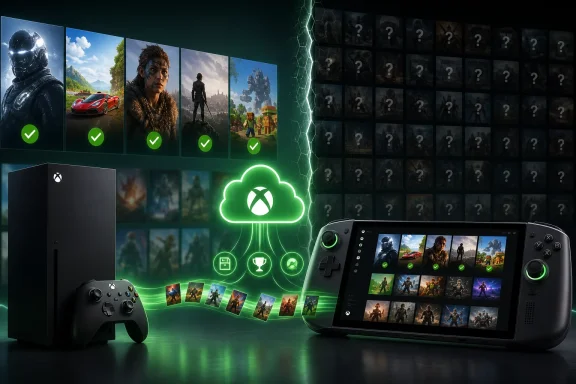 What Xbox Play Anywhere Actually Includes
Play Anywhere is more than cross-save support and less than universal ownership. For an eligible digital game purchased through Xbox, the customer receives rights to the Xbox console and Xbox-on-PC versions under the same Microsoft account. The program also combines cloud-save roaming, achievements, and, where implemented, synchronized progression and add-on access.
It does not mean every Xbox game can be downloaded to Windows. It does not cover disc purchases. It does not automatically cover a Steam, Epic Games Store, Ubisoft Connect, PlayStation, or Nintendo Switch copy. It also does not mean a title can be played simultaneously everywhere without licensing limits: Microsoft’s developer documentation says Play Anywhere titles can be configured for one offline console and one offline PC.
That distinction is increasingly important now that Windows handhelds are becoming an explicit part of Xbox’s pitch. On an Xbox Ally or another Windows handheld, a Play Anywhere game is a native PC installation with the user’s Xbox license and save available. A console-only purchase, by contrast, may require Remote Play, cloud streaming if supported, or a second purchase on a PC storefront.
Microsoft’s developer material describes Play Anywhere as a combination of cross-entitlement and cross-progression. A studio has to publish on both Xbox console and PC, configure the product for both device families, and make the licensing and save systems work together. Microsoft says a game using a single TitleID can be enabled for cross-entitlement, but that language should not be mistaken for a one-click conversion of an old release.
For a current game, teams still need a Windows build, PC-specific quality assurance, store packaging, input and display testing, cloud-save compliance, metadata work, and support capacity for a second platform configuration. A developer with a console version but no viable PC version has no Play Anywhere shortcut.
The 50% Figure Measures a Better Pipeline, Not a Solved Problem
KoreaXboxNews’ data points to a genuine shift in the release pipeline. Prominent games including IO Interactive’s 007 First Light have been listed with Play Anywhere support, while Xbox’s 2025 Partner Preview and recent release messaging have put more emphasis on console, PC, cloud, and handheld availability under one purchase.
Xbox has been actively selling the program to creators. Its current developer resource page says there are more than 1,000 Play Anywhere-enabled titles in the Xbox Store and argues that multi-device buyers are more engaged. Reporting from Game Developer on Xbox’s 2026 GDC presentation said Microsoft told developers that Play Anywhere purchasers spent more than twice as many hours playing as other customers. That is Microsoft’s internal platform metric, not an independently published study, but it explains why the company is promoting the feature more aggressively.
The manually tracked near-50% figure is therefore plausible as a measure of recent additions. It is also narrower than the way it is likely to be read on social media. New releases are not the same thing as the catalog customers already own, and a percentage based on store tags can move sharply depending on whether a given week contains several small games, a major publisher’s slate, or a set of delayed PC ports.
Microsoft’s own documentation contains an odd reminder of how fragmented Play Anywhere’s public accounting has been. One current developer page says there are “over 400” enabled titles, while another newer Xbox developer page says “over 1,000.” Xbox’s July 2025 announcement also used the 1,000-plus number. The 400-title page appears to be stale, but Microsoft has not corrected the contradiction. It is a small documentation failure with a larger effect: players and developers have no authoritative, consistently maintained public dashboard showing which titles are covered, when they were added, and how the catalog is growing.
The program needs that clarity if it is to become a buying consideration rather than a badge enthusiasts hunt for on a store page.
Big Releases Are the Test Microsoft Still Has to Pass
The most encouraging change is that Play Anywhere is appearing on larger upcoming and current releases, rather than being treated primarily as an indie or Game Pass feature. Windows Central singled out 007 First Light as a notable AAA adoption because it was not publicly announced as a Game Pass launch. The Xbox Store lists the game as Play Anywhere across PC, Xbox Series X|S, cloud, and handheld use cases.
But the individual win also exposes the larger weakness. Buyers must check every title separately because Play Anywhere remains optional. Major publishers can support Xbox on console and offer a Windows version through a different store, launcher, or entitlement system without participating. Ubisoft is a current example of the uneven experience: its PC distribution has expanded within the Xbox app, including Ubisoft+ Classics access for eligible Game Pass subscribers, but those are not automatically Play Anywhere entitlements.
That is why “available on Xbox PC” and “Play Anywhere” cannot be used interchangeably. The former means there is a PC route to play or buy a game. The latter means the customer’s console purchase carries over and their Xbox progression is designed to follow. The difference can be $70, a replacement save file, and a fragmented friends-and-achievements record.
Some games also arrive with support after their initial announcement or release. That is better than permanent omission, but it undercuts consumer confidence. A buyer deciding whether to purchase on Xbox, Steam, or another PC store needs the entitlement status before checkout, not a possibility that the game may receive the label later.
The same problem is sharper for older games. Microsoft’s current publishing documentation says adding PC support to a previously released console title can give existing owners PC access. In theory, that means back-catalog additions are possible. In practice, every old game needs a maintained or revived PC build and the work to connect licenses, saves, DLC, achievements, support systems, and certification. For delisted titles, games with expired licensed music or cars, and releases whose original developer has moved on, the obstacles can be far larger than the store configuration.
Microsoft’s own back catalog remains the most visible evidence. If Xbox cannot turn every suitable first-party or acquired game into a shared console-PC entitlement, third-party publishers have little reason to view the program as an expected baseline.
A Better Revenue Split Is Not a Business Case by Itself
Windows Central argues that Xbox PC sales can return more revenue to creators than Steam sales. There is a factual basis for the narrower claim: Microsoft says it charges a 12% fee for games using its commerce platform in the Microsoft Store, while Steam’s standard public revenue share has historically been higher, with larger games eligible for lower tiers as sales rise.
But the conclusion that an Xbox PC release therefore produces more revenue is too broad. Store fees are only one input. A lower percentage of a smaller sales base can generate less money than a higher percentage of a larger one. Publishers also weigh wish lists, discoverability, regional reach, launcher friction, technical support, multiplayer population, mod support, and the cost of maintaining another PC version.
Microsoft has not published evidence that the 12% rate alone is changing publisher behavior at scale. Nor has it disclosed how many Play Anywhere games are enabled through a single modern development path versus how many require custom work across separate products and services. The company is selling a credible player-value proposition, but developers need a credible production and commercial proposition.
Its own documentation points toward the practical answer: reduce the number of decisions required to ship. Make Play Anywhere the default recommended configuration for a game releasing on both Xbox and PC, improve conversion tools for existing titles, publish a transparent compatibility catalogue, and create funding or technical-assistance programs for small teams. Microsoft already has the Developer Acceleration Program and has said it is helping independent creators enable the feature, but it has not publicly tied that help to clear Play Anywhere adoption targets.
The near-50% new-release trend is progress. The customer-facing problem remains that Xbox’s best cross-device feature is still something users must discover title by title, after years of buying games under a console-first license model. Until the Play Anywhere tag becomes routine on major releases and Microsoft makes a serious effort to expand the back catalog, an Xbox Ally will continue to reveal both the strength of Xbox’s shared-library strategy and the size of the library it has left behind.
