
Larian Studios has added Xbox Play Anywhere support to Baldur’s Gate 3, giving digital Xbox Store owners access to the Windows PC version without buying the game again and bringing their Xbox entitlement to supported Windows handhelds. The change is live as of August 3, and Microsoft’s own Xbox Play Anywhere catalogue now lists Larian’s RPG among participating titles.
The practical benefit is straightforward: someone who bought the digital Xbox version can sign into the Xbox app on a Windows 10 or Windows 11 PC, install Baldur’s Gate 3, and use the same Xbox account rather than purchasing the Microsoft Store edition separately. The same entitlement applies to supported Windows handhelds running the Xbox app. Microsoft’s Play Anywhere terms also say participating games share saves, add-ons, and achievements across Xbox console and PC.
Windows Central, which first reported the developer’s explanation, says Larian publishing director Michael Douse described the decision as a player-friendly use of time and resources rather than the result of a commercial arrangement or a Game Pass deal. Larian had the capacity to do it, Douse told the outlet, and considered it a worthwhile feature for people already buying into Xbox’s cross-device model.
That answer is more revealing than it may sound. Baldur’s Gate 3 is a major third-party release that had already sold for nearly three years without a Microsoft PC storefront version or a cross-buy promise. Larian has now chosen to absorb the packaging, validation, store, and account-entitlement work needed to treat Xbox console and Windows PC as one purchase.
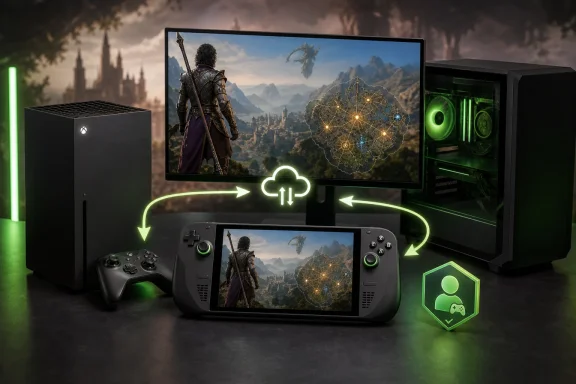
The announcement has been framed around moving a Baldur’s Gate 3 adventure from an Xbox Series X|S console to a PC or handheld. Players should separate two things that were already available from the part Larian has actually added.
Larian supported cross-save between PC, PlayStation 5, and Xbox through a Larian account before the Xbox version launched in December 2023. In August 2023, Douse publicly confirmed that Xbox saves would work across PC and PlayStation as well as Xbox. Larian’s current support FAQ still states that cross-saves and cross-play are available across the game’s PC, PlayStation 5, macOS, and Xbox versions.
In other words, an Xbox owner who also owned Baldur’s Gate 3 on Steam or GOG could already move a supported Larian cloud save between platforms. Play Anywhere does not invent that continuity. It removes the second purchase for players who want the Xbox app version on Windows and places save synchronization, entitlement, add-ons, and Xbox achievements under Microsoft’s platform rules.
That distinction has consequences for existing players. A Steam copy does not become an Xbox Play Anywhere copy, and a PlayStation purchase does not create a Windows license. Conversely, an Xbox digital owner receives access through the Xbox/Microsoft Store ecosystem, not through Steam, GOG, or a direct Larian download.
For an RPG built around long campaigns and dozens of hours of character progression, the entitlement is more valuable than it would be for a short single-player game. It lets an Xbox owner use a desktop PC for keyboard-and-mouse play, a console for couch sessions, and a Windows handheld while travelling without splitting the purchase between storefronts.
The Baldur’s Gate 3 Xbox Store page says the game is cloud-playable with Xbox Game Pass Essential, Premium, or Ultimate, but also says that game purchase is required. That means a player can own the game and still need an eligible Game Pass tier to stream it through Xbox Cloud Gaming. The purchase grants the game license; the subscription provides the streaming route.
This is where Xbox marketing routinely blurs two different propositions. Play Anywhere is a digital cross-buy and cross-progression program. Xbox Cloud Gaming is a service layer with its own access rules. A player who wants native Windows performance on an ROG Ally, Lenovo Legion Go, or another Windows 11 handheld can download the game through the Xbox app under Play Anywhere. A player who wants to stream it to a browser, TV, phone, or lower-power device still needs to meet Microsoft’s cloud requirements.
There is also no announcement from Larian or Microsoft that Baldur’s Gate 3 is joining the Game Pass catalogue. The addition to Play Anywhere should not be read as evidence that a subscription release is imminent. The store language points in the other direction: it describes cloud access for a separately purchased game, not Game Pass library access.
Microsoft’s Play Anywhere program has existed since 2016, but high-profile third-party participation has been inconsistent. Publishers can sell separate console and PC editions, maintain different release and patch pipelines, or prioritize Steam’s much larger established PC audience. For many companies, those choices preserve a second potential purchase and avoid the work of tying builds, DLC, saves, and storefront metadata together.
Larian’s decision does not prove those obstacles have vanished. It does show that an established, premium-priced game can be added after release when a publisher believes the customer value offsets the work. That makes this more useful than another Play Anywhere badge attached to a new launch: it tests whether old libraries can be converted rather than leaving console customers stranded when they move to PC.
Microsoft has been trying to make that proposition easier. Its newer Game Development Kit and PlayFab work aims to reduce friction around common packaging, Xbox identity services, cloud saves, and cross-platform development. Windows Central has previously reported that the tooling historically left Xbox and Windows development paths more divided than Microsoft’s “play anywhere” message suggested.
Larian’s choice should therefore be treated as evidence of an improving path, not proof that Microsoft has solved the broader problem. A publisher with an already successful game, an existing multi-platform save system, and direct control over its own release strategy is unusually well positioned to make the switch. It is a less obvious proposition for annualized franchises, games with separate PC publishers, or titles whose console and PC builds have diverged for years.
Physical-disc owners are the exception. Microsoft explicitly limits Xbox Play Anywhere to digital games, so a disc license does not become a Windows license under this program. The same limitation applies to used physical copies, even if the player uses the disc on an Xbox Series X.
Players migrating an active campaign should also use Larian’s cross-save function and verify that the intended save is uploaded before changing devices. Microsoft’s Play Anywhere framework supports shared Xbox saves, but Baldur’s Gate 3 has long used Larian Accounts for broader cross-platform progression, including Steam and PlayStation. Keeping that account connected remains the safest route for anyone whose campaign predates the new Microsoft PC version.
There is a minor date inconsistency in the primary material around the original Xbox launch. Microsoft’s current product listing gives Baldur’s Gate 3 a December 8, 2023 release date, while Larian’s own FAQ says December 12, 2023; Xbox publicly announced the surprise Series X|S launch on December 7, 2023. The difference does not change the new entitlement, but it does underline that this is a late addition to a game already deep into its post-launch life rather than a day-one platform feature.
For Xbox owners who held off on buying the game a second time for PC, Larian has eliminated the reason to wait. For Microsoft, the harder task remains convincing other major publishers to make the same calculation before their games are three years old.
Windows Central, which first reported the developer’s explanation, says Larian publishing director Michael Douse described the decision as a player-friendly use of time and resources rather than the result of a commercial arrangement or a Game Pass deal. Larian had the capacity to do it, Douse told the outlet, and considered it a worthwhile feature for people already buying into Xbox’s cross-device model.
That answer is more revealing than it may sound. Baldur’s Gate 3 is a major third-party release that had already sold for nearly three years without a Microsoft PC storefront version or a cross-buy promise. Larian has now chosen to absorb the packaging, validation, store, and account-entitlement work needed to treat Xbox console and Windows PC as one purchase.
The new feature is cross-buy, not cross-save
The announcement has been framed around moving a Baldur’s Gate 3 adventure from an Xbox Series X|S console to a PC or handheld. Players should separate two things that were already available from the part Larian has actually added.Larian supported cross-save between PC, PlayStation 5, and Xbox through a Larian account before the Xbox version launched in December 2023. In August 2023, Douse publicly confirmed that Xbox saves would work across PC and PlayStation as well as Xbox. Larian’s current support FAQ still states that cross-saves and cross-play are available across the game’s PC, PlayStation 5, macOS, and Xbox versions.
In other words, an Xbox owner who also owned Baldur’s Gate 3 on Steam or GOG could already move a supported Larian cloud save between platforms. Play Anywhere does not invent that continuity. It removes the second purchase for players who want the Xbox app version on Windows and places save synchronization, entitlement, add-ons, and Xbox achievements under Microsoft’s platform rules.
That distinction has consequences for existing players. A Steam copy does not become an Xbox Play Anywhere copy, and a PlayStation purchase does not create a Windows license. Conversely, an Xbox digital owner receives access through the Xbox/Microsoft Store ecosystem, not through Steam, GOG, or a direct Larian download.
For an RPG built around long campaigns and dozens of hours of character progression, the entitlement is more valuable than it would be for a short single-player game. It lets an Xbox owner use a desktop PC for keyboard-and-mouse play, a console for couch sessions, and a Windows handheld while travelling without splitting the purchase between storefronts.
Xbox Cloud Gaming remains a separate subscription question
The most important qualification is that Xbox Play Anywhere does not itself provide unrestricted cloud streaming. Microsoft’s Play Anywhere documentation promises console, Windows PC, and supported Windows handheld access at no added cost; it does not list cloud gaming as a core entitlement.The Baldur’s Gate 3 Xbox Store page says the game is cloud-playable with Xbox Game Pass Essential, Premium, or Ultimate, but also says that game purchase is required. That means a player can own the game and still need an eligible Game Pass tier to stream it through Xbox Cloud Gaming. The purchase grants the game license; the subscription provides the streaming route.
This is where Xbox marketing routinely blurs two different propositions. Play Anywhere is a digital cross-buy and cross-progression program. Xbox Cloud Gaming is a service layer with its own access rules. A player who wants native Windows performance on an ROG Ally, Lenovo Legion Go, or another Windows 11 handheld can download the game through the Xbox app under Play Anywhere. A player who wants to stream it to a browser, TV, phone, or lower-power device still needs to meet Microsoft’s cloud requirements.
There is also no announcement from Larian or Microsoft that Baldur’s Gate 3 is joining the Game Pass catalogue. The addition to Play Anywhere should not be read as evidence that a subscription release is imminent. The store language points in the other direction: it describes cloud access for a separately purchased game, not Game Pass library access.
Larian joined a program many large publishers still skip
The striking part of the move is not that Baldur’s Gate 3 can run on Windows. It has been available on PC since August 3, 2023. It is that Larian elected to ship and maintain the Microsoft PC version after building sales around Steam, GOG, PlayStation, and Xbox console.Microsoft’s Play Anywhere program has existed since 2016, but high-profile third-party participation has been inconsistent. Publishers can sell separate console and PC editions, maintain different release and patch pipelines, or prioritize Steam’s much larger established PC audience. For many companies, those choices preserve a second potential purchase and avoid the work of tying builds, DLC, saves, and storefront metadata together.
Larian’s decision does not prove those obstacles have vanished. It does show that an established, premium-priced game can be added after release when a publisher believes the customer value offsets the work. That makes this more useful than another Play Anywhere badge attached to a new launch: it tests whether old libraries can be converted rather than leaving console customers stranded when they move to PC.
Microsoft has been trying to make that proposition easier. Its newer Game Development Kit and PlayFab work aims to reduce friction around common packaging, Xbox identity services, cloud saves, and cross-platform development. Windows Central has previously reported that the tooling historically left Xbox and Windows development paths more divided than Microsoft’s “play anywhere” message suggested.
Larian’s choice should therefore be treated as evidence of an improving path, not proof that Microsoft has solved the broader problem. A publisher with an already successful game, an existing multi-platform save system, and direct control over its own release strategy is unusually well positioned to make the switch. It is a less obvious proposition for annualized franchises, games with separate PC publishers, or titles whose console and PC builds have diverged for years.
What existing Xbox owners should check
Microsoft’s published Play Anywhere rules apply to digitally owned participating games. Players who bought Baldur’s Gate 3 digitally through the Xbox Store should check the Xbox app’s My Library section on a Windows PC while signed into the account that owns the console version. The game should appear as installable rather than as a new purchase.Physical-disc owners are the exception. Microsoft explicitly limits Xbox Play Anywhere to digital games, so a disc license does not become a Windows license under this program. The same limitation applies to used physical copies, even if the player uses the disc on an Xbox Series X.
Players migrating an active campaign should also use Larian’s cross-save function and verify that the intended save is uploaded before changing devices. Microsoft’s Play Anywhere framework supports shared Xbox saves, but Baldur’s Gate 3 has long used Larian Accounts for broader cross-platform progression, including Steam and PlayStation. Keeping that account connected remains the safest route for anyone whose campaign predates the new Microsoft PC version.
There is a minor date inconsistency in the primary material around the original Xbox launch. Microsoft’s current product listing gives Baldur’s Gate 3 a December 8, 2023 release date, while Larian’s own FAQ says December 12, 2023; Xbox publicly announced the surprise Series X|S launch on December 7, 2023. The difference does not change the new entitlement, but it does underline that this is a late addition to a game already deep into its post-launch life rather than a day-one platform feature.
For Xbox owners who held off on buying the game a second time for PC, Larian has eliminated the reason to wait. For Microsoft, the harder task remains convincing other major publishers to make the same calculation before their games are three years old.
References
- Primary source: Windows Central
Published: 2026-08-05T08:25:26+00:00
Loading…
www.windowscentral.com - Related coverage: windowscentral.com
Loading…
www.windowscentral.com - Related coverage: gamesradar.com
Loading…
www.gamesradar.com - Related coverage: xbox.com
Loading…
www.xbox.com - Related coverage: xbox.com
Loading…
www.xbox.com - Related coverage: news.xbox.com
XBOX Games Showcase 2026 Recap: The Return of Exclusives, World Premieres, and Anniversary Hardware - XBOX Wire
XBOX Game Showcase 2026 just concluded. Find out everything announced - from the return of exclusives, to anniversary hardware, to games from XBOX and our partners – inside.news.xbox.com - Related coverage: news.xbox.com
Loading…
news.xbox.com - Related coverage: larian.com
Loading…
larian.com - Related coverage: gamespot.com
Loading…
www.gamespot.com - Related coverage: forums.larian.com
Loading…
forums.larian.com - Related coverage: trueachievements.com
Loading…
www.trueachievements.com - Related coverage: help.bethesda.net
Loading…
help.bethesda.net - Related coverage: mktplassets.xbox.com
Loading…
mktplassets.xbox.com - Related coverage: epix.xbox.com
Loading…
epix.xbox.com - Related coverage: pcgamer.com
Loading…
www.pcgamer.com - Related coverage: creativebloq.com
Loading…
www.creativebloq.com - Related coverage: as.com
Loading…
as.com - Related coverage: microsoft.com
Loading…
www.microsoft.com - Related coverage: gamerz-forum.com
Loading…
gamerz-forum.com - Related coverage: resetera.com
Loading…
www.resetera.com - Related coverage: gamingbible.com
Loading…
www.gamingbible.com - Related coverage: kitguru.net
Loading…
www.kitguru.net - Related coverage: playground.ru
Loading…
www.playground.ru - Related coverage: en.generacionxbox.com
Loading…
en.generacionxbox.com - Related coverage: microsoft.com
Loading…
www.microsoft.com