

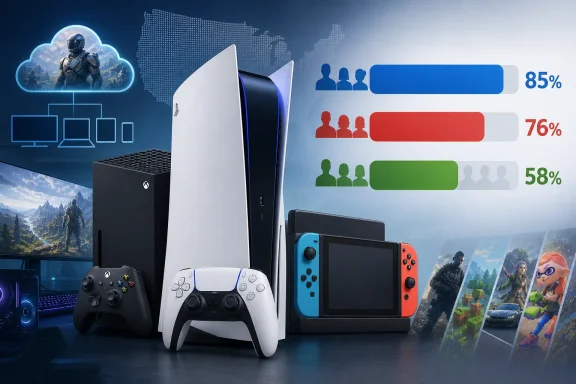
The 27-point gap with PlayStation is a serious warning for Xbox’s retail hardware business. It is also a far larger pool of people than the usual console-war framing allows: a majority of surveyed console players still regularly use an Xbox platform. Microsoft’s immediate problem is not that Xbox has no audience. It is that too many people who still play Xbox games have found little reason to make an Xbox console their primary, current-generation device.
A survey of use is not a market-share table
The Statista figures measure whether respondents “frequently” play on PlayStation, Nintendo, or Xbox consoles. Respondents were evidently allowed to select more than one answer, which means the percentages overlap. A player who regularly uses a PlayStation 5, Nintendo Switch 2, and Xbox Series X could appear in all three groups.
That makes 85%, 76%, and 58% useful as a comparative reach and engagement snapshot. They cannot be read as a split of the U.S. console market, where the three numbers should total 100%. Nor can they tell us how many Xbox Series X|S systems Microsoft has sold, how much time is spent on each platform, which platform receives the most game purchases, or how many respondents are using an Xbox 360 rather than Microsoft’s current console line.
Those gaps are more than methodological footnotes. The survey mixes console generations under each brand. A respondent who still boots an Xbox 360 for backward-compatible library access, Call of Duty, Minecraft, or legacy digital purchases counts as an Xbox player, while contributing nothing to current Xbox hardware demand. Likewise, a PlayStation 4 user counts toward PlayStation’s result even if that user has not upgraded to a PlayStation 5.
Windows Central highlights the apparent durability of Xbox 360 engagement. That is plausible, but Statista’s published chart does not establish why players remain on old Xbox hardware, how often they use it, or whether Microsoft can convert them to a newer console. The key missing detail is the breakdown of the 58% figure by Xbox One, Xbox Series X|S, Xbox 360, and other Xbox-capable hardware.
Statista also excludes PC and mobile from this comparison. That omission is defensible for a console survey, but it is especially consequential for Microsoft. Xbox’s public strategy has spent years expanding onto Windows PCs, handheld PCs, cloud streaming, smart TVs, and competing consoles. The survey therefore captures the part of Xbox’s business most exposed to Sony and Nintendo while leaving out the areas Microsoft treats as its growth path.
The direction matches retail evidence
The survey is not an isolated warning. It lines up with a string of more concrete indicators that Xbox hardware is struggling in the United States, even if each source measures a different thing.
Circana data reported by TechRadar showed PlayStation 5 taking 47% of U.S. console unit sales during Black Friday 2025, against 23% for Nintendo Switch 2 and 10% for Xbox systems. That was a short promotional period rather than a measure of the installed base, and pricing clearly influenced the result: PlayStation had aggressive bundles and discounts while Xbox systems did not. Still, a four-to-one gap between PlayStation and Xbox in a major U.S. buying week is consistent with Statista’s much wider gap in reported regular use.
Microsoft’s own financial reporting points in the same direction. In its fiscal 2026 third-quarter results, Microsoft said gaming revenue fell 7% year over year, while Xbox content and services revenue declined 5%. The company then forecast a low-teens decline in Xbox content and services for the following quarter and said hardware revenue would also fall year over year.
Microsoft attributed part of the content-and-services comparison to an unusually strong prior year of first-party releases. That is a legitimate financial explanation, but it does not soften the hardware message. Microsoft is acknowledging declining hardware revenue at the same time that independent retail reporting shows Xbox with a much smaller slice of big sales periods and Statista finds Xbox trailing in regular console use.
The Statista survey is therefore best read as confirmation of the direction of travel, not a replacement for unit sales data Microsoft no longer publishes.
Xbox’s 200 million players and its 58% console result can both be true
Xbox CEO Asha Sharma has cited 200 million Xbox players in a month, according to Windows Central. Microsoft has not publicly provided a sufficiently detailed definition to let outsiders reconcile that number with a survey of U.S. console users.
The likely explanation is scope. A company-level Xbox player count can include people who play Microsoft-owned games across Windows, Xbox consoles, cloud streaming, Android, iPhone, PlayStation, Nintendo hardware, and perhaps different definitions of active engagement across titles and services. A Statista console survey asks a narrower question: which branded console platforms do U.S. gamers frequently play on?
That is a business-model advantage and a hardware-brand weakness at the same time. Microsoft can earn money from Minecraft, Call of Duty, Sea of Thieves, or other Xbox-owned games on systems it does not manufacture. Yet every player who buys Microsoft software on a PlayStation 5, Nintendo Switch 2, or Windows PC is also a player who may not need an Xbox console.
For shareholders, the 200 million figure can describe a broader addressable audience. For the Xbox hardware team, the 58% survey result identifies the conversion problem: a large portion of the gaming public may recognize and use Xbox, but a much smaller group treats Xbox hardware as the place to buy and play new games.
Microsoft’s older “play anywhere” message was designed to make the Xbox brand less dependent on a box beneath the television. The current retail numbers show the cost of that approach when hardware sales and platform identity need rebuilding. The company has created a path for audiences to remain Xbox customers without becoming Xbox console customers.
Grand Theft Auto VI will not solve Xbox’s relative position
One point in the original Windows Central analysis needs correcting. Grand Theft Auto VI is not exclusive to Xbox Series X|S and PlayStation 5 in any rivalry-defining sense. Rockstar Games has confirmed that it will launch on both PlayStation 5 and Xbox Series X|S on November 19, 2026. It is current-generation-console-only at launch, and Rockstar has not announced a PC version, but that does not give Xbox an exclusive advantage over PlayStation.
The game may lift sales of both current-generation console families. It cannot by itself close the gap between Xbox and PlayStation, because the same blockbuster is available on the rival system—and Sony begins with the stronger U.S. retail footprint. PlayStation has also publicly emphasized its marketing partnership and PS5-specific features around the release.
Microsoft needs a reason to choose Xbox that persists after a player has finished Rockstar’s game. That means price, service value, backward compatibility, performance, a compelling handheld or living-room device, and games that are available first or only on the Xbox platform.
There is evidence that exclusives still affect that decision. Windows Central, citing Circana research discussed by The Game Business, reported that 41% of U.S. console players in a first-quarter 2026 survey named exclusive games as their leading reason for choosing console gaming. That finding is not a prescription to pull every Microsoft title from rival platforms. It does show why a strategy built entirely around ubiquitous publishing makes it harder to sell distinct hardware.
Sharma has acknowledged the weakness directly, saying Xbox’s business is “not particularly healthy” while explaining the company’s return to selected console exclusives. The relevant test is no longer whether Microsoft can publish a popular game everywhere. It already can. The test is whether its next software decisions make an Xbox console feel like a differentiated purchase again.
The opportunity is real, but it is narrower than the headline suggests
The Statista result gives Microsoft a usable target: the 58% of surveyed U.S. console gamers who already report frequent Xbox use. This is a retention and upgrade audience, not an untouched market waiting to discover the brand.
Microsoft needs to establish how many of those respondents are still on Xbox 360 or Xbox One, how many are playing only one or two long-running games, and how many are primarily PC or PlayStation players who occasionally use Xbox hardware. Without that breakdown, treating the full 58% as likely Xbox Series X|S buyers would be a mistake.
The November 19 launch of Grand Theft Auto VI will supply a real-world stress test. It will reveal whether Xbox can turn an audience that still plays within its brand into customers willing to buy a current console at current prices—or whether the larger share of that spending continues to flow to PlayStation, Nintendo, Windows PCs, and Microsoft’s own multiplatform software business.