
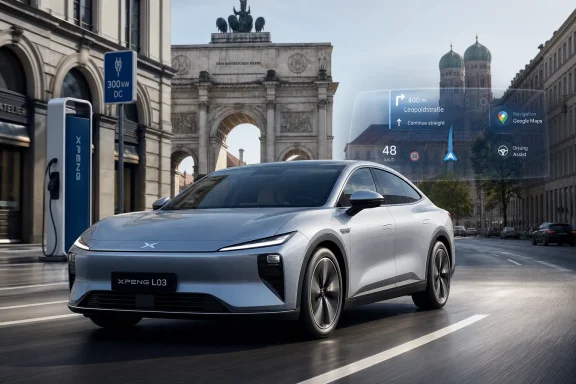
InsideEVs first reported the Munich debut, where Xpeng removed the “Mona” branding used for the Chinese-market L03 and presented the vehicle as a global model. Xpeng says it plans to sell the L03 across 65 markets this year, giving the launch significance well beyond a single German price list.
At 183 inches long, the L03 is slightly shorter than the Model Y, a potentially useful distinction in European cities and garages. Its fastback-crossover shape also gives Xpeng a cleaner visual identity than simply following Tesla’s familiar compact-SUV formula.
 Range and power are not limited to a single bargain trim
The base rear-wheel-drive L03 pairs a 58.3 kWh battery with a 241 hp motor and is rated for up to 276 miles on the WLTP cycle. A 71.2 kWh long-range model retains the same rear motor but raises the claimed WLTP range to 323 miles.
Xpeng also plans an all-wheel-drive performance version with 382 hp, though its quoted range falls to 273 miles WLTP. Those figures remain subject to the usual differences between WLTP testing and real-world motorway driving, but the lineup gives buyers more choice than a stripped-down price-leader strategy would suggest.
An extended-range electric version is also planned. Xpeng has promised up to 621 miles of total driving range, although it has not yet confirmed final European specifications for the range-extender model.
Google Maps is the software wedge
The more consequential differentiator may be inside the cabin. Xpeng says the L03 is the first Chinese-brand vehicle to integrate Google Maps through Google’s automotive services, rather than relying only on phone projection or a proprietary navigation stack.
That integration is not merely an infotainment feature in Xpeng’s pitch. The company says Google map data will support its NGP driver-assistance platform, which is built around the company’s Vision-Language-Action 2.0 model. Xpeng demonstrated the system in Munich, but its planned European rollout is expected from 2027 and remains dependent on homologation and national approvals.
For buyers—and especially IT-minded owners accustomed to asking who controls the data, updates, and interface—the arrangement matters. Google Maps offers a familiar navigation layer, while Xpeng retains responsibility for the vehicle’s assistance features, update cadence, and safety claims. It is not autonomous driving, regardless of the marketing comparison with Tesla Full Self-Driving.
Price starts the conversation; support will decide it
The German starting price makes the L03 a credible Model Y challenger on paper. But Xpeng still has to prove that dealer coverage, servicing, parts availability, software support, charging integration, and resale confidence can match the established players it is targeting.
The L03’s real test begins once European customers encounter it outside a Munich launch event. A lower sticker price and Google-backed navigation may get Xpeng into the shortlist; dependable ownership experience will determine whether it stays there.
