
TechPowerUp’s Gamescom hands-on puts the physical finish front and center, particularly the highly reflective magnetic backplate. That is useful confirmation that the card’s distinctive surface treatment is more than a product render trick. It also underlines the awkward reality of this edition: its most visible flourish faces the motherboard tray in many conventional PC cases, and the reflection will be most apparent in vertical-mount builds, open benches, or cases with generous glass clearance.
The part that deserves more scrutiny is availability. ZOTAC announced the card on August 13, while TechPowerUp’s August 26 Gamescom report describes the event as an unveiling. ComputerBase and Hardwareluxx both reported that the card had already been shown at Computex and formally announced earlier in August. Gamescom, then, was an opportunity for a closer look at hardware already released—not the product’s first public appearance.
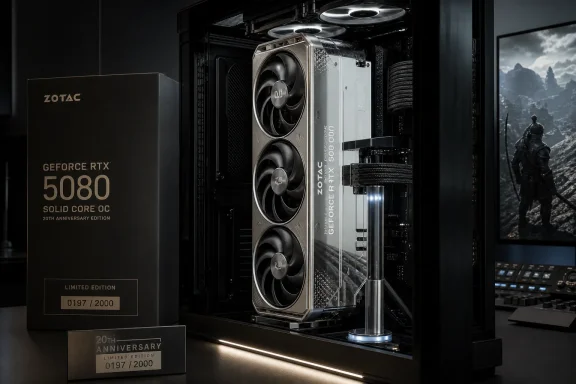 The anniversary card does not change RTX 5080 performance
Under the titanium-colored shroud, ZOTAC has not created a special-bin GPU or raised the power limit. ComputerBase lists 10,752 CUDA cores, 16 GB of 30 Gbps GDDR7 on a 256-bit memory bus, a 2,640 MHz boost clock, PCIe 5.0 x16, and a 360 W power specification. Those figures align with NVIDIA’s baseline RTX 5080 platform, except for ZOTAC’s modest factory overclock.
That distinction should govern purchasing decisions. There is no reason to expect the Anniversary Edition to outperform a regular SOLID CORE OC in games, CUDA work, local AI inference, video production, or Windows GPU-accelerated applications. Its software stack is the same: NVIDIA’s Game Ready and Studio drivers, the NVIDIA app, DLSS 4 features, and ZOTAC’s FireStorm utility remain the relevant tools. Buyers who already own a SOLID CORE OC are not missing a new performance tier.
The hardware specification also means the usual RTX 5080 installation requirements remain intact. NVIDIA rates the RTX 5080 at 360 W and recommends an 850 W system power supply, while ZOTAC uses a single 12V-2x6 input. The Anniversary Edition’s visual changes do not make cable routing, case airflow, or power-supply selection less important.
A 2.5-slot design still needs a real fit check
The Anniversary Edition is a relatively compact card by current premium RTX 5080 standards, but “compact” should not be confused with small. ComputerBase reports dimensions of 303.5 × 115.8 × 55.7 mm, occupying 2.5 slots. That length is manageable in many mid-tower cases, yet the card still needs enough room at its power connector for a 12V-2x6 cable to leave the card without being sharply bent against a side panel.
ZOTAC’s cooling package remains the practical hardware story. IceStorm 3.0 combines a vapor chamber, six composite copper heat pipes, a full-length heatsink, and three BladeLink fans. The company also includes a metal frame and its 12V-2x6 Safety Light feature, intended to prevent the card from starting if the plug is not fully seated. Those are worthwhile design choices, but they are inherited from the existing SOLID CORE OC platform rather than anniversary-specific engineering.
The included DUO ARGB GPU Support Stand has more functional value than the mirror plate. A graphics card of this length and mass can sag over time, particularly in cases moved frequently or systems transported to LAN events. The support stand provides a practical reason to prefer the package if its price is competitive, assuming the stand’s adjustable arm fits around front intake fans, bottom-mounted radiators, or cable channels in a particular chassis.
For Windows enthusiasts who manage a high-end gaming system as a long-lived build rather than a display piece, that stand is the accessory that changes the ownership experience. It also avoids a common premium-GPU irritation: paying separately for a bracket after discovering that the card’s weight makes one desirable.
Germany’s price is unusual; global pricing is still missing
The most interesting commercial detail is in Germany, where ComputerBase reported the special edition listed exclusively through Alternate at €1,699. TechPowerUp reports that Germany received 200 units and that Alternate’s Anniversary Edition price was €20 below the regular SOLID CORE OC at the same retailer. PC Games Hardware likewise reported that the limited edition undercut the standard card at Alternate while including the illuminated support stand.
That is unusual for a limited-run GPU. Special editions normally charge for exclusivity, particularly when production is capped at 2,000 pieces worldwide. Here, at least at one German retailer and at a specific point in time, the anniversary package appears to function as a better-equipped alternative to the usual model rather than a collector premium.
There are two cautions. First, the €20 comparison is a retailer-price snapshot, not a manufacturer’s suggested-price policy. Graphics card pricing shifts with inventory, regional taxes, exchange rates, and promotions, so it should not be carried over to other countries or even assumed to persist at Alternate. Second, ComputerBase had previously pegged regular SOLID CORE OC availability around €1,450 through broader German price comparisons. The €1,699 Anniversary Edition is therefore still substantially above the lowest market price of a non-anniversary card, even if it briefly beats Alternate’s own standard-model listing.
For U.S. buyers, there is no published U.S. price, allocation, retailer partner, or launch timetable. ZOTAC has confirmed a 2,000-unit global cap, but it has not publicly supplied a market-by-market breakdown. TechPowerUp’s figure of 200 German units is specific and plausible, but no other reporting reviewed here independently confirms that allocation. A limited worldwide run does not guarantee that every national ZOTAC store or distributor will receive stock.
The mirror plate is a display feature, not a thermal upgrade
The mirror-finish backplate attaches magnetically, allowing the owner to remove it without tools. That makes more sense than permanently integrating a highly reflective panel: builders can preserve the titanium look if fingerprints, cable reflections, or the visual clash with a darker build become unwelcome.
It should not be read as extra cooling. The primary thermal hardware is the same vapor chamber, heatsink, and fan assembly found on the standard SOLID CORE OC. The extra plate is an exterior visual layer, and a reflective surface may require more cleaning than a conventional matte backplate. The supplied coverage does not establish whether the added plate changes temperatures, acoustics, clearance, or long-term durability, and no independent benchmark comparison has yet shown a performance or cooling advantage.
TechPowerUp’s hands-on does establish a more modest point: the titanium color and reflective panel are more striking in person than in the official images. For modders building around silver, white, gray, or brushed-metal components, that may be enough. For a system tucked under a desk with no visible GPU window, it is hard to justify paying more than the lowest-priced conventional RTX 5080 with equivalent cooling.
Scarcity is the product feature ZOTAC can guarantee
ZOTAC’s 2,000-card limit is real differentiation, but it provides scarcity rather than extra compute capability. The company had teased Anniversary Edition hardware through its twentieth-anniversary campaign before retail availability, and the RTX 5080 model appeared in those promotions alongside special-edition cases and other hardware. The retail card is the rare version of an established SKU, not a surprise new entry in NVIDIA’s product stack.
That makes the right buyer unusually clear. Someone already shopping for ZOTAC’s SOLID CORE OC, building a visible titanium-themed PC, and able to obtain the card at or below the ordinary local model’s price receives useful extras without giving up performance. Someone shopping strictly on frames per dollar, CUDA throughput per dollar, or the lowest available RTX 5080 price should compare standard cards first.
The immediate consequence is simple: availability—not benchmarks—will decide whether this model is worth buying. If an Anniversary Edition appears at a local price comparable to the ordinary SOLID CORE OC, its support stand and distinctive finish make it the sensible version to take. If scarcity turns it into a marked-up collector item, the same silicon, same cooling architecture, and same Windows driver experience are already available in ZOTAC’s standard card.
