

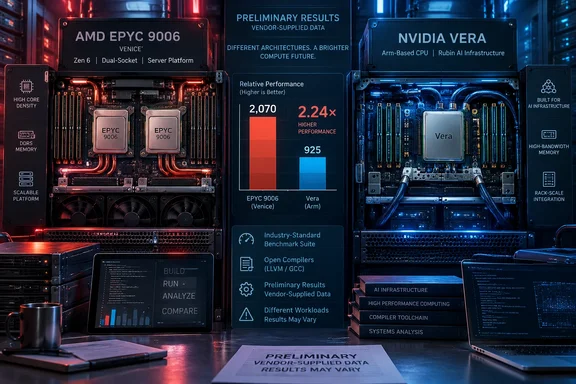
AMD detailed the figures in a September 18 newsroom post and accompanying white paper, while Tom’s Hardware independently examined the footnotes and configuration gaps. The most important finding is less dramatic than the headline: AMD has supplied enough data to show where its advantage could come from, but not enough to establish a clean, independently reproducible Venice-versus-Vera result.
The paper is nevertheless worth attention. NVIDIA has positioned its 88-core Arm-based Vera processor as the CPU companion for Rubin AI systems and agentic workloads. AMD is now answering that pitch directly with a 256-core Zen 6 EPYC part, making the fight about host-CPU throughput and deployment flexibility rather than accelerators alone.
The 2.24× figure measures capacity, not a fair one-core contest
AMD’s headline comparison is a throughput test using SPECrate 2026 Integer, a benchmark suite intended to measure how much concurrent integer work a system can complete. Higher is better, and the test runs multiple simultaneous copies of its workloads. That makes it useful for heavily parallel server tasks, but it also means core count, memory configuration, socket count, compiler settings, and the number of copies all matter.
The reported arithmetic is straightforward: 2,070 divided by 925 is approximately 2.24. But the configurations are fundamentally different in scale. AMD’s estimate covers a two-socket system using EPYC 9996 processors, each with 256 cores; NVIDIA’s Vera score is derived from NVIDIA’s own published material and is identified in AMD’s footnote as an 88-core Vera configuration.
That does not make the result invalid. It means the claim answers a narrow procurement question: How much aggregate integer throughput might a maximum-density EPYC server deliver versus a Vera-based alternative? It does not answer whether one Venice core is inherently more capable than one Olympus core, whether either platform is faster at a particular production service, or which system delivers better work per watt after memory, cooling, networking, and accelerator requirements are included.
AMD’s own marketing language blurs that distinction by calling the result “platform-level performance.” In a data center, platform throughput is often the metric that pays the bills. But readers should not turn a 2.24× rate score into a general statement that Venice is 2.24 times faster than Vera.
AMD’s per-core claim is a different test with a different processor shape
AMD also claims a 96-core high-frequency Venice configuration is about 1.2 times faster per core than NVIDIA Vera in SPECrate 2026 Integer. The company says that system produces an estimated score of 1,210, or 6.3 points per core, against Vera’s reported 925, or 5.3 points per core across 176 cores in the cited comparison.
The oddity is the processor identity. Venice’s flagship EPYC 9996 is a 256-core CPU, but AMD’s per-core comparison uses a version with 96 active cores. Tom’s Hardware reports that AMD achieved this by disabling cores on the 9996 rather than identifying the commercial 96-core high-frequency SKU by model number.
That is more than a naming nuisance. A down-cored flagship can have a different frequency, power headroom, cache-per-active-core ratio, and memory-bandwidth-per-core profile from the production SKU an administrator would actually order. AMD’s newsroom footnote calls it a “96c HF processor,” while the reporting identifies it as a 9996 configuration. The company has not published a complete purchase-ready bill of materials for that exact test system.
The headline per-core comparison also omits the power setting needed to interpret it fully. A 96-core high-frequency part may be a sensible choice for latency-sensitive services, but it is not interchangeable with a 256-core density SKU. Buyers planning host nodes for virtualization or CPU-bound inference orchestration need a SKU-level comparison, including power limits and DIMM population, before treating the 20% figure as a capacity-planning input.
The compiler issue affects subtests, but not the headline ratio
One detail in the coverage needs careful separation. Tom’s Hardware found that some of AMD’s per-subtest comparisons use GCC 16.1 for Venice while comparing against Vera data NVIDIA generated using GCC 15.2. Compiler version can materially change results, especially in a brand-new CPU generation where compilers are still adding architecture tuning.
That is a legitimate warning for AMD’s breakdown charts. It weakens any claim that a particular Venice advantage in individual workloads—such as compiler, database, or simulation subtests—represents only hardware. A newer compiler can expose scheduling, vectorization, or instruction-selection improvements that older toolchains did not apply.
But the 2.24× platform-throughput headline has a more defensible footing than those subtest charts. AMD’s own footnote says both its estimated 2,070 score and the cited Vera 925 score use GCC 15.2. The same is true of AMD’s stated 1.2× per-core SPECrate 2026 comparison.
The practical conclusion is that the compiler discrepancy should not be used to dismiss every Venice-versus-Vera result. It should, however, stop readers from treating AMD’s detailed subtest bars as apples-to-apples proof. AMD’s white paper combines internal estimates, NVIDIA-published estimates, AMD internal workload tests, public cloud measurements, and results from prior controlled testing. Those are useful inputs; they are not one uniform benchmark campaign.
“Official SPEC” is still the missing comparison
AMD and NVIDIA have each published performance data based on SPEC CPU 2026 methodology, and SPEC’s public database already contains submitted CPU 2026 results from other vendors and platforms. What is missing is a pair of official, fully disclosed SPEC result submissions for comparable production Venice and Vera systems.
That distinction matters because an official submission provides the configuration record that marketing slides usually compress away: firmware, operating system, compiler commands, memory topology, run rules, workload copies, power policy, and availability status. SPEC’s published format also makes it easier to determine whether a result is base or peak, whether the CPU was pre-production, and whether a later performance-affecting change requires a republished score.
Neither company’s present material clears that bar for this matchup. NVIDIA says its Vera CPU 2026 figures were measured internally in July. AMD describes its Venice figures as preliminary engineering estimates and explicitly says results may change. There is no evidence in the material reviewed that an independent lab has received both platforms and performed a matched test campaign.
This is why the 2.24× number should be treated as a directional signal rather than a settled ranking. It shows AMD expects its Zen 6 density part to be formidable in aggregate integer throughput. It does not yet establish the extent of a real-world performance lead across a server fleet.
What matters for enterprise deployments
For administrators, the x86-versus-Arm divide may be as important as the score. Venice runs the established EPYC software stack, while Vera uses NVIDIA’s in-house Olympus cores implementing Arm v9.2-A. An organization with container images, third-party agents, licensed databases, performance-tuned libraries, and internal extensions built for x86 must factor porting and validation into any apparent CPU efficiency gain.
NVIDIA’s counterargument is that Vera is built for a tightly integrated AI-factory design: 88 Arm cores, LPDDR5X memory, up to 1.2 TB/s of memory bandwidth, and coherent connectivity into Vera Rubin systems. That may be persuasive where the CPU is dedicated to feeding NVIDIA accelerators, running AI orchestration, serving data pipelines, and executing large numbers of smaller agent tasks.
AMD is making the broader infrastructure argument. Its white paper pairs Venice with claims of 2.4× to 3.7× gains over Intel Xeon 6980P in selected Java, OpenSSL, MongoDB, Redis, NGINX, and transaction-processing tests, along with up to 3.13× in selected HPC tests. Those are AMD internal results, so they should be read as workload-selection evidence rather than neutral rankings. Still, they point to the company’s real sales pitch: one x86 server family that can cover conventional enterprise workloads alongside AI-adjacent capacity.
AMD says Venice is already in production, with OEM platforms expected to launch and cloud deployments beginning later in 2026. The next number that will matter is not another modeled rack chart. It is a submitted, reproducible comparison of shipping Venice and Vera systems with identical workload definitions, disclosed power limits, current compilers, and production firmware.