

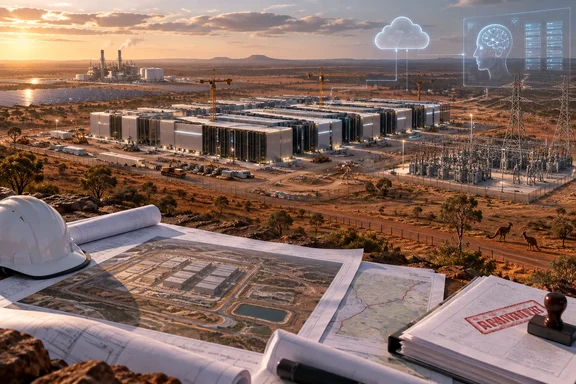
The underlying deal, reported by Capacity and independently confirmed by SBS and Capital Brief, is consequential for enterprise AI customers because it signals Anthropic’s intention to establish local inference infrastructure rather than rely exclusively on overseas capacity. But the more immediate reality is less settled than the headline suggests: Anthropic has become an anchor tenant for a proposed regional campus, not the operator of an active Australian cloud region or a completed data centre.
That distinction changes the practical reading of the announcement. Australian organisations with data-residency, latency, procurement, or continuity requirements cannot yet treat the lease as proof that Claude API processing will occur in Queensland, or that every Claude service will gain an Australian hosting option. Anthropic, Zerra DC, and the Queensland government have not publicly set out which Claude products, customer tiers, regions, model families, or data-handling commitments would be tied to the facility.
An anchor tenant for a project still in planning
Western Downs Digital Park is proposed for a 725.5-hectare site near Kogan, about 37 kilometres north-west of Dalby and roughly 250 kilometres from Brisbane. Zerra DC, a Singapore-based developer, filed its application with Western Downs Regional Council in August. The project documentation describes four AI-ready buildings with 360MW of IT capacity each, for 1.44GW of IT load across the initial campus.
The largest number attached to the site, 2.16GW, needs careful handling. ABC News reports that as the proposal stands, the project could have a peak electricity demand of 2.16GW — a grid-load figure equivalent to about 1.5 million average Australian households — while planning coverage has described four 360MW facilities. Those are not interchangeable measures of usable computing capacity.
That distinction has already been blurred in some coverage. One syndicated report described Anthropic as securing access to “up to 2.1GW,” but neither Anthropic nor Zerra DC has publicly disclosed the leased megawatt figure, the number of buildings involved, or the financial value and duration of the contract. SBS reports that Anthropic is set to use the first of the four planned buildings. Until the companies publish the lease terms, claims that Anthropic has booked the full campus or anything close to its peak power draw should be treated as unverified.
The timing is also ambitious. ABC News reported that the council application could take years to approve and that the physical build could take four to six years. A 2027 capacity target is therefore an objective tied to a phased development, not a completed construction schedule. The lease is reportedly also subject to review by Australia’s Foreign Investment Review Board, creating another gate before Anthropic can convert the agreement into operating infrastructure.
Inference capacity is useful, but it is not model-training sovereignty
ABC and Capital Brief report that the Queensland site is intended for inference, the compute work performed when Claude answers prompts, processes documents, or serves API requests. That is the customer-facing portion of generative AI: it affects response times, throughput, geographic routing, and potentially how organisations meet local-data requirements.
Inference is strategically important for enterprise use. An Australian deployment could reduce latency for local users, provide more capacity during regional demand spikes, and give large regulated organisations a clearer path to ask whether their workloads can remain within Australia. Microsoft, AWS, and Google have long benefited from the fact that enterprise buyers often care as much about data location and supportability as they do about raw model quality.
But an inference deployment does not mean Anthropic will train frontier models in Australia. Training requires much larger, sustained clusters, extensive data pipelines, specialised networking, and enormous energy commitments. It also raises separate questions about copyright, training-data governance, export controls, and the procurement of large numbers of advanced AI accelerators.
Anthropic has not said the Western Downs lease will include a sovereign Claude offering, a dedicated government environment, local key management, or a guarantee that prompts and outputs will be retained, logged, or processed only in Australia. Those details matter more to a chief information security officer than the headline size of the development.
For now, Australian users should distinguish three claims that are being compressed into one announcement:
- Anthropic has committed to lease capacity at a planned Queensland data-centre project.
- Anthropic reportedly intends to use that capacity for serving Claude inference workloads.
- Anthropic has not publicly committed to a generally available Australian Claude region with defined residency and compliance terms.
The first two are supported by reporting. The third remains an assumption until Anthropic publishes product-level commitments.
The direct lease does not mean Anthropic has abandoned cloud partners
The deal is being framed as Anthropic going “straight to a developer” instead of buying capacity from AWS, Google Cloud, or Microsoft Azure. Structurally, that is accurate: Zerra DC is a developer and data-centre infrastructure provider, not a hyperscale public-cloud platform.
Yet it would be a mistake to read the lease as a wholesale break with hyperscalers. Anthropic’s models have been distributed through major cloud platforms, and its global compute strategy has historically involved large infrastructure partners. Leasing a purpose-built facility is a way to secure physical capacity, power access, and more control over build-out terms. It does not reveal who will supply the servers, accelerators, network fabric, managed services, or operational staff inside the building.
For IT buyers, the relevant question is whether the future Australian deployment will be exposed as Anthropic-operated capacity, delivered through a cloud marketplace, or made available through both channels. Those options can produce very different commercial and technical outcomes. A direct Anthropic service may offer distinct data policies and support arrangements; a hyperscaler-hosted service may fit better with existing identity, billing, governance, and networking controls.
No public announcement answers that question yet.
The lease does show that frontier-model vendors are increasingly behaving like infrastructure customers in their own right. As demand rises, access to high-voltage power, substations, land, cooling, and buildable sites can become as decisive as traditional cloud-region geography. A direct relationship with a developer gives Anthropic leverage over those scarce inputs, particularly where established Sydney and Melbourne data-centre corridors face capacity and grid constraints.
Queensland’s energy case is the real policy test
Queensland’s government has portrayed the Anthropic agreement as validation of its approach to attracting AI infrastructure. The site is near the Braemar substation and several gas-fired generation assets, including the Darling Downs and Braemar power stations, as well as renewable projects. Zerra DC has said the campus would connect directly to the substation rather than rely on local distribution infrastructure.
The project’s location reflects the practical logic of modern AI data-centre siting: large campuses go where grid connections, generation, land, and planning pathways can be assembled. For users of Claude, that may eventually produce lower latency and more regional capacity. For Queensland’s energy system, it concentrates a potentially enormous new industrial load in a state already balancing affordability, reliability, and decarbonisation goals.
ABC’s reporting puts the proposed site’s full daily consumption at about 47GWh, compared with average Queensland daily electricity consumption of 170GWh. Associate Professor Andreas Helwig of the University of Southern Queensland warned ABC that poor grid integration could affect stability and consumer costs. That risk is not resolved by locating beside existing generation; it depends on connection agreements, new generation, demand-management arrangements, network upgrades, and the commercial allocation of those costs.
The Albanese government’s July policy statement says large data centres should underwrite new power supply, pay their connection costs, reduce consumption when the grid needs support, and improve water efficiency. Anthropic’s March memorandum of understanding with the federal government specifically said the company would align future Australian operations with federal expectations for data-centre and AI infrastructure developers.
That creates a testable standard for the Western Downs project. The lease itself does not establish compliance with those expectations. The key missing disclosures are how much new generation will be underwritten, whether Anthropic or Zerra will bear all grid-upgrade costs, what curtailment commitments will apply, and how water demand will be handled during normal operations and heat events.
What Australian enterprise customers should watch next
Anthropic’s lease gives its Australian expansion a physical direction, but it does not yet give customers an operating service they can procure. The first milestone is the council’s development decision, followed by foreign-investment clearance and concrete disclosures from the companies about the scope of the lease.
The technical milestones matter just as much. Enterprises should look for a defined Australian Claude availability date; supported API and application services; data-residency language; audit and compliance documentation; disaster-recovery design; and clarity on whether customers can select Queensland processing rather than merely being routed there when capacity permits.
Until those details appear, the deal should be understood for what it is: a major commitment to secure future Australian AI compute, and a valuable anchor for Zerra DC’s proposed campus. It is not yet a local Claude region, and it does not settle the questions of power, approval, customer data location, or service architecture that will determine its value to Australian IT teams.