

This is a Microsoft customer story, and it reads like one. The reporting and interviews were done by Goran Zarić of the agency Propulsion. Petlja's own public documentation independently confirms the assistant's origins, its pilot size and its basic design. The classroom anecdotes, the current user counts and the funding picture come only from Microsoft's account, and this piece attributes them that way.
Petlja AI Assistant Runs on Azure OpenAI With a Deliberately Thin Architecture
Petlja, whose name means "loop," was founded in 2017. Microsoft's feature ties that year to Serbia making programming a mandatory fifth-grade subject. Teaching materials were scarce then, so the foundation built a browser-based platform where students could write and run code without installing anything. Petlja's 2024 executive summary describes a free platform with 35,000 to 50,000 weekly active users outside holidays and school strikes, measured by Google Analytics. The same summary says Petlja had fully covered 24 of the 25 programming-related subjects in Serbia's primary, grammar-school and vocational curricula. Those figures describe the learning platform, not the AI assistant. It's an easy mix-up to make.
According to Microsoft, the platform is built on .NET and C# and runs on Azure. The feature's technical summary lists Azure OpenAI Service, Azure hosting and Azure SQL for the assistant, plus Microsoft 365 (Teams, Exchange and Office) for day-to-day operations. Director Milan Simić, who spent 17 years in the software industry, including time at Microsoft, before joining Petlja in 2023, says Azure let the nonprofit be "cloud-native from day one" rather than run its own servers.
Petlja's 2024 summary shows how the assistant works. It was then being piloted with 30 teachers as a chatbot that works in Serbian. Before a teacher's prompt reaches OpenAI's service, Petlja classifies it and adds context based on its type. When it's useful, the system searches Petlja's own course materials and inserts key passages into the prompt. This approach is usually called retrieval-augmented generation: the model is fed trusted, curriculum-aligned source text so it doesn't have to answer from general training alone. Microsoft's 2026 description is compatible with this: Azure OpenAI supplies the model, and Petlja's platform supplies "the educational context around teachers' questions." Neither source says whether the 2024 design is still the whole story in 2026.
The design is modest, and that is its strength. Petlja didn't train a model or build a new product category. It put a thin routing and retrieval layer between teachers and a hosted model, and anchored it to content the foundation had spent seven years writing. That layer, not the model, is what makes the tool Serbian and specific to the curriculum.
The Bačka Palanka M3 Screw Shows Prompting and Iteration at Work
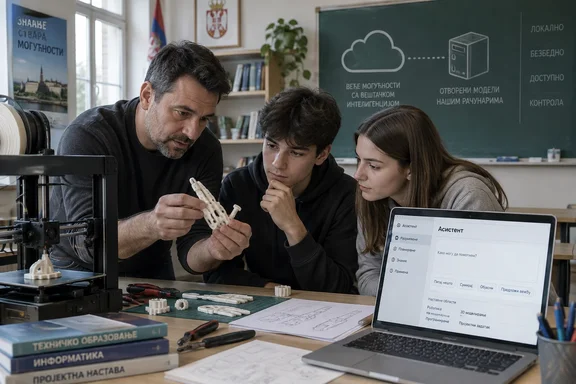
The episode Microsoft chose to lead with took place in an extracurricular robotics section. Sanja Rajić, a mathematics and programming teacher at the Palanka Gymnasium, runs it on top of her regular teaching. Her students were building a mechanical finger from six 3D-printed parts, each held together by an M3 screw. The feature describes that screw as three millimeters in diameter. Rajić says she searched hardware stores across town and found none.
So the group asked the Petlja assistant what "M3" meant, how to configure the 3D printer, and how to stop a print from shifting partway through. The printed screw came out at five millimeters. After three failed attempts, the students tried scaling the model to 80, 70 and finally 60 percent, and at 60 percent it fit. The arithmetic checks out: 60 percent of five millimeters is three, the nominal M3 size. The finger worked.
Read carefully, the assistant didn't produce the answer. It explained a term, helped with printer settings, and left the students to converge on the right scale by trial and error. Rajić's own summary is careful: "Maybe we would have stopped before AI." That's a claim about persistence, not about the tool solving the problem, and it's the most honest line in the piece.
Two student projects follow the same pattern. Second-year students Ana Stojanović and Barbara Radulović built BrAInUp, a well-being app for the 2026 Student Companies Competition that offers daily suggestions based on a short questionnaire. The students led the concept and design, while Rajić and the assistant helped with technical development. In a motion-controlled game modeled on Flappy Bird, the students asked which color their computer-vision setup would detect most reliably. The assistant suggested yellow, and the students tested it against alternatives and found it worked best for their setup. In both cases, the students checked the AI's suggestion before relying on it.
Serbian Lesson "Preparations" Are Where the Assistant Saves the Most Time
The assistant's day-to-day value is less photogenic than the screw story. In the Serbian school system, teachers write formal lesson "preparations" that set out a lesson's goals, expected outcomes, teaching methods and tasks. Rajić says one can take an experienced teacher a couple of hours. "The AI writes the entire preparation," she told Microsoft's reporter, adding that she then edits it based on her experience.
Her Haskell-and-Prolog lesson shows how the workflow goes. The two languages teach very different approaches to problem-solving. Rajić started with a simple seed example, adding two numbers in each language, then asked the assistant for harder exercises, activities for different skill levels and a full lesson plan. Its first draft targeted "high school or university students," which was too broad. She narrowed it to fourth-year IT-track students, and the assistant adjusted and produced two versions of a test.
After three years of use, her advice is to be specific: "the more specific I am, the better it responds." She also learned to push back on a draft instead of accepting it. Her students report a knock-on effect: classes cover more material because the assistant helps them get past syntax errors and spend the time on understanding.
Microsoft also cites a 2025 study by Lenka Protić, Jovan Mihojević and Đorđe Volarević. The feature calls them independent research consultants, but the work was done with Petlja's support. Teachers reported saving time, finding new lesson ideas and getting help with differentiated teaching. They also stressed that AI-generated material must be reviewed and adapted before it's used in class. The study itself couldn't be located, so its sample size and methods are unknown. Treat its findings as teachers' own perceptions, not measured time savings or learning gains.
250 Accounts and 50–60 Active Users Show the Real Scale of the Azure OpenAI Pilot
Put the numbers side by side and you can see how the rollout has gone:
| Period | Figure | Where it comes from |
|---|---|---|
| Autumn 2023 | Early pilot shown at a Belgrade conference; Rajić volunteers and gets access within days | Microsoft feature |
| 2024 | Pilot with 30 teachers | Petlja's 2024 executive summary |
| September 2026 | About 250 teachers with access, 50 to 60 active | Microsoft feature |
Growing from 30 to 250 accounts in about two years is real progress. An active rate of roughly one in five, though, suggests most teachers who get access don't make the assistant part of their routine. Rajić, the teacher who "raised her hand" at the 2023 conference, is by the feature's own framing a self-selected early adopter. Her results are an example of what a motivated teacher can do with the tool, not a forecast of what an average teacher will do.
The support around her matters too. Microsoft notes that her robotics section exists because principal Nataša Marković backed it from the start. Adoption here came from individual teachers and supportive school leaders, not from a ministry mandate. That makes it durable where it takes hold and patchy everywhere else.
Pay-per-Token Costs Push Petlja Toward Open Models and Tenstorrent Hardware
The most useful detail for anyone planning a similar deployment is the cost problem. Petlja gives the assistant away, but every interaction with a commercial AI service costs money. The more teachers use it, the higher the bill, and a nonprofit has no revenue that grows with usage.
Petlja's answer runs through UNICEF's TLM4EL project. The team is fine-tuning an open-source model for Serbian education, using Azure GPU infrastructure for the training, and plans to run it on donated hardware. Microsoft gives three goals: lower operating costs, keep data under local control, and eventually open the assistant to more teachers. Its partner list names UNDP Serbia as project coordinator, Serbia's Ministry of Education as a funder, UNICEF for the open-model phase, Microsoft for technology, expertise and financial support, and Tenstorrent for compute hardware. Local deployment is still a plan, not something that has shipped.
UNICEF's own innovation arm makes a similar argument for open source in general. Its Venture Fund says open source reduces reliance on proprietary software, preventing costly dependencies and safeguarding data sovereignty. For a tool used by schools, keeping data under local control is an argument in its own right, not just a way to save money.
Funding is the constraint that will decide the timeline. Simić says there is no fixed user target and no confirmed funding for a wider rollout. He adds that project funding can take six to 12 months to secure, which in AI can be long enough for the technology to overtake the original plan. An independent UNDP evaluation of its Serbia programme backs up this concern: it lists Petlja among partnerships that yielded positive results in · areas such as diaspora engagement, environmental protection and digital literacy. The same report notes that, according · to interviewed stakeholders, challenges remain in ensuring the sustainability of these efforts.
What schools and IT teams building on Azure OpenAI can take from Petlja
If you're scoping a teacher- or staff-facing assistant, the practical choice is architectural. Petlja's approach, a hosted model plus a routing and retrieval layer over content you own, is fast to launch and needs little infrastructure. Its running costs, however, grow with every query. The open-model work is Petlja's hedge against that, and it moves the burden from API bills to training, hosting and hardware donations. Neither path is free. They just charge you in different places.
The human workflow counts as much as the stack. Everything Microsoft attributes to Rajić depends on her reviewing and correcting the output: narrowing a target audience, asking for a second test version, rejecting a first draft. Any rollout that skips training teachers in that habit is betting on output quality that the study's own participants said they couldn't take for granted.
- Petlja's assistant grounds a hosted Azure OpenAI model in its own curriculum materials, according to its 2024 documentation. That retrieval layer, not the model, is what makes it useful for Serbian classrooms.
- About 250 teachers have access but only 50 to 60 are active, so plan for uneven adoption and budget for training, not just licences or API spend.
- Usage-based pricing becomes a cost problem for free tools, and Petlja is responding by fine-tuning an open-source model for local deployment on donated Tenstorrent hardware. That deployment hasn't happened yet.
- The teacher-reported benefits of time savings, lesson ideas and differentiation come from a Petlja-supported 2025 study whose methods aren't public. Treat them as perceptions, not benchmarks.
- Review of AI output is built into Rajić's workflow and was stressed by the study's participants. Write it into any classroom or staff policy rather than leaving it implied.
- Grant cycles of six to 12 months can outlast a technology plan, so design deployments that can change models without a rebuild.
The screw in Bačka Palanka fits because a teacher and two students kept printing until it did, and Microsoft's own account says as much. For Petlja, the next milestone is financial, not technical. It needs its fine-tuned open model running on local hardware before per-query costs and slow grant cycles cap the assistant at the few dozen teachers who use it today. If that works, a cheap Azure OpenAI pilot becomes a sustainable national tool. If it doesn't, the Bačka Palanka project will stay a well-told pilot.