

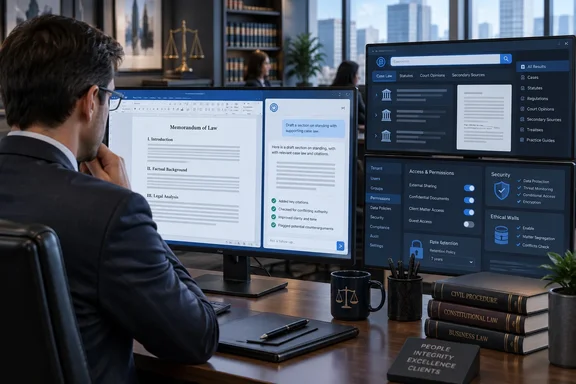
As first reported by Neowin and detailed in OpenAI’s September 17 announcement, Astra for Law is aimed at professional legal research, analysis, drafting, and deal work. The company says the system searches U.S. case law, statutes, regulations, court rules, and administrative decisions, then applies those materials to a client’s facts, including finding contrary authority and explaining how contract language shifts risk.
The important qualification is that Astra for Law is not a newly disclosed standalone foundation model. OpenAI describes it as GPT-6 Astra tailored through a dedicated Legal Search Index and custom legal instructions. That makes this release as much a retrieval, workflow, and governance product as a model launch—and it explains why the accompanying Word add-in and partner connectors may matter more to firms than the model-picker label.
The claimed improvement comes from legal retrieval, not a proven replacement for Westlaw
OpenAI says Astra for Law passed an overall correctness check on 54% of 200 questions from a private validation set associated with Vals AI’s Legal Research Bench. GPT-6 Astra using web search alone scored 38.7% under the same highest-reasoning setting, according to the company. On case-law questions, OpenAI also reports that its legal configuration surfaced 24% more reference cases and retrieved up to 54% more relevant passages from the correct opinions.
Those are meaningful retrieval gains if they hold up in real matters. A general web search is an awkward substitute for structured legal research: court opinions can be mirrored, incomplete, superseded, badly indexed, or presented without the metadata lawyers need to assess jurisdiction, subsequent treatment, and precedential status. An index constructed around legal sources should produce better starting material than an open-web query.
But the launch benchmark does not establish that Astra for Law beats the research systems firms already buy. OpenAI compared its legal configuration with its own base model using web search, not with Westlaw, Lexis+, vLex, or Thomson Reuters’ CoCounsel Legal. No public independent evaluation has yet reproduced the 54% result on the private 200-question set or compared Astra for Law with those incumbent services.
That omission affects how firms should read the headline. A 54% correctness result also means the system did not clear the benchmark’s overall check on 46% of the test questions. The relevant deployment question is therefore not whether Astra can generate a usable first-pass research memo; it is whether its citations, quotations, negative treatment checks, and jurisdictional coverage can be audited inside the firm’s existing review process before an attorney relies on the output.
OpenAI itself tells users to review Astra for Law’s answers and cited sources before relying on them. That is appropriate guidance, but it puts the system in the role of research accelerator rather than legal authority. Firms that treat the output as a finished answer risk recreating the citation and verification failures that have already made courts wary of unreviewed generative-AI filings.
CourtListener broadens the corpus, but coverage is not editorial treatment
The legal index incorporates material from the Free Law Project’s CourtListener collection. Free Law Project says CourtListener contains more than 99.9% of published U.S. precedential case law, a substantial public-law foundation for an AI search layer. OpenAI says it supplements that case-law collection with statutes, regulations, court rules, and administrative decisions, while adding new sources daily.
The distinction between source breadth and a premium legal-research product remains substantial. CourtListener’s coverage claim concerns published precedential opinions; it does not mean every jurisdiction’s unpublished decisions, proprietary editorial analysis, practice guides, litigation analytics, citator functions, docket material, or commercial treatise content is included in Astra’s index. Those are among the services firms pay established legal publishers to provide.
Thomson Reuters’ own announcement makes the commercial split clearer. Its HighQ connection is available through a Model Context Protocol integration with ChatGPT Enterprise, while its CoCounsel Legal experience inside ChatGPT is still being previewed. Thomson Reuters says HighQ can bring authorized matter context into ChatGPT, but CoCounsel remains a separate product with its own legal capabilities and content.
OpenAI is therefore pursuing an integration strategy, not asking firms to abandon their document systems and research vendors. The initial plugin catalog includes iManage, Intapp, DeepJudge, Relativity, Clio, and Thomson Reuters services, among others. For enterprise IT, that is a more consequential design choice than a generic “legal AI” label: the value proposition depends on bringing firm-managed documents, permissions, and institutional playbooks to the model without copying the entire practice into a new repository.
ChatGPT for Word shifts the deployment burden to Microsoft 365 admins
ChatGPT for Word is the part of this announcement that will reach ordinary lawyer desktops first. OpenAI’s release notes say the add-in opens ChatGPT in a Word sidebar, where users can draft from notes, revise selected text, summarize a document, reorganize headings, adjust formatting, and flag unclear or inconsistent terminology.
It is distributed through Microsoft Marketplace and requires both sides of the organization’s controls to cooperate. OpenAI says workspace administrators can enable or disable ChatGPT for Word in the ChatGPT admin console, while Microsoft 365 administrators must also allow the add-in for it to appear for employees. In other words, a law firm cannot assume that an OpenAI workspace setting alone governs the rollout.
That should trigger a familiar Microsoft 365 review before broad deployment:
- Administrators should determine whether the ChatGPT add-in is permitted under the firm’s Microsoft 365 integrated-app policy and whether it can be scoped to a pilot group rather than deployed tenant-wide.
- Security teams should verify which Word document content is sent to OpenAI, what identity and workspace controls apply, and whether the firm’s retention, eDiscovery, data-loss prevention, and information-barrier policies cover that use.
- Practice leaders should define which document classes are off-limits, particularly privileged drafts, merger materials, litigation strategy, regulated-client work, and documents subject to ethical walls.
- Firms should require human review of all citations, defined terms, redlines, and formatting changes, because a polished Word revision can conceal a substantive error more effectively than a plain chatbot response.
OpenAI says ChatGPT for Word is available across its plans, including Free, but that does not turn it into a consumer-grade deployment decision for a law firm. The firm’s enterprise agreement, user authentication, add-in permissions, and document-handling rules determine whether it is suitable for client work. The availability of a Microsoft Marketplace add-in may also create a shadow-IT path if lawyers can install it independently under looser tenant policies.
“Zero Data Retention” is narrower than the marketing shorthand suggests
OpenAI is limiting Astra for Law initially to selected U.S. law firms through its Trusted Access program in ChatGPT and Codex, with API availability promised later. It will appear as “GPT-6 Astra Law” in ChatGPT; OpenAI has not published a general launch date for the API version or a public price for the legal offering.
For eligible firms, OpenAI promises Zero Data Retention for API use and says ChatGPT Enterprise usage is excluded from human review by default. Those are useful assurances, but they are separate commitments. Zero Data Retention applies to the API arrangement described by OpenAI; exclusion from human review is the stated default for ChatGPT Enterprise usage. Neither phrase, by itself, answers every question a firm must settle about logs, retention, plugin data flows, backups, user access, export controls, or the terms governing third-party connectors.
LawSites reports that the Trusted Access terms are more detailed than the short launch language, quoting OpenAI legal-industry leader Jason Boehmig as saying the relevant agreement runs roughly 30 pages. That is unsurprising in a profession where confidentiality duties, conflicts rules, client instructions, and firm-specific ethical walls are core operating requirements. It also means legal and IT teams should read the actual agreement rather than treating a two-word privacy label as a completed risk assessment.
OpenAI says it is working with Latham & Watkins on information permissions, ethical walls, client instructions, and firm oversight. Those are the right control categories, but they are still described as work in progress rather than as a published feature matrix with supported Microsoft 365, iManage, or HighQ enforcement behavior.
The immediate consequence is straightforward: Astra for Law gives selected firms a better-grounded OpenAI research workflow, while ChatGPT for Word gives their lawyers a new path to send live document content into that environment. The safer early rollout is a controlled Word pilot with named practice groups, approved matter types, logging and retention review, and a clear rule that AI-produced legal research remains work product to be checked—not a source to be trusted on its own.