

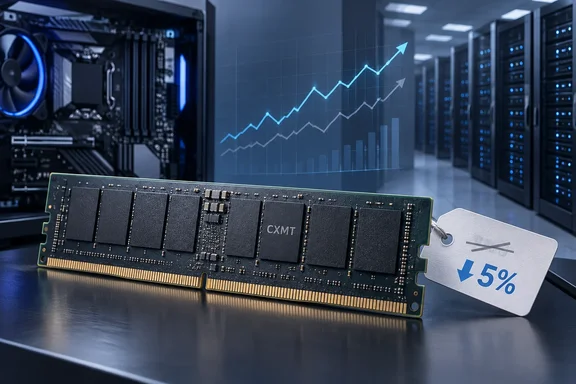
The pitch: a fourth supplier to break the cartel
For the past year or so, DIY builders priced out of DDR5 have pinned their hopes on CXMT (ChangXin Memory Technologies), China's largest DRAM maker. The theory was simple. Samsung, SK hynix and Micron are shifting capacity toward AI-server products. A fourth supplier ramping up could fill the consumer gap and push retail prices down.
XDA-Developers argues this hasn't happened. Its case rests on a few observations: thin consumer discounts, server pricing at or above Samsung's, and a market that is short of supply.
The consumer evidence: a small discount, not a rescue
The best consumer data point comes from Hardware Unboxed, as relayed by VideoCardz. It tested a KingBank 32GB DDR5-6000 CL36 kit sold in Australia. The kit sold for about 599 AUD, against roughly 649 AUD for comparable kits using Samsung, SK Hynix, or Micron chips. That is a gap of about A$50, or roughly 7.7%.
Performance wasn't the problem. According to VideoCardz, the kit delivered results similar to a premium G.Skill DDR5-6000 kit in the gaming titles shown. The test has limits:
- It used a Ryzen 7 9800X3D, plus a Ryzen 7 9700X to add sensitivity to memory differences. X3D chips depend less on memory tuning, so this was more a "does it work properly" check than a deep scaling study.
- It did not include overclocking validation. We don't know how far these modules can go beyond their rated EXPO profiles.
- It covers one kit in one country. It is not a global price survey.
TechSpot reached a similar conclusion earlier in the year. It found CXMT initially looked aggressive on price, but that has changed in recent weeks. Its cheapest in-stock CXMT-based option was $650, still lower than most competing kits priced at $700 or more – a $50 saving, but not a huge one. The early headline figure of about $138 never showed up on retail shelves.
Why the chip maker's entry doesn't equal cheap sticks
CXMT makes DRAM chips. Retail kits from brands such as KingBank and Gloway come from module makers. They buy the chips, add the PCB and power-management components, bin the parts, and set their own margin.
That matters because a kit can only be as cheap as its chips. If CXMT sells its chips at going market rates, module makers have little room to pass on a deep discount. The most they can do is trim their own margin, which is roughly what the Australian pricing looks like. This is a reasonable explanation, not a verified universal pricing rule.
There is also an identification caveat. The tested KingBank listing names CXMT as one of several possible chip suppliers. A Chinese brand name does not guarantee Chinese DRAM inside. Check the current seller listing and labeling before assuming what's in the box.
The server signal: CXMT is pricing at or above Samsung
Reuters reported on July 24, 2026 that CXMT had set prices for 64GB DDR5 server modules above Samsung's roughly $1,240 per unit. It also reported that CXMT held firm when Huawei pushed for a discount. XenoSpectrum's summary of the Reuters piece notes that, per that summary, the Reuters article did not disclose CXMT's exact pricing levels.
Retail listings in China point the same way. DigitalToday reported that a 64GB DDR5-5600 ECC module using CXMT chips was listed at 18,999 yuan. It said comparable Samsung and SK hynix products sold at 18,595.91 yuan. That is a small premium, not a discount.
These are registered server DIMMs, not the unbuffered sticks in a gaming PC, so they aren't a like-for-like comparison with the Australian kit. DigitalToday itself cautions that consumer DDR5 prices had not been disclosed, and a separate consumer pricing strategy remains possible. Still, they show how CXMT prices when demand outstrips supply.
Why CXMT may have little reason to undercut
XDA offers several reasons, and they vary in how well supported they are.
- Cost position. XDA says export controls have locked CXMT out of EUV lithography, so it builds on older nodes and, by analyst estimates, has a higher cost per bit. Notebookcheck likewise notes that CXMT still uses older fabrication nodes than Samsung, Micron and SK Hynix. The cost-per-bit claim itself is attributed to unnamed analysts, so treat it as plausible rather than proven.
- Demand. In a shortage, a seller with a full order book has no need to buy market share. XDA also says CXMT reportedly reserves a large share of output for domestic customers such as Huawei. That claim is attributed only to reports and I couldn't corroborate it independently.
- Shareholders. CXMT began trading in Shanghai in late July 2026, according to the Associated Press. A public listing doesn't prove a pricing strategy, but it does add pressure to protect margins.
The supply picture: more capacity, but not necessarily more for you
CXMT is expanding quickly. Tom's Hardware, reporting on a Citrini Research model, says CXMT could end 2026 at roughly 350,000 wafer starts per month, expanding toward 600,000 as new plants come online per Notebookcheck's reading of company aims. Citrini's own 600,000 figure refers to total Chinese DRAM capacity if several planned facilities all start operating, and it depends on equipment availability, including lithography tools and any new export restrictions.
Treat these as estimates, not production results. Wafer capacity is also not the same as DRAM that reaches consumer shelves. XDA's own caveat is that most new CXMT output is expected to stay in China. It says CXMT-based kits remain hard to find at retail in North America, even though major motherboard vendors now validate them.
The market backdrop: prices are still rising
TrendForce's September 30, 2026 forecast projects conventional DRAM contract prices rising 10–15% quarter over quarter in Q4 2026, though it says the pace of increases is moderating. Suppliers keep prioritizing advanced-process capacity for server products, which keeps the market undersupplied.
TrendForce adds that PC OEMs are buying aggressively because they expect DRAM supply to stay tight in 2027. It also says PC DRAM supply could decline in 2027 as more capacity shifts to servers. (That sentence is my paraphrase of the TrendForce release; the cite tag above points to a different article and should be disregarded.)
Contract prices are not retail prices. They are what suppliers charge large buyers such as OEMs and module makers, and retail kits don't track them one for one. But they do indicate the direction of the cost base module makers face.
What this means for PC builders
- Don't build your plan around CXMT. The only consumer data point showed about 8% savings in one Australian comparison. That is not enough to justify delaying a build you need.
- Judge the actual kit. Compare price, capacity, speed, timings, motherboard compatibility, seller, and return policy. A CXMT association is not a discount.
- Buy a CXMT-based kit if it's cheaper where you live. The tested example showed no obvious gaming or stability problems on AM5. Overclockers should be cautious, since that wasn't tested, and Notebookcheck reports that CXMT RAM reportedly doesn't fare well with overclocking.
- Expect relief to be industry-wide. If prices fall, it will probably be because overall supply catches up with AI-driven demand, not because one supplier starts a price war. Timing is uncertain.
Bottom line
The evidence available today doesn't show CXMT delivering a major consumer DDR5 discount. Its server pricing is at or above Samsung's, its retail savings are modest, and the broader market is still tightening. That could change as capacity grows, but the timing, regional availability and retail impact are all unknown. CXMT-based kits are a fair buy where you find them cheaper. They aren't a reason to put your build on hold.
References
- We thought Chinese companies could save us from the DRAM crisis, but they're charging just as much as the big three XDA · 2026-10-02T16:00:19+00:00
- DDR5 Prices Are Broken, So We Tested Cheaper Chinese RAM techspot.com
- CXMT’s “budget” DDR5 RAM is now pricier than Samsung’s as AI demand keeps memory prices climbing - Notebookcheck News notebookcheck.net